
🛒 Best Price Today on Amazon
Prime members get fast, free shipping on everything above, plus member-only deals. New members get a 30-day free trial — cancel anytime.
When a generator engine comes apart for a rebuild, the key measurement is the cylinder bore. Ring wear, taper and out-of-round decide whether the block goes back together with fresh rings or needs machine work first. A telescoping gauge is the simplest tool that answers the question. It is a T-shaped transfer gauge: spring-loaded plungers expand until they touch the bore walls, a lock freezes that span, and you withdraw the gauge and read the plungers with an outside micrometer. The gauge has no scale and shows no number; it captures a size and hands it to the micrometer you already own.
As an Amazon Associate, we earn from qualifying purchases.
Quick answer
For most rebuild work, the Mitutoyo 155-903 is the set to buy: smooth plungers, a lock that holds without shifting, and readings that repeat closely. For deep cylinders, the Fowler 52-470-007-0 adds long 12 inch handles. The Beslands and AuSL sets cover the same span for occasional work, and the QWORK small hole set handles tiny bores such as valve guides.
Mitutoyo 155-903 Telescoping Gage Set

Mitutoyo is the name machinists reach for when a transfer gauge has to feel right. The six gauges step from 5/16 inch to 6 inches, covering small utility engines through the largest air-cooled generator cylinders. Each plunger is hardened steel with a ground contact face, and its spring is balanced so both sides push out evenly and the head centers itself in the bore.
That even pressure is the whole game. A gauge that drags on one side gives a different span every time you lock it, while the Mitutoyo slides, settles and locks with little drama. The satin chrome finish shrugs off the oily film inside a used cylinder, and repeated readings at one spot tend to agree within a whisker, the confidence you need before deciding on a hone or a rebore.
Specs
– Range: 5/16 to 6 in across six gauges
– Steps: 5/16–1/2, 1/2–3/4, 3/4–1-1/4, 1-1/4–2-1/8, 2-1/8–3-1/2, 3-1/2–6 in
– Hardened steel plungers, ground contact faces
– Satin chrome finish, self-centering action
– Knurled clamp lock on each handle
– Fitted plastic wallet included
Fowler 52-470-007-0 Telescoping Gage Set
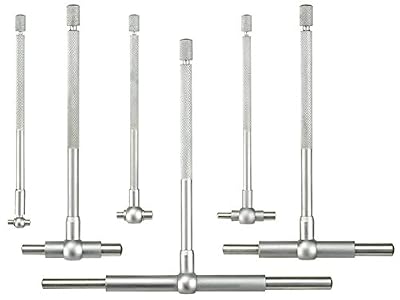
The Fowler set solves the one problem standard handles create: reach. Its gauges ride on rigid handles about 12 inches long, so you can work down a deep cylinder or recessed housing while your hand stays up at the deck where you can see. The double-action design extends the plungers from both sides of the head at once, keeping the gauge centered instead of cocked against one wall.
Contact points are hardened, precision-ground tool steel, and spring tension stays constant across each gauge’s travel, helping the head settle as you rock it through the bore. The lock sits at the top of the handle, far from the head, so tightening it does not nudge the plungers. On larger standby units, or any bore where a stud or casting rib blocks a short handle, that reach earns its keep.
Specs
– Range: 5/16 to 6 in, six gauges
– Long rigid handles, about 12 in, for deep bores
– Double-action, self-centering plunger movement
– Hardened, precision-ground tool steel contacts
– Constant spring tension across plunger travel
– Fitted vinyl case included
Beslands 6 Pc Telescoping Gage Set

The Beslands set covers the familiar 5/16 to 6 inch span in six pieces, built from stainless steel, a sensible choice for a tool that lives in a toolbox. The contact points are hardened tool steel, ground to a radius so they enter the smallest bore in their range without catching on the chamfer at the top of a cylinder.
Plunger action is firm and even, and the knurled locking knob holds the span while you ease the head out with the slight tilt the technique calls for. Like every gauge here, it reads nothing by itself: lock it, withdraw it, and measure across the plungers with a micrometer. For a home shop that tears down an engine once in a while rather than weekly, this set covers the work well.
Specs
– Range: 5/16 to 6 in (8 to 150 mm), six pieces
– Stainless steel construction
– Hardened tool steel contact points
– Knurled locking knob on each gauge
– Self-centering, spring-loaded plungers
– Vinyl storage case included
AuSL 6PCS Precision Telescopic Gauge Set
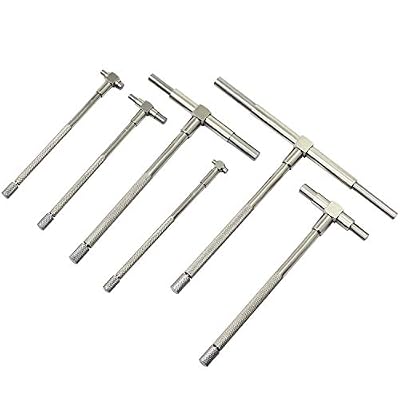
The AuSL kit is the no-frills version of the classic six-piece layout. Six carbon steel gauges span 5/16 to 6 inches, each with the double-action rigid handle design that pushes both plungers out together so the head finds the center of the bore on its own. The contact ends are heat treated and ground to a radius, letting the gauge pass the mouth of a bore and still register the worn section deeper down.
The routine is the same as with any transfer gauge: compress the plungers, set the head a touch past square, let the springs take up the span, rock the handle slowly through center so the plungers trace the true diameter, then snug the lock and withdraw. Repeat each reading; when the micrometer agrees with itself, you have your number. It makes a sensible spare set for a service truck.
Specs
– Range: 5/16 to 6 in, six gauges
– Carbon steel construction
– Double-action rigid handles, self-centering
– Heat-treated contact ends ground to a radius
– Spring-loaded plungers with end lock
– Storage pouch included
QWORK Small Hole Gauge Set, 4 Pieces

Below about 5/16 inch, a T-gauge head will not fit, and that is where this QWORK set takes over. These are small hole gauges: a split ball at the tip expands as you turn the knurled sleeve, filling bores from 1/8 to 1/2 inch. On a generator engine that covers valve guides, small bushings and pilot holes, places where wear matters and a caliper cannot reach.
The full-round ball form contacts the bore around a band rather than at two points, so it rides over light scoring and gives a span that transfers cleanly to a micrometer. Checking a valve guide at the top, middle and bottom tells you quickly whether it is bell-mouthed or still round enough to hold a stem seal.
Specs
– Four gauges covering 1/8 to 1/2 in (3 to 13 mm) combined
– Full-round expanding ball contacts
– Knurled sleeve adjustment with lock
– Hardened steel construction
– Reads with an outside micrometer, sold separately
– Suited to valve guides, bushings and small bores
How to choose
Begin with range. Nearly every six-piece set spans 5/16 to 6 inches, enough for portable and standby generator engines; add a small hole set if you also check valve guides. Next, handle length: short handles are nimble in small engines, while long rigid handles earn their place in deep cylinders.
Then judge the two things that decide repeatability. Plunger smoothness comes first: the plungers should glide with even spring pressure and no gritty steps, because any drag tilts the head and inflates the reading. Lock consistency comes second: the clamp should freeze the span without pulling it tighter or letting it relax as you withdraw the gauge. Technique ties it together: rock the handle slowly through the vertical so the plungers pass over the true diameter, measure at several heights for taper, and turn 90 degrees at each height for out-of-round.
FAQ
Do telescoping gauges show the bore size directly?
No. They have no scale or dial. The gauge captures the bore span, locks it, and you measure across the plungers with an outside micrometer. The micrometer produces the number.
How accurate can a telescoping gauge be?
With smooth plungers, a firm lock and practiced rocking technique, repeat readings can agree within a few ten-thousandths of an inch. Sloppy locking or a tilted head will throw a reading off by far more.
What is the difference between taper and out-of-round?
Taper is a size change along the length of the bore, found by measuring at several heights. Out-of-round is a size change around the circumference, found by measuring across different diameters at one height. A worn cylinder usually shows both.
Can I use a caliper instead of a micrometer?
You can for rough work, but a micrometer gives a firmer, more repeatable feel across the plunger ends and reads finer divisions. For rebuild decisions, the micrometer is the right partner.
Verdict
Pick the Mitutoyo 155-903 if you measure bores often and want the smoothest plungers and the most trustworthy lock. Choose the Fowler 52-470-007-0 when deep cylinders make reach the priority. The Beslands and AuSL sets cover the same ground for occasional rebuilds, and the QWORK small hole set completes the kit by handling valve guides and other bores under 5/16 inch. The micrometer and rocking technique do half the work, so practice on a known bore first.
Write Your Review
No reviews yet. Be the first to share your experience!