
🛒 Best Price Today on Amazon
Prime members get fast, free shipping on everything above, plus member-only deals. New members get a 30-day free trial — cancel anytime.
An infrared thermometer is the quickest way to answer questions that come up around a generator, an engine bay, or a grill: Is one cylinder running hotter than the others? Is the manifold even across all ports? Is the pizza stone ready? Pull the trigger, read the number, move on — no burned fingers.
Used carelessly, though, these guns produce confident numbers that mean very little. Every model below reads surface temperature only, the laser dot is just an aiming aid, and shiny metal will fool all of them unless you handle emissivity correctly.
As an Amazon Associate, we earn from qualifying purchases.
Quick answer
For most home and garage work, the Etekcity Lasergrip 774 covers the widest range of everyday checks, with adjustable emissivity and a sensible 12:1 spot ratio. If the tool will live in a work truck and get dropped, the Fluke 62 MAX+ is the rugged pick. Choose the MESTEK IR02C when you also need a contact probe, the Klein Tools IR07 for a shirt pocket, and the VEVOR IR05 for kilns, forges, and smelting work.
Etekcity Lasergrip 774 Infrared Thermometer
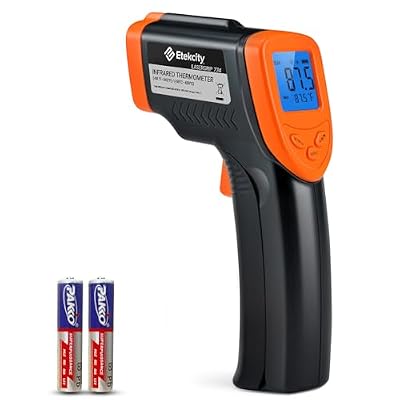
The Lasergrip 774 is the general-purpose gun most households actually need. Its range runs from -58°F to 842°F, covering freezer walls, grill grates, brake rotors, and radiator hoses. The 12:1 distance-to-spot ratio means that from twelve inches away it reads a circle about one inch wide, tight enough for most engine and cooking checks.
What lifts it above basic guns is adjustable emissivity, from 0.1 to 1.0. A cast-iron skillet, a painted block, and a polished valve cover all radiate heat differently, and a fixed-emissivity gun treats them as the same surface. The trade-offs are a light plastic housing, no probe input, and a single laser showing the center of the circle, not its edges.
Specs
– Range: -58°F to 842°F (-50°C to 450°C)
– Distance-to-spot ratio: 12:1
– Emissivity: adjustable, 0.1 to 1.0
– Response time: under 500 ms
– Power: 2 AAA batteries, backlit display
Fluke 62 MAX+ Infrared Thermometer

The Fluke 62 MAX+ is built for people who knock tools off ladders. It is sealed to IP54 against dust and splashing water and drop-tested from three meters. Dual lasers bracket the measured area, so you can see the edges of the spot instead of guessing from a single dot.
Its range extends from -22°F to 1202°F with a 12:1 ratio, enough for exhaust manifolds and wood stoves, and accuracy above freezing is quoted at plus or minus 1 percent of the reading. The honest limits: you pay a premium for the housing and sealing, and it still cannot see through glass or read coolant inside a hose — it reads the hose surface, usually the clue you need.
Specs
– Range: -22°F to 1202°F (-30°C to 650°C)
– Distance-to-spot ratio: 12:1, dual laser targeting
– Emissivity: adjustable, 0.10 to 1.00
– Build: IP54 sealed, 3 m drop tested
– Power: 1 AA battery, backlit display
MESTEK IR02C Infrared Thermometer

The IR02C answers the biggest weakness of infrared-only tools by adding a K-type thermocouple probe in the box. The gun reads from -58°F to 1472°F with a 12:1 ratio. When the surface number is not the number you need — the inside of a roast, frying oil, cooling-system water — plug in the probe and take a true contact reading.
It also senses ambient temperature and humidity and shows dew point on its color screen, useful in generator enclosures where condensation corrodes cold metal. Note that the probe tops out well below the gun’s headline range, and the color display draws battery power faster than a plain screen.
Specs
– Infrared range: -58°F to 1472°F (-50°C to 800°C)
– Probe: K-type thermocouple included
– Distance-to-spot ratio: 12:1, multi-point laser guide
– Emissivity: adjustable, 0.1 to 1.0
– Extras: humidity and dew point sensing, color display
Klein Tools IR07 Dual Infrared and Probe Pocket Thermometer

The IR07 is the thermometer you carry when a full-size gun would stay in the truck. Pocket sized at about six and a half inches long, it pairs an infrared sensor with a folding contact probe and adds a hanging hook sized for air vents, making it a favorite for quick HVAC and kitchen checks. Scan the vent or the pan, then unfold the probe for the internal number.
That two-in-one design is what infrared-only tools lack for food safety checks. The surface of a chicken breast on the grill says almost nothing about the center; the probe tells you the part that matters, and it handles coolant and oil checks around a generator too. The compromise is a modest spot ratio and an upper range far below the Fluke or VEVOR picks.
Specs
– Type: pocket infrared thermometer with folding probe
– Modes: non-contact scans plus contact probe readings
– Special feature: hanging hook for vent checks
– Display: backlit LCD
– Power: 2 AAA batteries, pouch included
VEVOR IR05 Infrared Thermometer

The VEVOR IR05 is the high-temperature specialist. Its range runs from -40°F to 2732°F, deep into territory where the other four tools stop: kiln interiors, forge work, metal smelting, and glass work. A 50:1 distance-to-spot ratio matters enormously here, because at those temperatures you cannot stand close. From fifty inches back it reads a one-inch circle, letting you check a crucible or kiln wall from a safer distance.
Dual lasers outline the target, response time is a fast quarter second, and emissivity adjusts from 0.10 to 1.00 — essential when the target is molten or polished metal, the surfaces that fool fixed-setting guns worst. Keep expectations realistic at the extremes: accuracy widens near the top of the range, so a figure near 2700°F is a guide, not a laboratory value.
Specs
– Range: -40°F to 2732°F (-40°C to 1500°C)
– Distance-to-spot ratio: 50:1, dual laser targeting
– Emissivity: adjustable, 0.10 to 1.00
– Response time: 0.25 seconds
– Extras: high and low temperature alarms
How to choose
Begin with the distance-to-spot ratio, because it decides how far away you can stand and still read only your target. The math is simple division: a 12:1 gun held 24 inches from an engine reads a two-inch circle, and anything else inside that circle — a cooler hose beside the hot manifold — drags the average down. For close work, 12:1 is plenty. For ceiling ducts or kiln walls, look for 20:1 or the VEVOR’s 50:1.
Next, be honest about emissivity. Matte, dark, and painted surfaces radiate heat predictably and read accurately on almost any gun. Shiny metal does not: polished aluminum and chrome reflect infrared from surrounding objects and typically read far below their true temperature, sometimes dangerously so. Either choose a gun with adjustable emissivity and set it low for bare metal, or stick a patch of matte tape on the part, let it reach the part’s temperature, and read the patch instead.
Finally, remember what these tools cannot do. They read surfaces only — never the internal temperature of food, the coolant inside a sealed system, or the air in a room — and they are not designed or approved for measuring people. When the number that matters is inside something, pick a model with a probe input.
FAQ
Why does my thermometer read low on shiny metal parts?
Polished and plated metal reflects infrared energy instead of emitting its own, so the gun picks up reflections of cooler surroundings. Lower the emissivity setting toward the value for that metal, or read a patch of matte tape on the surface.
Can I use one of these to check whether meat is done?
Only the surface. A gun pointed at a roast reads the crust, which can be far hotter than the center. For doneness and safety, use the contact probe on a model like the MESTEK IR02C or Klein IR07.
What does the laser actually do?
It aims; it does not measure. The sensor gathers energy from a circular area whose size grows with distance, following the distance-to-spot ratio. Dual-laser models help because their two dots mark the edges of that circle.
Can an infrared thermometer measure engine coolant temperature?
Not directly. It reads the outside of the hose, thermostat housing, or radiator tank — useful for spotting a stuck thermostat or clogged radiator section. For the coolant itself, use a probe in the fluid.
Verdict
For a single tool that handles the grill, the engine bay, and the generator enclosure, the Etekcity Lasergrip 774 is the sensible default, with the Fluke 62 MAX+ as the step up for anyone whose tools live a hard life. Add the MESTEK IR02C or the pocket Klein IR07 when contact readings matter, and reserve the VEVOR IR05 for genuinely hot work — kilns, forges, and smelting — where its range and 50:1 optics earn their keep.
Write Your Review
No reviews yet. Be the first to share your experience!