
🛒 Best Price Today on Amazon
Prime members get fast, free shipping on everything above, plus member-only deals. New members get a 30-day free trial — cancel anytime.
A battery rarely fails on a convenient day. It fails on the coldest morning of the year, or during a power outage when the standby generator turns over twice and gives up. A battery tester replaces guesswork with a number you can act on while there is still time to charge or swap it.


One honest warning applies to every tool below: voltage alone proves very little. A tired battery can show a healthy 12.6 volts on the bench and still collapse the moment a cranking motor asks it for real work. Better testers either compute cranking amps from internal resistance, or apply a genuine load and watch how the voltage sags.
As an Amazon Associate, we earn from qualifying purchases.
Quick answer
For most car and generator owners, the TOPDON BT100 is the easiest pick: a conductance analyzer that reports health, charge, and measured cranking amps in seconds. Want a true load test instead of an estimate? The Schumacher BT-100 pulls a real 100-amp draw through a carbon pile. If good batteries keep dying in one vehicle, the KONNWEI KW208 adds a charging test with a live waveform to expose a weak alternator. The QUICKLYNKS BM2 watches a standby battery from your phone, and the D-FantiX BT-168 sorts loose household cells.
TOPDON BT100 12V Battery Tester
The BT100 is a handheld conductance analyzer for 12-volt lead-acid batteries. Clamp it on, pick the battery type, enter the CCA figure printed on the case, and within seconds it shows voltage, measured cranking amps, internal resistance, health, and charge, ending in a verdict: good, recharge, or replace. It also runs cranking and charging tests.
Conductance testing is an estimate. The BT100 computes likely cranking power from resistance; it never makes the battery do hard work. That makes it fast and safe to use in the vehicle, but the result leans on the CCA figure you type in and on clean clamp contact. Test a rested battery, not one fresh off a charger, because surface charge flatters every reading.
Specs
- Test method: digital conductance, no load applied
- Range: 12V batteries, 100-2000 CCA
- Battery types: flooded, AGM flat plate, AGM spiral, GEL, EFB
- Tests: battery health, cranking, charging system
- Readout: voltage, measured CCA, resistance, health and charge percent
Schumacher BT-100 Battery Load Tester
The Schumacher BT-100 is the old-school answer: a carbon-pile load tester with an analog needle. Flip the switch and it drags a genuine 100 amps out of a 12-volt battery for about ten seconds (50 amps on 6-volt batteries) while you watch how far the needle falls. It handles batteries up to 1000 cranking amps and checks charging output too.
This is the only tester here that makes the battery actually work, which is why many mechanics trust it over an estimate. The trade-offs are real: the load is fixed, so a small powersport battery gets a harsher workout than in service, the pile gets hot, and reading a sweeping needle takes practice. For a generator or truck battery, that honesty is worth it.
Specs
- Test method: carbon-pile load, analog meter
- Load: 100 amps on 12V, 50 amps on 6V
- Capacity: batteries up to 1000 cranking amps
- Tests: battery under load, charging system, cranking motor draw
- Clamps: heavy-duty copper-plated
KONNWEI KW208 12V Battery Tester

The KW208 matches other compact analyzers — battery health, cranking, and charging tests across 100-2000 CCA — but its color screen and live voltage waveform make it the pick when the charging side is under suspicion. Its charging test graphs voltage over time and checks ripple, which is how you catch an alternator with a failing diode: the battery tests fine, yet keeps going flat.
It reports voltage, internal resistance, measured CCA, health and charge percent, plus a good, recharge, or replace verdict, across CCA, DIN, IEC, EN, and SAE scales. Like every conductance unit, it estimates cranking ability rather than proving it under load. Within that limit, it is a sharp tool for telling a bad battery apart from a bad charging system.
Specs
- Test method: digital conductance with waveform display
- Range: 12V batteries, 100-2000 CCA
- Battery types: flooded, AGM flat plate, AGM spiral, GEL
- Tests: battery health, cranking, charging with ripple check
- Display: 2.4-inch color screen, 8 languages
QUICKLYNKS BM2 Bluetooth Battery Monitor
The BM2 takes a different approach: instead of a tool you fetch when trouble appears, it bolts onto the battery terminals and stays there, watching voltage around the clock. It pairs with a phone app over Bluetooth 4.0 at about ten meters, runs cranking and charging checks, keeps up to 31 days of voltage history, and sends a low-voltage alarm as charge fades. For a standby generator or a boat that sits for months, that early warning is the whole point.
Be clear about what it cannot do. The BM2 tracks voltage and infers condition from it; it never measures cranking amps or internal resistance, so it complements a real tester rather than replacing one. It also sips about 1.5 milliamps of its own — trivial on a driven car, worth knowing on a battery that sits all winter without a maintainer. Lead-acid only, not lithium.
Specs
- Connection: Bluetooth 4.0, app for iPhone and Android
- Input range: 6-20 volts, for 12V lead-acid batteries
- Tests: voltage monitoring, cranking, charging
- Alarm: low-voltage notification through the app
- Memory: up to 31 days of voltage data
D-FantiX BT-168 Battery Tester
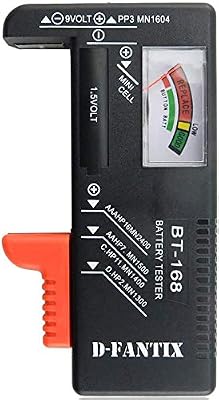
Not every battery lives under a hood. The BT-168 is the classic drawer checker for household cells: slide an AA, AAA, C, or D cell into the arm, touch a 9V battery to the side contacts, or lay a button cell on the pad, and the needle swings into green, yellow, or red zones for good, low, and replace. It needs no battery of its own; the cell being tested powers the meter.
Keep expectations matched to the tool. The BT-168 applies only a tiny load, so it shows rough remaining charge under that small load rather than a true measure of capacity — a cell can land in the green and still fade quickly in a hungry flashlight. What it does brilliantly is the ten-second sort: good cells back in the drawer, dead ones into recycling.
Specs
- Cells: AA, AAA, C, D, 9V, 1.5V button cells
- Readout: analog needle, good / low / replace zones
- Test method: small fixed load, voltage based
- Power: none, powered by the cell under test
- Use: household cells only, not vehicle batteries
How to choose
Match the tool to the question. If the question is “will this battery crank the engine or the generator on the coldest morning,” a conductance analyzer like the BT100 or KW208 gives a fast answer, and a carbon-pile tester like the Schumacher proves it under load. If good batteries keep dying in the same vehicle, the problem may be charging, so pick a tester with a charging test and ripple readout. If the battery sits idle for months, a permanent monitor earns its keep by warning you early.
Whatever you buy, test the battery rested. A battery fresh off a charger carries a surface charge that makes weak batteries look strong. Let it sit for several hours, then test, and clean the terminals first, since corroded posts corrupt resistance readings. For a standby generator, test before storm season and again mid-winter, and keep it on a maintainer between checks.
FAQ
Why does my battery show 12.6 volts but still fail to crank?
Because voltage at rest is only half the story. Sulfation and age raise internal resistance, so the battery holds a normal reading yet cannot deliver cranking current. A conductance or load test exposes that gap.
Should I test right after charging?
No. Charging leaves a surface charge that flatters every measurement. Let the battery rest for several hours so the reading reflects the battery, not the charger.
Can one tester cover my car, my generator, and my AA cells?
Not really. Vehicle and generator batteries need CCA-based testing, while household cells need a small checker built for 1.5 and 9 volts. The BT-168 handles the drawer; the other four handle engines.
How often should I test a standby generator battery?
Every few months, and always before storm season. A generator battery ages quietly on standby duty, and a two-minute test beats finding out during an outage.
Verdict
Most households need one engine-side tester and one drawer checker. The TOPDON BT100 is the default for cars and generators, the Schumacher BT-100 is the honest choice for a true load test, the KONNWEI KW208 earns its place when the alternator is a suspect, and the QUICKLYNKS BM2 guards batteries that sit and wait. Add the D-FantiX BT-168 for the drawer, and every battery you own gets a truthful answer.




Write Your Review
No reviews yet. Be the first to share your experience!