
Our Short List of 3

- Nut range: up to 7/8 in across the flats
- Body: stainless steel, chrome plated finish
- Cutter: hardened steel jaw
- Drive: screw turned with a hand wrench
- Nut range: 7/16 in to 3/4 in across the flats
- Frame: forged, heat-treated steel C-frame
- Handle: offset for clearance in tight bays
- Duty: non-heat-treated nuts only

- Nut range: 7/16 in to 3/4 in across the flats
- Frame: drop forged steel
- Chisel: rotates 360 degrees for alignment
- Action: parallel pusher, single-side split
All 4 Picks at a Glance
| Product | Specs | Action |
|---|---|---|
| OEMTOOLS 25126 Nut Splitter |
| Check price on Amazon |
| OTC 4576 Universal C-Frame Nut Splitter |
| Check price on Amazon |
| KD Tools 715 Universal Nut Cracker |
| Check price on Amazon |
 QWORK 3-Piece Nut Splitter Set |
| Check price on Amazon |
🛒 Best Price Today on Amazon
Prime members get fast, free shipping on everything above, plus member-only deals. New members get a 30-day free trial — cancel anytime.
Every generator owner meets this nut eventually. The exhaust or manifold fastener has lived through years of heat cycles, the penetrant has soaked overnight, the torch has done its work, and the wrench still only rounds the flats further. The nut is scrap either way. The stud underneath it is not, and snapping that stud turns a small job into drilling and a ruined flange.
A nut splitter ends the argument without touching the stud. It slips over the nut, and a screw drives a hardened chisel into one flat until the nut cracks. The split relaxes the grip on the threads, the remains wind off by hand, and the stud survives to take a fresh nut — slow, quiet work with no sparks near a fuel tank.
The five tools below are all manual screw-driven splitters, covering 9 mm hardware up to nuts just over an inch across the flats. The technique is the same for each: seat the chisel on a flat, tighten in small turns, and ease off the moment the nut gives.
As an Amazon Associate, we earn from qualifying purchases.
Quick answer
For one tool that handles most jobs, take the OEMTOOLS 25126, good for nuts up to 7/8 inch across the flats. For cramped bays, the OTC 4576 C-frame has an offset handle, and the KD Tools 715 adds a rotating chisel for awkward angles. For metric sizes in dedicated rings, the QWORK three-piece set covers 9 to 22 mm; the Gatutul four-piece set stretches that to 27 mm.
OEMTOOLS 25126 Nut Splitter
- Nut range: up to 7/8 in across the flats
- Body: stainless steel, chrome plated finish
- Cutter: hardened steel jaw
- Drive: screw turned with a hand wrench
The 25126 is the classic ring-style splitter: a closed stainless steel body that drops over the nut, with a hardened jaw driven by a stout screw you turn with a hand wrench. It splits nuts up to 7/8 inch across the flats, taking in most exhaust, muffler and mounting hardware on portable and standby generators.
The closed ring is the point. Fully surrounding the nut, the body cannot slip sideways under load the way open-jaw tools sometimes do. OEMTOOLS is plain about the limits: hand tools only, never an impact wrench, since shock loads can crack the jaw rather than the nut.
OTC 4576 Universal C-Frame Nut Splitter
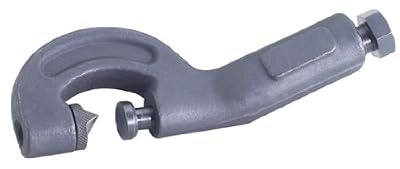
- Nut range: 7/16 in to 3/4 in across the flats
- Frame: forged, heat-treated steel C-frame
- Handle: offset for clearance in tight bays
- Duty: non-heat-treated nuts only
OTC built the 4576 around a forged, heat-treated C-frame with an offset handle, and that offset earns its place here. Exhaust nuts rarely sit in open space; the bent handle lets the frame sit flat on the nut while your wrench hand works clear of pipes, brackets and heat shields.
Capacity runs from 7/16 inch to 3/4 inch across the flats, aimed at ordinary hardware rather than hardened fasteners. OTC is explicit that this tool is for non-heat-treated nuts: a chisel driven into a hardened nut can chip instead of cutting. Choose it when access is the problem, not size.
KD Tools 715 Universal Nut Cracker
- Nut range: 7/16 in to 3/4 in across the flats
- Frame: drop forged steel
- Chisel: rotates 360 degrees for alignment
- Action: parallel pusher, single-side split
The 715 uses a compound C-frame design with one clever feature: the chisel rotates a full 360 degrees. On a nut you can barely reach, let alone see, you can swing the cutting edge parallel to the stud from whatever angle the frame sits at, instead of fighting to position the whole tool.
Its pusher works with a parallel action, pressing the chisel straight into one flat so the nut cracks on a single side while the frame bears evenly on the other — the controlled, one-sided split that protects the threads. The drop forged frame handles 7/16 inch to 3/4 inch across the flats, driven by a 3/4 inch hex screw head.
QWORK 3-Piece Nut Splitter Set
- Set contents: 3 splitters, 9–12 mm, 12–16 mm, 16–22 mm
- Material: bearing steel
- Cutter: hardened steel edge
- Type: manual pressure ring splitters
Sized ring sets take a different approach: instead of one adjustable frame, you get three compact tools, each bored for a band of metric sizes — 9 to 12 mm, 12 to 16 mm and 16 to 22 mm. A sized ring grips its nut with no slack, so the chisel lands exactly where you put it while you work the screw.
The QWORK set is bearing steel with a hardened cutting edge, short and simple enough to live in a service kit. Small fasteners are where these shine: muffler clamps, recoil housings and frame hardware are everyday generator work. Keep the applied torque moderate, as QWORK advises, and let the edge do the cutting.
Gatutul 4-Piece Nut Splitter Set
The Gatutul set extends the sized-ring idea to four tools, adding a 22 to 27 mm splitter on top of the same 9 to 12, 12 to 16 and 16 to 22 mm bands. That largest ring earns its keep on the heavy end of small-engine work: axle hardware, hitch fittings and the bigger mounting nuts on larger standby units.
The tools are alloy steel with a black and silver finish, supplied in a molded case that keeps the sizes in order instead of loose in a drawer. Choose it when one adjustable tool feels like a compromise and you want a ring matched to nearly every nut on the place.
Specs
- Set contents: 4 splitters, 9–12 mm, 12–16 mm, 16–22 mm, 22–27 mm
- Material: alloy steel
- Finish: black and silver
- Storage: molded case
- Weight: about 3.5 lb in the case
How to choose
Measure first. Nut size means the distance across the flats, and a splitter must match it closely: too small and it will not seat, too large and the chisel lands on a corner instead of a flat and skates off. If sizes vary, a wide-range frame or a full set earns its space.
Frame style is about access. Closed rings are the strongest and most forgiving, but they need clear space above the nut to drop on. C-frames and offset handles reach nuts crowded by pipes and brackets, and rotating chisels help when you cannot choose the approach angle.
Look at the chisel before the frame. Hardened steel is the minimum, and on some splitters the chisel pin is replaceable or reversible, doubling its working life. Hydraulic splitters exist for industrial flange nuts far beyond these sizes, but for exhaust work a screw-driven tool gives you feel, and feel saves threads.
Technique closes the deal. Split one flat until you hear or feel the crack, then back the screw off. If the nut still grips, move the tool 90 degrees and split a second flat. Stop the moment the nut opens — the threads sit just underneath, and the last fraction of a turn is where studs get nicked. Wear eye protection; a cracking nut can shed sharp fragments.
FAQ
Will a nut splitter damage the stud?
Used properly, no. The chisel is meant to cut the nut only, stopping at the split. Damage happens when the screw is driven well past the crack, so tighten in small turns and back off as the nut opens.
Can I split a hardened nut?
Treat hardened and heat-treated nuts as off limits for these hand tools. The chisel can chip or the frame can spring before the nut yields, a limit several makers state outright.
What if one split is not enough?
Split a second flat at 90 degrees to the first. Two cracks usually let the remains spread and wind off by hand, and a soak of penetrant after the first split helps.
Is a set better than a single adjustable splitter?
A set gives each size a snug ring, which stays aligned better under load. A single frame covers more sizes with one tool and takes less room. Known sizes favor the set; occasional surprises favor the frame.
Verdict
For most generator owners, the OEMTOOLS 25126 is the one to own: strong ring body, useful 7/8 inch capacity, nothing to fuss with. Add the OTC 4576 if your manifold nuts hide behind obstructions, or the KD Tools 715 when you work by feel at odd angles. If your fleet is metric, the QWORK trio covers the small end neatly, and the Gatutul set adds the big 22 to 27 mm ring. Split one flat at a time, and the stud survives.



Write Your Review
No reviews yet. Be the first to share your experience!