
Our Short List of 3


All 3 Picks at a Glance
| Product | Specs | Action |
|---|---|---|
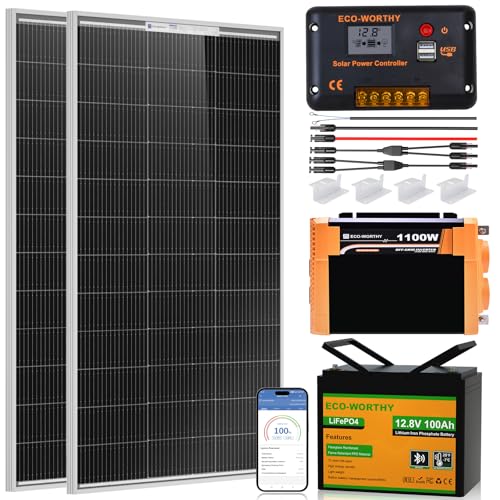
| 1. ECO-WORTHY 200 Watt 12V Complete Solar Panel Starter Kit with Battery and Inverter | Check price on Amazon | |
| 3. ECO-WORTHY Ultra 1200W 24V Lithium Battery Solar System with 3000W Pure Sine Wave Inverter | Check price on Amazon | |
| 4. ECO-WORTHY 5KW Off Grid Solar System Complete Kit with 51.2V 100Ah Server Rack Battery | Check price on Amazon |
🛒 Best Price Today on Amazon
Prime members get fast, free shipping on everything above, plus member-only deals. New members get a 30-day free trial — cancel anytime.
- What Counts as an Inverter Battery Combo
- Start With the Load, Not the Box
- System Voltage: 12, 24, or 48 Volts
- Battery Chemistry: Lithium Iron Phosphate Versus Lead-Acid
- Pure Sine Wave Output
- Charging: Why the Panels and Controller Are in the Box
- The Picks
- How the Picks Compare
- Installation and Safety Notes
- Frequently Asked Questions
- Bottom Line
An inverter and a battery only work as a team. The battery decides how long power lasts during an outage or off the grid, and the inverter decides which appliances can run at all, and how cleanly. Buy them separately without matching them and the usual results are an inverter that trips on loads the battery could have supplied for hours, or a large battery bank paired with an inverter too small to start a refrigerator compressor. An inverter battery combo solves that matching problem by packaging the two together, in the kits covered here alongside the solar panels and charge controller that keep the battery filled, so the voltage, capacity, and output have already been chosen to work as one system.
This guide explains how to size an inverter battery combo properly, how battery chemistry and system voltage change the decision, and where each verified combo below fits. The picks run from a compact 12 volt kit for an RV, shed, or a few home essentials, through a mid-size 24 volt system, up to a 48 volt whole-home off-grid package. All of them deliver 110 to 120 volt AC output for North American appliances, and all pair a lithium battery with a matched inverter in a single purchase.
As an Amazon Associate we earn from qualifying purchases.
What Counts as an Inverter Battery Combo
The term covers any package where the inverter and the battery are sold together as a matched set rather than as unrelated components. In markets with frequent grid outages, the classic form is a home inverter unit bundled with a large lead-acid tubular battery, sometimes on a trolley. In the North American market, the same idea is most often sold as a complete solar combo kit: solar panels, a charge controller, a lithium battery, and an inverter in one box. The panels and controller are the charging side of the system, while the inverter and battery remain the heart of the combo, storing energy and converting it back to household AC power when the grid is down or absent.
Either way, the questions that decide whether a combo is right are the same. What voltage is the system built around? How much energy does the battery store? How much continuous power, and how much short surge power, can the inverter deliver? And is the inverter’s output a pure sine wave that sensitive electronics can use safely? The sections below take those questions in order.
Start With the Load, Not the Box
Sizing begins with a list of what you actually intend to run. Add up the running wattage of the lights, refrigerator, router, television, fans, and other loads you want during an outage, then check the starting surge of anything with a motor or compressor, because a refrigerator or pump can draw several times its running wattage for a moment at start-up. Your inverter’s continuous rating must cover the running total with headroom, and its surge rating must cover the largest motor start on top of the other loads already running.
Then work out how long those loads must run. Battery capacity is stated in amp hours, but what matters is stored energy, which is amp hours multiplied by system voltage. A 100 amp hour battery at 12 volts stores roughly half the energy of the same amp hour figure at 24 volts, and a quarter of it at 48 volts, before inverter losses. Divide the stored energy by your total load wattage for a first estimate of runtime, then allow for the fact that no system should be planned around draining its battery completely and that conversion is never perfectly efficient. Combos make this arithmetic easier because the listings state the pairing plainly, such as a 100 amp hour 12 volt lithium battery matched to an 1100 watt inverter, so you can see at a glance which loads the pairing was designed around.
System Voltage: 12, 24, or 48 Volts
Small combos are built on 12 volts, the voltage of vehicle electrical systems and of a single common lithium battery. Twelve volt kits suit RVs, boats, sheds, cabins, and modest home backup for lights and electronics, and they keep wiring simple at low power levels. Their limit is current: pushing several thousand watts through a 12 volt system means very high DC current, heavy cables, and more loss.
Twenty-four volt systems halve that current for the same power and are a natural step up for larger cabins and more serious off-grid use. Forty-eight volt systems go further still and are the standard foundation for whole-home off-grid and large backup installations, where inverters of several kilowatts are involved. The picks below include one example at each level, plus a second 12 volt option with a more capable charging side, so you can match the voltage class to the scale of the job rather than forcing one kit to cover everything.
Battery Chemistry: Lithium Iron Phosphate Versus Lead-Acid
Traditional inverter combos used flooded lead-acid batteries, including the tall tubular designs sold for home backup in outage-prone regions. They are proven and tolerant, but they are heavy, need ventilation and periodic water checks in flooded form, and should normally only be drawn down to about half their capacity if they are to last. The combos sold for the North American solar market, including every pick below, use lithium iron phosphate batteries instead. This chemistry tolerates deep discharge far better, charges faster, weighs much less for the same usable energy, and carries a built-in battery management system that protects against overcharge, over-discharge, and short circuits.
The practical consequence is that a lithium combo’s nameplate amp hours are much closer to its usable capacity than a lead-acid combo’s. When comparing a lithium kit against an older lead-acid pairing, compare usable stored energy rather than the headline amp hour number, and factor in that the lithium battery needs no watering, no equalizing, and no separate ventilated battery room.
Pure Sine Wave Output
An inverter’s waveform matters to what you plug into it. Pure sine wave output matches the shape of grid power and runs motors, compressors, variable-speed tools, medical devices, and modern electronics without the buzzing, extra heat, or misbehavior that modified sine wave output can cause. For a combo intended to run a refrigerator, a furnace blower, or a computer, pure sine wave is the specification to insist on. One of the picks below names a pure sine wave inverter explicitly in its title, and in every case you should confirm the waveform in the listing details before ordering, along with the output voltage: North American homes need 110 to 120 volt output, while combos built for other markets may be wired for higher-voltage grids and are not interchangeable.
Charging: Why the Panels and Controller Are in the Box
A battery that cannot be recharged is a countdown timer. The solar combos below include panels and a charge controller sized to the battery, which turns a backup-only combo into a system that recovers by itself every sunny day. Two controller types appear. PWM controllers are simple and adequate on small 12 volt kits. MPPT controllers extract more energy from the panels, especially in cold or variable light, and become the expected choice as system size grows; the larger picks below use MPPT controllers of 40 amps and 60 amps. Some kits add Bluetooth monitoring so battery state and charging can be checked from a phone instead of at the equipment. If you plan to charge mainly from the grid or a generator rather than solar, confirm the inverter or a companion charger supports that input, because a solar combo’s controller alone does not charge from AC.
The Picks
1. ECO-WORTHY 200 Watt 12V Complete Solar Panel Starter Kit with Battery and Inverter
This is the entry point of the group: a complete 12 volt combo built around a 12.8 volt 100 amp hour lithium battery and an 1100 watt inverter, with two 100 watt solar panels, a 30 amp PWM charge controller, and cables included. The listing states the system generates about 800 watt hours of power daily and stores 1.28 kilowatt hours, which frames its role clearly: lights, a router, a television, device charging, and similar modest loads in an RV, shed, cabin, or as light home backup, rather than whole-house service.
Because everything arrives as one kit with model number L02M100N-CWMZIUS1000L100-2, there is no separate matching of battery voltage to inverter input or controller size, which is exactly the appeal of a combo at this scale. Choose this size when your load list is genuinely small and your priority is a self-contained system that one person can install, and step up to the larger picks below if a refrigerator and several rooms of loads are on the list.
2. ECO-WORTHY 1.6KWH Complete Solar Panel Kit 390W 12V
This second 12 volt combo keeps the same storage foundation, a 12 volt 100 amp hour lithium battery, and pairs it with a 1000 watt inverter, but doubles down on the charging side: two 195 watt panels for 390 watts total, and a 40 amp MPPT charge controller with a Bluetooth module instead of the smaller PWM unit above. The listing describes ideal daily output of 1.6 kilowatt hours under four hours of sunlight, with 1.28 kilowatt hours of storage, and positions the kit for RV, shed, cabin, and home backup use, running 110 volt AC devices.
The contrast with the first pick is instructive. Storage and inverter size are similar, so the loads you can run at one moment are similar, but the stronger panel array and MPPT controller refill the battery faster and harvest more on marginal days. If your site has limited sun hours, or you expect to cycle the battery daily rather than occasionally, that charging headroom is worth more than a larger inverter would be. The listing’s installation sequence is also a useful summary of how any of these combos goes together: connect the battery to the controller first, then the panels, then the inverter to the battery.
3. ECO-WORTHY Ultra 1200W 24V Lithium Battery Solar System with 3000W Pure Sine Wave Inverter
Stepping up to 24 volts, this combo pairs two 12.8 volt 280 amp hour lithium batteries with a 3000 watt pure sine wave inverter, six 195 watt solar panels for 1200 watts of array, and a 60 amp MPPT charge controller, with cables included. The listing states the system can generate 5.52 kilowatt hours of energy per day, which moves it into a different class from the 12 volt kits: a cabin or off-grid home running a refrigerator, lighting, entertainment, and workshop or kitchen loads in rotation, with storage deep enough to matter overnight.
Two details define this pick. The first is the pure sine wave inverter named in the title, which is the right output for motor loads and sensitive electronics at this scale. The second is the move to a 24 volt architecture, which keeps DC currents manageable at 3000 watts in a way a 12 volt system cannot. Choose this combo when the 12 volt kits’ storage and output both fall short but a full 48 volt whole-home installation is more than the site needs.
4. ECO-WORTHY 5KW Off Grid Solar System Complete Kit with 51.2V 100Ah Server Rack Battery
At the top of the group sits a 48 volt whole-home combo: twelve 195 watt monocrystalline panels totaling 2340 watts, a 48 volt 5 kilowatt off-grid inverter, and a 51.2 volt 100 amp hour server rack lithium iron phosphate battery. That battery format matters for expansion, because rack batteries are designed to be paralleled in a cabinet as storage needs grow, rather than replaced. The listing describes the kit as a whole-house storage system and flags an important condition plainly: professional electrician installation is required for a safety-critical system of this size, which connects to home wiring rather than to a power strip.
This is the combo for a genuinely off-grid house or a home that wants substantial outage backup, not for a shed or an RV. Its inverter output and panel array are in a different league from the other picks, and so are its installation requirements, physical footprint, and planning needs, including permits and inspection where local rules require them. Treat it as the starting point of a house system that can grow, and have an electrician confirm panel layout, battery placement, and code compliance before ordering.
How the Picks Compare
The four combos divide by voltage and scale rather than by good and bad. The two 12 volt kits share a 100 amp hour lithium battery and roughly 1000 to 1100 watts of inverter, and differ mainly in charging: the 200 watt kit with a PWM controller is the simple starter, while the 390 watt kit with a 40 amp MPPT controller and Bluetooth refills faster and suits daily cycling. The 24 volt system triples the inverter output, names pure sine wave output explicitly, and multiplies storage several times over. The 48 volt system is a whole-home platform with a rack battery and a professional-installation requirement. Match your load list and runtime target to that ladder, and buy the rung that covers them with headroom rather than the largest box available.
Installation and Safety Notes
Small solar combos are designed for straightforward self-installation, and their listings describe simple multi-step hookups, but the order of connections matters: battery to controller before panels, and inverter connections made carefully with correct polarity and cable sizes. Batteries and inverters at the larger sizes are heavy, produce real heat under load, and in the 48 volt case tie into household wiring, which is why the largest pick requires a professional electrician. At every size, keep batteries in a dry, ventilated, temperature-moderate space, follow the maker’s torque and cable guidance, and never mix batteries of different ages, capacities, or chemistries in one bank. If a combo will feed any part of a home’s wiring rather than standalone outlets, a proper transfer arrangement is essential so the system can never feed power back into a dead grid line.
Frequently Asked Questions
How long will an inverter battery combo run my appliances?
Estimate stored energy by multiplying battery amp hours by system voltage, then divide by your combined load wattage, and expect less than the simple figure after conversion losses and sensible discharge limits. A 100 amp hour 12 volt lithium battery running a 200 watt load, for example, is a matter of several hours, not a full day.
Can I expand a combo later?
It depends on the architecture. Rack battery systems such as the 48 volt pick are designed for added modules, and panel arrays can often grow within the controller’s limits. Small all-in-one kits have less headroom, so if expansion is likely, start with the voltage class you intend to end with.
Is lithium better than a tubular lead-acid battery for a home combo?
For usable capacity, weight, charging speed, and maintenance, lithium iron phosphate is ahead: it tolerates deep discharge, needs no watering, and lasts through many more cycles. Lead-acid tubular combos remain common in some markets, but compare usable energy rather than headline amp hours when weighing the two.
Do I need a pure sine wave inverter?
For motors, compressors, and modern electronics, yes. It reproduces grid-quality power and avoids the heat, noise, and compatibility problems that modified sine wave output can cause with those loads.
Will one of these combos run a whole house?
Only the 48 volt pick is positioned for whole-home use, and even then, running every load at once is not the goal. Whole-home backup normally means covering essential circuits generously, and that sizing should be confirmed against your own load list before purchase.
Bottom Line
The best inverter battery combo is the one whose inverter, battery, and charging side were sized for each other and for your load list. For an RV, shed, or light backup, the 12 volt ECO-WORTHY kits pair a 100 amp hour lithium battery with a matched inverter, with the 390 watt MPPT version refilling noticeably faster. For a cabin or serious off-grid use, the 24 volt system adds a 3000 watt pure sine wave inverter and far deeper storage. For a whole home, the 48 volt rack battery system is the expandable platform, with professional installation as part of the deal. Add up your loads, decide your runtime, pick the voltage class that fits, and the combo format takes care of the matching.




Write Your Review
No reviews yet. Be the first to share your experience!