
🛒 Best Price Today on Amazon
Prime members get fast, free shipping on everything above, plus member-only deals. New members get a 30-day free trial — cancel anytime.
For most large homes, the best robot vacuum is the Roborock Saros 10R because its reliable room mapping, recharge-and-resume behavior, low-profile design, and fully automatic dock reduce the amount of supervision required across multiple floors; choose the Dreame X50 Ultra for thresholds and mixed floor levels, or a simpler self-emptying model if mopping is not important.
Best robot vacuums for large homes: the short list
- Best overall for expansive, mostly level floors: Roborock Saros 10R. Strong mapping, obstacle recognition, dual spinning mop pads, and a compact robot body make it a practical choice for large open plans.
- Best for thresholds and difficult transitions: Dreame X50 Ultra. Its liftable chassis is designed to handle higher transitions than ordinary robot vacuums, though performance still depends on the threshold shape.
- Best for large homes with frequent pet mess: Roborock Qrevo Curv. Its curved anti-tangle brush system and large multifunction dock reduce hair-related maintenance.
- Best for a large home where mopping is secondary: iRobot Roomba j9+. It offers capable mapping and dirt-focused vacuuming, but its dock and mopping configuration are less automated than the premium all-in-one competitors.
- Best budget direction: a self-emptying LiDAR vacuum without a wash dock. You give up automated mop washing and drying, but usually gain a lower purchase price and fewer dock components to maintain.
What matters more in a large floor plan
Manufacturers often advertise a robot’s maximum runtime, but coverage depends on vacuum power, floor type, navigation behavior, furniture density, and whether the robot is mopping. A robot that cleans for 180 minutes can still need several hours to cover a home if it makes repeated passes or returns to the dock to wash its mop pads.

Shark AV2501S AI Ultra Robot Vacuum, with Matrix Clean, Home Mapping, 30-Day Capacity HEPA Bagless Self Empty Base, Perfect for Pet Hair, Wifi, Dark Grey
Included for 'Best Robot Vacuums for Large Homes' because the listing specifies with Matrix Clean and Home Mapping, details this guide uses to compare options.
View on Amazon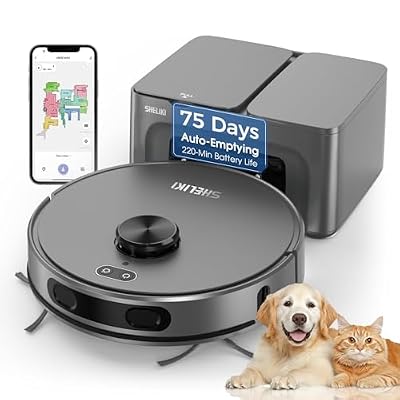
Robot Vacuum and Mop Combo, Mapping Robotic Vacuums Cleaner with 75 Days Self-Emptying, LiDAR Navigation Smart & Strong Suction, WiFi/App/Alexa/Voice Control, Quiet for Home Pet Hair Hard Floor Carpet
Included for 'Best Robot Vacuums for Large Homes' because the listing specifies Mapping Robotic Vacuums Cleaner with 75 Days Self-Emptying and LiDAR Navigation Smart & Strong Suction, details this guide uses to compare options.
View on AmazonMapped coverage and navigation
LiDAR mapping is particularly valuable in a large home because the robot can divide the house into rooms, save multiple floor maps, and follow efficient routes instead of wandering. Camera-based obstacle recognition helps it avoid cables, socks, and pet toys, but it does not replace room mapping.
Look for saved multi-floor maps if the robot will be carried between levels. The robot cannot normally travel upstairs by itself, and a dock located on one floor cannot empty or wash a robot operating on another. A good multi-level workflow is to carry the robot to the second floor, select the saved map, and return it to the correct dock when finished.
Battery endurance and recharge-and-resume
Recharge-and-resume is essential once the cleaning area exceeds a single battery’s practical coverage. The robot should return to its dock automatically, recharge, and continue the unfinished rooms from the correct location. This is more useful than a large advertised battery figure alone.
As a planning estimate, a 2,500-square-foot home may present approximately 1,700 to 2,100 square feet of actual cleanable floor after subtracting walls, cabinets, stairs, and permanently occupied areas. At roughly 700 to 1,000 square feet per hour in a furnished home, one complete vacuuming cycle can take two to three hours before charging, obstacle avoidance, and dock visits are included. Premium models generally handle this by splitting the job into sessions.
Bin capacity and dock capacity
A robot’s onboard dustbin matters most when the home has pets, thick carpets, or long gaps between cleaning cycles. A small bin may fill before the robot reaches the dock, causing it to pause or leave debris behind. An auto-empty dock solves this only if the dock bag or container is emptied regularly.
For mopping, dock water tanks can become the real limit. Large homes with hard floors may require a refill after one substantial session, especially when the robot washes its pads frequently. Plumbed-in docks can reduce this chore but require suitable water supply, drainage, and installation.
Head-to-head comparison
| Model | Robot size and battery | Dock and capacity details | Large-home advantage | Best suited to |
|---|---|---|---|---|
| Roborock Saros 10R | Approx. 7.98 cm high; 5,200 mAh battery | Auto-emptying, mop washing, warm-air drying, and water tanks; dock footprint is roughly 35 cm wide | Low clearance, multi-room mapping, obstacle recognition, and automatic continuation after charging | Large, furnished homes with beds and sofas that have limited clearance |
| Dreame X50 Ultra | Approx. 8.9 cm high; 6,400 mAh battery | Auto-emptying and multifunction mop dock with clean- and dirty-water tanks | Liftable chassis designed for taller thresholds than conventional round robots | Homes with uneven transitions, raised door tracks, or mixed floor levels |
| Roborock Qrevo Curv | Approx. 8.2 cm high; 5,200 mAh battery | Auto-emptying, mop washing, drying, and clean/dirty water tanks | Curved anti-tangle brush design and strong automated dock routine | Pet owners and large homes needing frequent unattended cleaning |
| iRobot Roomba j9+ | Approx. 8.7 cm high; battery runtime varies by mode | Clean Base auto-empty dock; docked debris storage can last multiple weeks depending on use | Room-aware navigation, dirt-focused cleaning behavior, and mature app scheduling | Vacuum-first households that do not need advanced mop automation |
Dimensions and capacities can vary slightly by regional version and dock configuration. Battery figures are nominal, while usable runtime is lower when maximum suction, carpet, or repeated mop washing is involved.
Choose by house, not just by specification
| Your situation | Most sensible choice | Why | Trade-off |
|---|---|---|---|
| More than 2,000 square feet, mostly hard floors, daily cleaning | Roborock Saros 10R | Efficient mapping and a dock that handles much of the mop maintenance | Premium purchase price and ongoing dock upkeep |
| Multiple thresholds or transitions around 2 to 3 cm | Dreame X50 Ultra | Its chassis is designed for more demanding transitions | Measure every threshold; rounded or awkward edges can still stop it |
| Several pets or long hair in the household | Roborock Qrevo Curv | Anti-tangle design and auto-emptying reduce daily intervention | Brushes still need inspection, especially around end caps |
| Vacuuming is important; mopping is occasional | iRobot Roomba j9+ | Less emphasis on a complex water-and-wash dock | Less hands-off mopping than premium all-in-one models |
| Limited budget or a second floor without a dock | Self-emptying LiDAR vacuum without an elaborate mop dock | Lower complexity and easier transport between maps | You may need to empty, charge, or mop-maintain it manually |
How to set up a robot vacuum for a large home
- Place the dock in a permanent location. Leave roughly 50 cm of open space on each side and about 1 m in front where possible. A cramped dock can cause failed returns.
- Run an initial mapping pass with the floors clear. Remove cables, loose clothing, and lightweight objects so the map reflects the actual layout rather than temporary obstacles.
- Label rooms and divide oversized areas. Schedule high-traffic rooms daily and quieter bedrooms less often. This reduces unnecessary battery cycles.
- Set no-go zones around fragile items and wet areas. Robot navigation is good but not infallible; thin cords, tassels, pet bowls, and low-friction rugs remain common trouble spots.
- Test thresholds before scheduling unattended runs. A robot can climb one transition and fail at another because of a different angle, height, or nearby furniture.
- Use recharge-and-resume rather than maximum suction everywhere. Standard or balanced power often covers more floor per charge, while maximum power can be reserved for carpets and high-debris rooms.
Ownership realities: what wears first
Robot vacuums are not maintenance-free. The main consumables are the filter, side brush, main brush, mop pads, and—on auto-empty docks—the dust bag. In a pet home, inspect the main brush and wheel axles weekly at first. Hair wrapped around an end cap can create resistance and noise even when the brush surface looks clean.
Wash reusable filters only as directed and allow them to dry completely before reinstalling them. A damp filter can restrict airflow and create odors. Mop pads should be washed frequently rather than left wet in the dock indefinitely; the dock’s drying cycle reduces moisture but does not eliminate the need to clean the wash tray and inspect its drain.
Expect general replacement costs to be moderate but recurring: consumable kits commonly fall in the approximate $30–$100 range, depending on brand and how many filters, brushes, bags, and pads are included. Premium dock components can cost more to replace, so check whether official parts are readily available before buying.
Final verdict
The Roborock Saros 10R is the strongest all-round answer for a large, mostly level home because it combines low clearance, sophisticated mapping, long-session automation, and recharge-and-resume behavior. Pick the Dreame X50 Ultra when thresholds are the deciding problem, and the Roborock Qrevo Curv when pet hair and brush tangles dominate your cleaning routine. If you mainly want dependable vacuuming and prefer fewer water-system parts to maintain, a self-emptying LiDAR model—or the Roomba j9+—may be the more sensible long-term purchase.




Write Your Review
No reviews yet. Be the first to share your experience!