
🛒 Best Price Today on Amazon
Prime members get fast, free shipping on everything above, plus member-only deals. New members get a 30-day free trial — cancel anytime.
- Best mobile scaffolding by situation
- How much platform height do you actually need?
- Head-to-head: narrow tower versus wide tower
- Load limits: calculate people and materials together
- Wheel locks and guardrails are not optional extras
- Setup time, storage, and indoor versus outdoor use
- Durability and ownership realities
- Decision checklist before purchase
- Bottom line
The best mobile scaffolding for most homeowners and light-trade users is a narrow, guardrailed steel or aluminum tower with a 4–6 ft platform, locking casters, and a clearly stated working load of at least 500 lb; choose a taller, wider tower only when its extra stability and reach justify the storage space.
Best mobile scaffolding by situation
| Situation | Best configuration | Useful target specifications | Main compromise |
|---|---|---|---|
| Indoor painting, lighting, or drywall repairs | Narrow rolling tower | 3–4 ft platform, 24–30 in width, 500 lb minimum load | Limited reach and less room for materials |
| Frequent trade work | Adjustable steel or aluminum tower with outriggers | 4–6 ft platform, 30–36 in width, 700–1,000 lb load | Heavier and slower to relocate |
| Exterior siding, gutters, or masonry | Wide rolling tower designed for outdoor use | 6–10 ft platform, 36–60 in base width, 1,000 lb load | Needs a level, firm surface and more storage |
| Occasional low-height maintenance | Compact baker-style scaffold | 2–4 ft platform, 24–30 in width, 500–750 lb load | Less stable at maximum height unless fully braced |
| Uneven floors or small level changes | Tower with adjustable legs and positive-lock casters | At least 6 in of practical leveling adjustment | More setup and more parts to inspect |
For recognizable commercial options, Metaltech produces baker-style and rolling scaffold systems, while Werner and Bil-Jax offer access equipment and scaffold products for professional use. Exact capacities, platform heights, and included guardrails vary by model and configuration, so treat the table as a buying specification rather than a claim about every product in a brand’s range.

WEN 4-Foot Portable Rolling Scaffolding, 500-Pound-Capacity with Foldable Design, Safety Rail and Tool Shelf (31107)
Included for 'Best Mobile Scaffolding: Safe, Stable Options' because the listing specifies 500-Pound-Capacity with Foldable Design and Safety Rail and Tool Shelf (31107), details this guide uses to compare options.
View on Amazon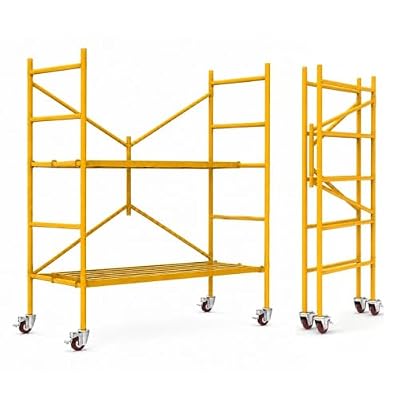
Scaffolding Platform, 800 LBS Capacity Heavy Duty Rolling Scaffold with Locking Wheels, Portable Mobile Scaffolding for Construction Site, Building Renovation, Roofing, Painting & Maintenance,71"H
Included for 'Best Mobile Scaffolding: Safe, Stable Options' because the listing specifies Portable Mobile Scaffolding for Construction Site and Building Renovation, details this guide uses to compare options.
View on Amazon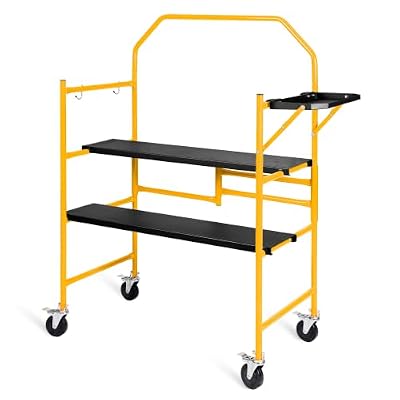
WORKESS 4FT Portable Rolling Scaffolding 500 lbs Capacity Folding Mobile Scaffolding Locking Wheels Safety Guard Rail Tool Shelf for Painting Ceiling Repair Home Renovation
Included for 'Best Mobile Scaffolding: Safe, Stable Options' as a relevant option in this category; details come from the product listing.
View on Amazon
WEN 31110T Baker-Style 6.25 ft. Multi-Purpose 1000-Pound-Capacity Rolling Steel Scaffolding
Included for 'Best Mobile Scaffolding: Safe, Stable Options' as a relevant option in this category; details come from the product listing.
View on AmazonHow much platform height do you actually need?
Platform height is not the same as working reach. A standing worker’s comfortable reach is often about 5–7 ft above the platform, depending on body height and the task. A person standing on a 4 ft platform may therefore reach approximately 9–11 ft, but should not stand on the guardrail, climb outside the frame, or stretch beyond a balanced position.
A useful sizing calculation is:
Required platform height = target work height − comfortable reach above the platform.
For a 12 ft ceiling and an estimated comfortable reach of 6 ft, the calculation is 12 − 6 = 6 ft. A 5–6 ft platform may be appropriate, provided the tower is rated and configured for that height. For work on a 20 ft exterior wall, a compact indoor unit is the wrong choice: a wider tower, additional sections, outriggers, and a site-specific stability plan are more important than simply adding height.
Head-to-head: narrow tower versus wide tower
Narrow mobile scaffold
A 24–30 in wide tower fits through many interior doorways and is easier to store in a garage. It is the better choice for hallways, kitchens, stair-free rooms, and work where tools are limited to a paint tray or small tool bag. Narrow units also require less effort to move.
The limitation is stability. A narrow base has less resistance to tipping, particularly on uneven floors or when the worker reaches sideways. At higher platform settings, use every supplied brace, stabilizer, and outrigger. A narrow tower should not be treated as a substitute for a wider outdoor system.
Wide mobile scaffold
A 36–60 in base provides a more stable footprint and creates room for materials. Wide towers are better for exterior work, long-duration tasks, and situations where two workers or bulky components must be accommodated—only if the platform’s rating allows that load.
They are harder to transport through doors, heavier to assemble, and more demanding to level. Measure the narrowest doorway, gate, and passage before buying. Also measure the stored height: a tower that fits its working location may not fit beneath a garage door or ceiling when assembled.
Load limits: calculate people and materials together
The working-load limit includes workers, tools, paint, boards, replacement parts, and anything else on the platform. If the scaffold is rated at 750 lb and two workers weigh 190 lb and 165 lb, with 120 lb of materials, the used load is 475 lb. That leaves 275 lb of nominal capacity—but the limit is not permission to concentrate all that weight in one corner.
Choose a margin for real work. For a single worker and light tools, a 500 lb platform may be adequate. For heavier materials or two-person work, look for 750–1,000 lb capacity and verify whether that rating applies to the complete assembled tower or only a particular platform configuration. Never mix frames, casters, platforms, or guardrail components from different systems unless the manufacturer explicitly permits it.
Wheel locks and guardrails are not optional extras
Each caster should have a positive locking mechanism that prevents both rolling and swiveling. A simple friction brake is less reassuring than a clearly engaged lock with a lever that cannot be mistaken for an unlocked position. Engage all caster locks before climbing, and test the tower with a gentle push. If it moves, stop and correct the problem.
Look for a complete guardrail system around exposed platform edges, including a top rail and midrail where required by the applicable safety rules. A toe board is valuable when tools or materials could slide off, especially outdoors or above occupied areas. Guardrails should not be improvised from lumber, rope, or removable parts that are not designed for that tower.
In the United States, OSHA rules distinguish between scaffold types and working conditions. Follow the instructions supplied with the exact unit and applicable local requirements. Outdoor towers may also need clearance from electrical conductors, protection from wind, and additional stabilization.
Setup time, storage, and indoor versus outdoor use
A small baker-style unit may take roughly 10–20 minutes to assemble when the parts are familiar. A braced tower with adjustable legs and outriggers can take 30–60 minutes, especially on the first setup. Claims of “tool-free” assembly do not eliminate the need to identify every brace, pin, and locking point.
Before buying, check these dimensions:
- Working footprint: include outriggers, not just the platform width.
- Transport width: compare it with doorways, gates, and vehicle access.
- Folded or disassembled size: determine whether parts can be stored safely without bending frames.
- Component weight: sections over roughly 50 lb may require two people to handle safely.
Indoor use favors nonmarking casters, compact dimensions, low noise, and protection for finished floors. Outdoor use favors corrosion-resistant aluminum or coated steel, larger casters, adjustable leveling, and a wider base. Neither material makes an unstable setup safe: a level, firm surface and correct bracing matter more than whether the frame is steel or aluminum.
Durability and ownership realities
Casters are usually among the first components to wear. Dust, paint, gravel, and overloaded swivel bearings can make them drag or fail to lock. Inspect them before every use and replace damaged casters as a matched, compatible set when specified by the manufacturer.
Other common wear points include:
- Platform hooks and pins, which can deform if dropped or forced into alignment.
- Brace clips and locking buttons, which can clog with paint or corrosion.
- Adjustable-leg threads, which can seize when dirt is left in the mechanism.
- Aluminum frame sections, which can crack or bend after impact even when surface damage looks minor.
- Guardrail sockets, which can loosen when repeatedly assembled without inspection.
Clean paint and mortar from moving parts before they harden. Do not lubricate a brake or locking surface unless the instructions specifically allow it. Keep platforms dry, store components off wet concrete, and retire any part that is bent, cracked, heavily corroded, or missing its identification label.
Decision checklist before purchase
- Measure the highest work surface and subtract a comfortable, non-stretched reach.
- Choose a platform height that keeps both feet fully on the platform.
- Confirm the working-load limit includes your workers and all materials.
- Require locking casters, complete guardrails, braces, and toe boards where appropriate.
- Check that the platform and frame dimensions fit every route to the work area.
- For outdoor work, prioritize width, leveling, corrosion resistance, and wind guidance over compact storage.
- Confirm replacement casters, braces, platforms, and guardrail parts are available.
General market prices range from about $150–$350 for compact low-height scaffold units, $300–$900 for heavier rolling towers, and $800–$2,000 or more for professional systems with wider frames, outriggers, adjustable legs, and higher capacities. The lowest purchase price is rarely the lowest ownership cost if replacement parts are unavailable or the unit cannot safely reach the required height.
Bottom line
Choose a compact, guardrailed 3–4 ft tower for indoor maintenance and a wider 4–10 ft system for sustained or exterior work. The best mobile scaffolding is the one whose platform height, load rating, wheel locks, guardrails, and footprint match the actual job—not simply the tallest or cheapest unit. When the surface is uneven, the height is substantial, or multiple workers and heavy materials are involved, use a professional-grade system and follow the manufacturer’s assembly and safety requirements exactly.




Write Your Review
No reviews yet. Be the first to share your experience!