
🛒 Best Price Today on Amazon
Prime members get fast, free shipping on everything above, plus member-only deals. New members get a 30-day free trial — cancel anytime.
- Frienda DC Golf Cart Battery Meter W/ Alarm, Green
- Renogy 30A Waterproof in-Line Fuse Solar Panel Holder w/Fuse, IP67 Waterproof
- Arrow 259 T25 Staples for Installing Low Voltage Wires & Cables, 1100 Count
- Frienda 3 Inch Round Terminal Battery Cable Lug Assortment
- Renogy 20A ANL Fuse Holder and ANL Fuse
- How to Choose
- FAQ
- Final Verdict
A generator shed bank rarely fails all at once. It drifts. A lug works a fraction loose through a season of vibration, a fuse holder seal lets in damp air, the thin lead running to the meter sags off its pins, and none of it announces itself until the exercise run stumbles or the bank sits flat on the one morning it is needed. The lowest-effort insurance against that slow drift is the short pass made before the run starts: the pre-run terminal check, a walk along the bank that stops at every connection point and asks the same small questions each time. Is the reading where it was last month? Is the fuse intact and seated? Is the lead pinned where it belongs? Does that cable end still look sound?
This guide gathers five refresh picks that support that walk, one for each stop. There is a meter for the log card, two fuse holders for the two fuse positions most shed banks carry, staples that keep the low-voltage lead run tidy, and a lug assortment for renewing cable ends gone tired. None of these picks replaces a charger, a proper tester, or an electrician. Each one supports a single stop on the pass, and together they turn a vague glance at the bank into a repeatable routine.
As an Amazon Associate, we earn from qualifying purchases.
Frienda DC Golf Cart Battery Meter W/ Alarm, Green
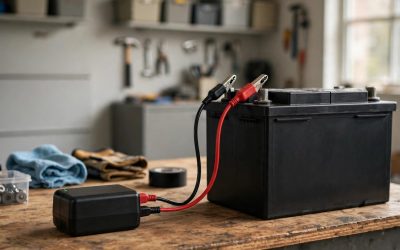
The first stop on the walk is the log card, and this meter is the pick that feeds it. The Frienda unit is a DC golf cart battery meter with an alarm function and a green display, and in this routine it is used in one narrow, honest way: as a repeatable trend readout for the shed bank. Read it under the same conditions each visit, before anything is touched or started, and write the reading on the card next to last month’s. A single reading says little. A line of readings that begins to drift is an early flag that a connection somewhere along the bank deserves a closer look during the rest of the pass.
That framing matters, because the meter is not a charger, it does not load-test the bank, and it is not a state-of-charge gauge. A surface reading cannot carry that weight. The alarm is best treated the same way: a threshold nudge that says look closer, not a diagnosis. Used as a trend tool and nothing more, the meter earns the first stop on the walk.
Specs
- Type: DC golf cart battery meter with alarm
- Display color: Green
- Role in this routine: repeatable trend readout for the shed bank log
- Voltage range and wiring requirements: confirm on the listing
Renogy 30A Waterproof in-Line Fuse Solar Panel Holder w/Fuse, IP67 Waterproof
The second stop is the solar feed that keeps the shed bank topped up between runs. That feed passes through an in-line fuse holder, and the pass is the moment to open it, look at the fuse element, and check that the seal is still doing its job. This Renogy holder is rated 30A, is described as waterproof with an IP67 rating, and comes with a fuse, which suits a holder mounted on a shed wall where weather finds every weak seal eventually. A holder whose cap still closes cleanly and whose fuse sits bright and unbroken lets the walk move on in seconds.
If the fuse has opened, treat that as information rather than an inconvenience. Fuses open because a circuit asked for more than it should, and swapping in a fresh fuse without a look at the feed and the connections at both ends just schedules the next opening.
Specs
- Type: in-line fuse holder for solar panel feeds
- Rating: 30A, per the product name
- Protection: waterproof, IP67 rated, per the product name
- Fuse: included, per the product name
- Accepted wire sizes: confirm on the listing
Arrow 259 T25 Staples for Installing Low Voltage Wires & Cables, 1100 Count
The third stop is the thin low-voltage lead that runs from the bank to the meter and any alarm or sensor points. That lead usually travels along shed framing, and over time it sags, gets knocked by stored gear, and ends up hanging where it can be snagged. These Arrow staples are made for installing low voltage wires and cables, which is exactly this run: pinning the lead back along the framing so it travels a fixed, visible path that the eye can follow during every future pass. The 1100 count box means the shed shelf never runs short mid-tidy.
The boundary here is plain and worth stating in full. These staples are for low-voltage runs only: the meter lead, an alarm lead, a sensor lead. They must never be used on power cords, extension leads, or mains wiring, and a staple driven carelessly through insulation can damage even a low-voltage lead, so each pin goes in as a loose guide rather than a tight clamp. Within that boundary, a tidy lead run is not cosmetic. A lead that follows a fixed path shows a new sag or a rub point immediately, which makes every future pass faster.
Specs
- Type: staples for installing low voltage wires and cables
- Model: 259 T25
- Count: 1100 staples
- Staple gun compatibility: confirm on the listing
Frienda 3 Inch Round Terminal Battery Cable Lug Assortment
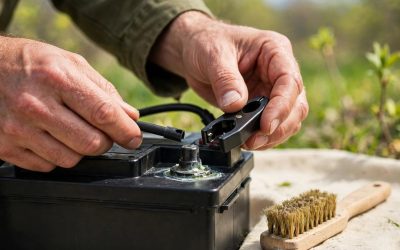
The fourth stop is the bank’s own cable ends, the heaviest connections in the shed and the ones that suffer most from vibration and damp air. The pass asks a simple question of each lug in turn: is the barrel still tight on the cable, is the ring still flat against its post, and is there any corrosion bloom creeping out from under the insulation? A lug that fails that look gets renewed from this assortment of 3 inch round terminal battery cable lugs, and an assortment is the right format because the tired lug is never the size there is a spare of.
Renewal follows fixed rules that the walk never shortcuts. The bank is disconnected first, the replacement lug’s barrel is matched to the cable it terminates, and the crimp is made with a proper crimp tool rather than improvised pressure that leaves a weak joint. Sizes and counts inside the assortment vary, so the listing is the place to confirm the spread before ordering. A renewed lug, seated flat and tight, closes the fourth stop and usually explains any drift the meter logged at the first one.
Specs
- Type: round terminal battery cable lug assortment
- Lug length: 3 inch, per the product name
- Sizes and counts in the assortment: confirm on the listing
- Crimp tool requirements: confirm on the listing
Renogy 20A ANL Fuse Holder and ANL Fuse
The last stop before the run is the bank’s main fuse position, and this Renogy ANL fuse holder with its 20A ANL fuse is the refresh pick for it. The pass opens the holder, checks that the fuse element is intact, and looks at how the fuse seats: a fuse that rocks in its holder, or a holder showing warmth discoloration around the contacts, is a fault found early rather than a failure found during an outage. Because this position guards the bank’s main path, its condition carries more weight than any other single check on the walk.
As with the solar feed’s fuse, an opened ANL fuse is a symptom to read, not just a part to swap. Replace it only with the same rating, and if a fresh fuse opens again, the circuit it protects needs proper investigation before the bank goes back into service. With this stop done, the walk is complete and the exercise run can start with the bank actually known, rather than assumed, to be sound.
Specs
- Type: ANL fuse holder with ANL fuse
- Rating: 20A, per the product name
- Accepted cable sizes: confirm on the listing
- Mounting method: confirm on the listing
How to Choose
Work the walk in the order given, because the order carries the logic. The meter comes first, while the bank is exactly as it was left, so the trend reading reflects a month of standing rather than a minute of disturbance. The fuse positions come next, then the lead run, then the cable ends, so each stop narrows where a flagged drift might live. When choosing the picks themselves, match every rating to the circuit it protects. The 30A in-line holder belongs on the solar feed it was sized for, the 20A ANL position belongs on its own circuit, and a fuse is never uprated to stop nuisance openings, because the openings are the message.
Lugs should be matched by barrel to the cable gauge and by ring to the post they land on, and the assortment’s listing is where that spread gets confirmed. Staples belong only where the run is genuinely low voltage, full stop. Finally, keep the spares on the shed shelf beside the log card: one fuse for each holder, a handful of lugs across the common sizes, and staples in the gun. A check that finds a fault nobody can fix on the spot is only half a routine.
FAQ
Is the Frienda meter a state-of-charge gauge for the shed bank?
No. In this routine the meter serves only as a repeatable trend readout, taken under the same conditions at every visit and written onto the log card. A drifting trend is a prompt to inspect connections during the rest of the walk, not a verdict on the bank. It is not a charger and it does not load-test anything.
Can the Arrow T25 staples tidy the generator’s power cord run too?
No. These staples are made for low voltage wires and cables, and that is the whole of their role here: the meter lead, an alarm lead, a sensor lead. Power cords, extension leads, and mains wiring must never be stapled, and permanent mains work belongs to an electrician rather than a shed tidy-up.
What should I do if a fuse has opened before the run?
Treat the opened fuse as a symptom. Look over the circuit it protects, including the connections at both ends, then replace the fuse only with one of the same rating. If a fresh fuse opens again, leave the bank out of service and have that circuit investigated properly.
Do the lugs in the assortment fit every battery cable in the shed?
Not automatically. The assortment covers a range of sizes, but a lug only does its job when its barrel matches the cable gauge and its ring sits flat on the post, so confirm the size spread on the listing against the shed’s cables. Any renewal happens with the bank disconnected and a proper crimp tool.
Final Verdict
The pre-run terminal check is a small routine with an outsized payoff, because nearly every shed bank failure begins as a connection fault that a ten-minute walk would have caught. These five picks map one to one onto its stops: the Frienda meter keeps the trend log honest, the Renogy in-line holder and the Renogy ANL holder cover the two fuse positions, the Arrow staples keep the low-voltage lead run pinned and visible, and the Frienda lug assortment makes renewing a tired cable end a same-visit job. Owners whose banks run different fuse ratings or cable sizes should match those details to their own circuits before ordering, and then let the walk, done the same way every month, do the rest.


Write Your Review
No reviews yet. Be the first to share your experience!