
🛒 Best Price Today on Amazon
Prime members get fast, free shipping on everything above, plus member-only deals. New members get a 30-day free trial — cancel anytime.
An angle finder earns its place the first time a corner refuses to be 90 degrees. Walls lean, old framing wanders, and a generator enclosure on a sloped pad rarely sits square. Measuring the real angle, then cutting to that number, is the difference between tight miters and gaps. The tools below fall into two families: two-arm digital protractors that open into a corner and read the angle between their blades, and compact magnetic gauges that read tilt against gravity for setting saw blades.

As an Amazon Associate, we earn from qualifying purchases.
Quick answer
For trim and enclosure work, the Bosch GAM 220 MF is the strongest pick: long arms, tight accuracy, and built-in simple and compound miter calculation. The Klein Tools 935DAF covers the same corner work in a lighter body with its own miter mode. For less, the GemRed 82305 gives stainless two-arm measuring with a proper locking knob. For setting a saw blade instead of reading a corner, the Klein Tools 935DAG magnetic gauge is the one to own; the GemRed 82412 does the same job in a smaller, backlit cube.
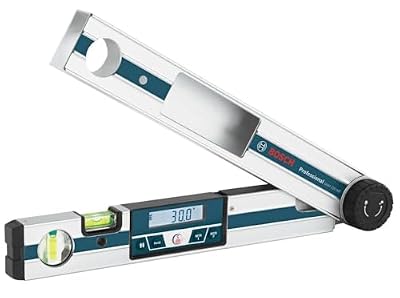
Bosch GAM 220 MF Digital Angle Finder
The Bosch is the professional end of this group, built around 16 inch aluminum arms that span wavy walls where short blades bridge bumps and mislead you. Stated accuracy is plus or minus 0.1 degree, the tightest figure here, and a mechanical lock keeps a reading intact on the walk to the saw.
What sets it apart is the calculation brain. Measure a corner, press a button, and it works out the miter setting; a compound mode turns spring and corner angles into miter and bevel settings for crown work. The math is exact, but it assumes your saw scales are honest. Hold and memory store readings, and the sealed body shrugs off dust and splashes.
Specs
- Measuring range: 0 to 220 degrees
- Stated accuracy: plus or minus 0.1 degree
- Arm length: 16 in (40 cm)
- Functions: hold and memory, simple and compound miter calculation
- Build: aluminum arms, IP54 sealing, leg extension, case, 4 AA power (about 80 hours)
Klein Tools 935DAF Digital Angle Finder
Klein built this finder as a 3-in-1 tool for corner work: it measures inside and outside angles, works as a short rule for lengths, and calculates the miter saw setting from the corner you just measured. That removes the halving arithmetic where most trim mistakes happen, though the result still depends on seating both blades flat.
The body mixes stainless steel blades with an ABS housing, runs 8.55 inches long, and weighs under seven ounces. Stated accuracy is plus or minus 0.2 degree, realistic for this class, and the bright LED display reads well in dim corners. There is no gravity sensor: it reads the angle between its blades, not level or plumb.
Specs
- Stated accuracy: plus or minus 0.2 degree
- Measures: inside angles, outside angles, and lengths
- Calculation: miter saw cut angle from the measured corner
- Body: stainless steel and ABS plastic
- Size: 8.55 in long, 6.9 oz; bright LED display
GemRed 82305 Digital Angle Finder Protractor

The GemRed 82305 is the straightforward two-arm protractor: two stainless steel rulers, 7 inches and 200 mm long, joined by a hinge with a locking knob. Open the blades into a corner and the screen shows the angle; close them onto a bevel and it copies that too. Etched scales double as short layout rules.
Its stated accuracy is plus or minus 0.3 degree with 0.1 degree display steps. The screen moves in fine steps, but the true reading can sit a few tenths either side: fine for framing and general carpentry, marginal for fussy joinery. Hold freezes the number, zero sets a relative reference, and the lock knob matters more than any electronic feature: a hinge that creeps in transit quietly ruins the cut.
Specs
- Blades: 7 in (200 mm) stainless steel with etched scales
- Measuring range: 0 to 225 degrees
- Stated accuracy: plus or minus 0.3 degree; display steps 0.1 degree
- Functions: hold, zero for relative angles, locking knob
- Power: CR2032 coin cell, auto shutoff
Klein Tools 935DAG Digital Electronic Level and Angle Gauge
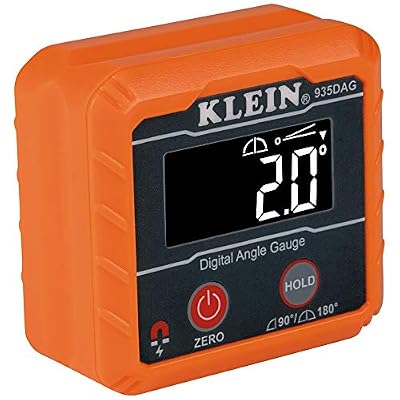
The 935DAG belongs to the second family: a small magnetic gauge that reads tilt against gravity rather than the angle between two blades. Zero it on your saw table, stick it to the blade, and tilt to the exact bevel you want. That workflow is why these gauges are standard kit for saw setup and machine tables.
It offers two ranges, 0 to 90 and 0 to 180 degrees, with stated accuracy of plus or minus 0.2 degree. Repeatability is what counts: lift it off, set it back down, and it should land on the same number, and this one behaves well there. The reverse contrast display flips past vertical so it never reads upside down, and V-groove edges sit steady on pipe and conduit.
Specs
- Ranges: 0 to 90 and 0 to 180 degrees
- Stated accuracy: plus or minus 0.2 degree
- Base: magnetic, with V-groove edges for pipe and conduit
- Display: reverse contrast, auto-rotating
- Functions: zero calibration for relative angles, hold
- Build: IP42 sealing, 2 AAA batteries, case included
GemRed 82412 Digital Angle Gauge

The 82412 is the compact cube version of the magnetic gauge idea, an aluminum-framed box about 60 mm across that sticks to a saw blade and reads tilt in 0.1 degree steps. Its green backlit display is the standout detail: under a saw table or inside a dim enclosure frame, that glow beats a plain gray screen.
Stated accuracy is plus or minus 0.2 degree across a four-quadrant range, matching the Klein gauge above on paper. Hold freezes a reading when you cannot see the screen, and zero turns any surface into your reference. It will not read a wall corner, since there are no arms, and the small base can rock on dirty steel, so wipe the blade first.
Specs
- Range: 4 x 90 degrees (full circle of tilt)
- Stated accuracy: plus or minus 0.2 degree; display steps 0.1 degree
- Display: green backlit screen
- Housing: aluminum frame with magnetic base
- Functions: hold and zero for relative readings
- Size: about 60 x 60 x 30 mm, pouch included
How to choose
First decide which question you are asking. The angle between two surfaces, a corner, a bevel, a stair pitch, calls for a two-arm protractor. A blade, fence, or frame set at an exact tilt from level calls for a magnetic gauge. Many workshops end up with one of each, because neither tool does the other job well.
Read accuracy figures with care. A display counting in 0.1 degree steps shows only resolution; the accuracy line tells you how far the reading may drift from the truth. Plus or minus 0.1 degree suits trim that must close invisibly; 0.3 is honest framing accuracy. Test repeatability by measuring the same angle five times and watching the spread.
Blade length decides how truthful a corner reading is: long arms average out bumps and bowed walls, short blades fit inside cabinets and small frames. Locking strength decides whether the reading survives the trip to the saw, so favor a real lock knob over hinge friction. On magnetic gauges, check for strong magnets, a flat base face, and a V-groove for round stock. Analog tools stay valid too: a dial locator or sliding bevel gauge reads to about a degree, never dies mid-job, and transfers angles physically.
FAQ
How accurate is a digital angle finder in real use?
Expect the stated figure, not the display step. A finder showing tenths but rated at plus or minus 0.3 degree can be off by three tenths on one reading. Clean faces, firm seating, and measuring twice bring results close to the stated figure.
What does the miter calculator actually do?
It halves a measured corner angle; compound models also combine corner and spring angles into miter and bevel settings. The math saves arithmetic mistakes, but cannot fix a sloppy saw scale or a workpiece that rocks on the fence.
Can a magnetic angle gauge measure a wall corner?
No. A magnetic gauge reads tilt against gravity on one surface at a time. The zero function lets it compare two surfaces in turn, but a two-arm protractor opens into a corner and reads it directly.
Verdict
Buy the Bosch GAM 220 MF if trim, stairs, and enclosure framing are regular work and you want the miter math handled for you. The Klein 935DAF delivers the same workflow in a lighter body, and the GemRed 82305 covers basic corner copying. Add the Klein 935DAG, or the backlit GemRed 82412, when blade setup is the job.
Write Your Review
No reviews yet. Be the first to share your experience!