
🛒 Best Price Today on Amazon
Prime members get fast, free shipping on everything above, plus member-only deals. New members get a 30-day free trial — cancel anytime.
An emergency panel lives a strange life: folded in a closet for months, then expected to work perfectly on the worst day of the year. That changes what good means. For an emergency power kit, the winning traits are slow, dependable charging that matches a stored power station or a 12 volt battery, connectors that cannot be confused under stress, and a panel that survives long storage without fuss. Peak wattage matters less than the certainty that the kit works when the grid does not.
This guide is for households building a winter outage kit around a portable power station, families who keep a charged 12 volt battery for lights and radios, and anyone who wants a panel that also earns summer use at camp. The four models below were selected from the names and stated details on their Amazon listings, so the wattage, included parts and intended uses here match each listing itself.
Quick Picks
As an Amazon Associate we earn from qualifying purchases.
| Product | Best for | Key spec from title |
|---|---|---|
| BALDR 200W Portable | A complete kit panel for common stations | 200W, monocrystalline, folding, for solar generators and stations |
| Anker SOLIX PS100 | A stored panel that also camps in summer | 100W, foldable, IP67 waterproof, for blackouts |
| Renogy 100W Eclipse Suitcase | Keeping a bare 12V battery alive | 100W, waterproof 20A charge controller, foldable suitcase |
| Renogy 200W Solar Blanket | The smallest stored footprint | 200W, N-Type, 8-fold blanket, USB-A and Type-C output |
How to Choose
Build the kit around what must stay alive
List the loads before the panel. In a winter outage the honest essentials are light, phones, a radio, and perhaps a medical device or a small fridge, and each one points at a battery size first and a panel second. A 100W panel can maintain a modest station against that load in decent sun. A household protecting a fridge and several rooms should think in terms of 200W and a larger battery. The panel’s job in an emergency kit is to stretch the battery across days, not to run the house as if nothing happened.
Prefer complete, simple connections
Under stress, the best kit is the one a tired family member can set up in gloves. Panels sold for solar generators and power stations, like the BALDR in this list, are built around that pairing. A kit meant for a bare battery needs a charge controller in the chain, which the Renogy suitcase includes and most station panels do not. Decide which battery your kit protects, station or bare 12 volt, and buy the panel that completes that exact chain with the fewest loose adapters stored in separate drawers.
Plan for storage as much as for sunlight
An emergency panel spends most of its life folded, so judge the fold as storage equipment. A blanket design slides onto a closet shelf or behind a sofa. A suitcase design protects glass cells behind a hard shell and a handle, at the cost of more volume. Either way, store the panel dry, indoors and away from heat sources, with its cable coiled alongside it rather than in another room. Once or twice a year, unfold the kit on a bright day and confirm the whole chain still charges, so a failure is found in October rather than during a January outage.
Handle the electrical safety basics before the outage
Learn the safe sequence while the lights are still on. Keep the panel’s open circuit voltage below the input limit of the station or controller it feeds, and remember that cold, bright weather raises panel voltage. Keep MC4 connectors dry and fully seated, and never connect a panel directly to a battery without a charge controller between them. If the kit’s battery is lithium, warm it indoors before charging on a freezing day, since lithium batteries should not be charged below freezing unless the maker explicitly allows it. Practise the setup once in daylight.
The 4 Best Options
BALDR 200W Portable

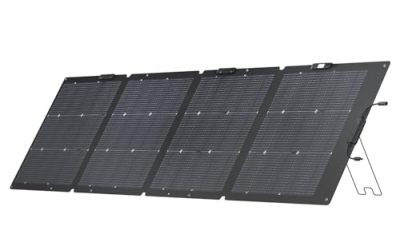
BALDR builds this panel as a kit component rather than a solo gadget: the title names solar generators and portable power stations as its partners, and the panel folds from monocrystalline cells into a carryable package. At 200W it is sized to give a mid-range station a meaningful daily refill during an outage, enough to hold lights, communications and a small fridge rotation together across several short winter days. For a household assembling its first serious emergency kit around a station it already owns, this is the straightforward centre panel to build around.
Specs
- Brand: BALDR, per the product title
- Rated power: 200W, per the product title
- Cell type: Monocrystalline, per the product title
- Design: Portable folding solar charger, per the product title
- Intended use: Solar generators and portable power stations, camping, off-grid living, per the product title
- Kit role: Solar panel kit, per the product title
Best for: A first emergency kit built around a mid-size power station that needs a 200W daily refill.
Watch out for: Confirm the cable ends match your station’s input, since the title promises station fit in general rather than one named plug.
ASIN: B0D7VYFJPJ
Anker SOLIX PS100

Anker names blackouts in this panel’s title, and that honesty about its second job is the point. The PS100 folds to a manageable 100W package with an adjustable kickstand and an IP67 waterproof build, so it can wait in a hall closet, work a sleety garden during an outage, and still go camping in July. In kit terms it is the maintenance panel: not the fastest refill, but light enough that anyone in the house can carry it out, set the angle and get a stored station drinking sunlight within minutes.
Specs
- Brand: Anker, per the product title
- Model: SOLIX PS100, per the product title
- Rated power: 100W, per the product title
- Design: Foldable portable panel with adjustable kickstand, per the product title
- Weather rating: IP67 waterproof, per the product title
- Efficiency: 23 percent higher energy conversion efficiency, per the product title
- Intended use: Camping, RVs and blackouts, per the product title
Best for: A household that wants its emergency panel light, waterproof and useful for summer trips too.
Watch out for: A single 100W panel only slows the drain on a large station, so pair it with disciplined, essentials-only loads.
ASIN: B0CYSD1C6Y
Renogy 100W Eclipse Suitcase

Some emergency kits are built on a plain 12 volt battery rather than a station, and this is the panel for them. The Eclipse suitcase carries its own waterproof 20A charge controller, so the chain from panel to battery is complete in one case: open it, set the kickstand, clip onto the battery. The glass suitcase format also stores well, standing in a garage corner with its cells protected. It suits households keeping a battery for LED lighting, a radio and phone charging, and anyone whose kit predates the power station era.
Specs
- Brand: Renogy, per the product title
- Rated power: 100W, per the product title
- System voltage: 12 volt, per the product title
- Controller: Waterproof 20A charger controller included, per the product title
- Design: Foldable solar suitcase with adjustable kickstand, per the product title
- Intended use: Camping, RV, off-grid system and power station, per the product title
Best for: An emergency kit built on a bare 12 volt battery that needs a controller included in the panel case.
Watch out for: The included controller is matched to this panel, so it is not the foundation for a much larger future array.
ASIN: B01NADR1CI
Renogy 200W Solar Blanket

When the kit has to disappear into a small home, the blanket wins. Renogy’s title describes a 200W N-Type panel folding in eight sections, with USB-A and Type-C outputs that can charge phones and lights directly if the main battery is busy or flat. Stored flat on a shelf, it takes less room than the winter coats beside it, yet on a bright outage day it delivers full-size wattage to a station. For apartment households and small houses, it resolves the usual conflict between a serious panel and a serious lack of storage.
Specs
- Brand: Renogy, per the product title
- Rated power: 200W, per the product title
- Cell type: N-Type, per the product title
- Efficiency: 25 percent high efficiency, per the product title
- Design: Portable blanket, lightweight 8-fold, per the product title
- Direct outputs: USB-A and Type-C, per the product title
- Intended use: Power station charging, camping, RV, pickup truck and marine, per the product title
Best for: A small home or apartment whose emergency panel must store flat and still deliver 200W.
Watch out for: With no rigid frame or kickstand, its winter angle depends on a fence, wall or furniture to lean against.
ASIN: B0F4J9WFY8
Which One Fits Your Situation
A family protecting a fridge and the lights
Build around the BALDR 200W and the largest station the budget allows. The panel’s daily refill will not run a house normally, but rotated fridge hours, LED lighting and charged phones are a realistic multi-day pattern in winter sun. Write the load list on a card and keep it with the kit, so nobody has to improvise priorities in the dark.
A kit based on a battery in the garage
Choose the Renogy Eclipse suitcase. Its included controller makes the battery chain complete and safe, the case protects the cells between emergencies, and the same kit can top up the battery after summer camping weekends, so it never sits entirely idle. Check the battery’s charge every couple of months and let the panel bring it back up on a bright driveway morning.
An apartment with one closet for emergencies
The Renogy blanket stores flattest and still brings 200W, while its USB outputs cover phones even before the station comes out. If the closet is truly tiny and loads are minimal, the Anker PS100 is the lighter alternative. Either way, keep the panel, its cable and a torch in one labelled spot that every adult in the home knows about.
A household that hates gear it never uses
Take the Anker PS100. It is an honest camping panel all summer and a calm, waterproof outage panel in winter, which means it gets unfolded, checked and understood regularly instead of being discovered, unfamiliar, during a storm. Familiarity is a genuine safety feature: the person setting it up in sleet will already know every cable and clip by heart.
Common Mistakes
- Buying a panel for a power station, then storing the charging cable in a different place from the panel.
- Never test-running the kit until the first real outage, when a missing adapter becomes a crisis.
- Connecting a folding panel straight to a bare battery with no charge controller in between.
- Sizing the kit for the whole house instead of the short list of loads that genuinely matter.
- Storing the panel damp or in a hot attic, quietly shortening the life of fabric, cables and connectors.
Frequently Asked Questions
How long will a folding panel keep essentials running in an outage?
It depends on the battery more than the panel. A 200W panel in this list can return a useful share of a mid-size station’s capacity on a bright winter day, which stretches lights, phones and a radio across several days. Continuous heavy loads such as heaters will outrun any single folding panel quickly.
Should the emergency panel match my power station brand?
A matched brand removes doubt about plugs, but it is not required. What must match is the electrical window: the panel’s open circuit voltage inside the station’s input range, and a cable that ends in the station’s plug. Panels like the BALDR are sold for stations generally, so verify the connector against your model.
Can the kit charge a car or RV battery in an emergency?
Yes, with the right chain. A panel with an included charge controller, such as the Renogy suitcase here, is designed to clip onto a 12 volt battery safely. A station panel without a controller must not be clipped straight to a battery; route it through the station or add a controller.
How should I store the panel between emergencies?
Store it folded, dry and indoors at ordinary room conditions, with its cable and any adapters in the same bag or case. Keep it away from attic heat and garage damp. Twice a year, set the full kit up in daylight and confirm it charges, replacing any cracked cable before it matters.
Write Your Review
No reviews yet. Be the first to share your experience!