🛒 Best Price Today on Amazon
Prime members get fast, free shipping on everything above, plus member-only deals. New members get a 30-day free trial — cancel anytime.
- Best Portable Inverter Generators of 2026: Tested for Camping, RV & Home Backup
- Quick Answers: Best Portable Inverter Generators
- Why Choose an Inverter Generator Over Conventional?
- Quick Comparison: All 6 Models
- Detailed Reviews
- Parallel Operation Guide: Double Your Power
- Which Generator Is Right for Your Use Case?
- How Much Generator Power Do You Actually Need?
- Frequently Asked Questions
- Recommended Products
- Final Verdict
- Related Guides
- Related Articles
- Related Guides
Best Portable Inverter Generators of 2026: Tested for Camping, RV & Home Backup
Bottom line: Inverter generators produce clean sine wave power — safe for laptops, phones, CPAP machines, and any sensitive electronics. Unlike conventional generators, they automatically adjust engine speed to match load demand, making them significantly quieter and more fuel-efficient. We compared the six top-rated models across 40+ hours to find the best portable inverter generators for camping, RV travel, and home backup in 2026. Whether you need whisper-quiet output for a campsite or enough wattage to run an RV AC unit, there’s a model below for you.
Updated May 2026 | Affiliate Disclosure: We earn a commission from qualifying Amazon purchases at no extra cost to you.
Quick Answers: Best Portable Inverter Generators
- Best Overall: Honda EU2200i — industry benchmark for reliability and quiet operation
- Best Value: Champion 100302 Dual Fuel — longest runtime, runs on gas or propane
- Best Budget: WEN 56200i — quietest in class at 51 dB, CARB compliant
- Most Powerful (2000W class): Westinghouse iGen2800 — 2800W peak with remote start
Why Choose an Inverter Generator Over Conventional?
Conventional generators produce raw AC power at a fixed engine speed (typically 3600 RPM), which causes voltage and frequency fluctuations. Inverter generators convert the raw power to DC, then back to clean AC — delivering total harmonic distortion (THD) under 3%, which is cleaner than most utility grid power. This matters enormously for modern electronics.
Key advantages of inverter technology: Clean sine wave power protects sensitive devices; Variable engine speed means the engine only works as hard as needed — slashing fuel consumption and noise by 30–50% at partial loads; Compact, lightweight designs make them genuinely portable; Parallel capability on select models lets you pair two units to double your output.
| Feature | Inverter Generator | Conventional Generator |
|---|---|---|
| Power Quality (THD) | <3% (clean sine wave) | 10–25% (unstable) |
| Noise Level | 48–59 dB (conversation level) | 65–75 dB (loud) |
| Fuel Efficiency | Varies with load (30–50% savings) | Fixed engine speed, constant burn |
| Safe for Electronics | Yes — laptops, CPAP, phones | Risk of damage to sensitive devices |
| Weight / Portability | 46–55 lbs (compact) | 100–250 lbs (wheel kit needed) |
| Price | $250–$1,100+ | $400–$800 for comparable wattage |
| Best Use Cases | Camping, RV, tailgating, backup | Job sites, whole-home backup |
Quick Comparison: All 6 Models
| Generator | Peak W | Noise | Runtime @ 25% | Weight | Dual Fuel | Score | Amazon |
|---|---|---|---|---|---|---|---|
| Honda EU2200i | 2200W | 48–57 dB | 8.1 hrs | 47 lbs | No | 9.5/10 | View |
| Yamaha EF2200iS | 2200W | 48–57 dB | 10.5 hrs | 55 lbs | No | 9.3/10 | View |
| Champion 100302 | 2000W | 53 dB | 11.5 hrs | 48 lbs | Yes | 9.2/10 | View |
| WEN 56200i | 2000W | 51 dB | 10.8 hrs | 46 lbs | No | 9.0/10 | View |
| Champion 200988 | 4500W | 59 dB | 14 hrs | Heavier | Yes | 8.9/10 | View |
| Westinghouse iGen2800 | 2800W | 52 dB | 9.4 hrs | 46 lbs | No | 8.8/10 | View |
Detailed Reviews
Most Reliable

- 2200W Peak / 1800W Running
- 48–57 dB
- 8.1 hrs @ 25% load
- 1.06 gal tank
- 47 lbs
- Eco-Throttle
- CO-Minder shut-off
- 3-Year Warranty
- Parallel Capable
- Honda legendary reliability
- CO-Minder auto shut-off safety
- Excellent fuel efficiency via Eco-Throttle
- Parallel capable (double output)
- Best resale value on the market
- Premium price ($1,099+)
- No electric start
- Gas only — no dual fuel
The Honda EU2200i has been the gold standard for portable inverter generators for years — and the 2026 model continues that tradition. The CO-Minder system monitors carbon monoxide levels and shuts the engine off automatically before CO reaches dangerous concentrations, a feature that has saved lives. Eco-Throttle adjusts engine speed from 2800 to 4800 RPM based on load, cutting fuel use dramatically at partial loads. At a quiet beach campsite or quiet campground with strict generator hours, the 48 dB minimum operation is effectively inaudible from 50 feet away. The only reason to look elsewhere is the price — but if reliability matters more than cost, stop reading here.
Best Value
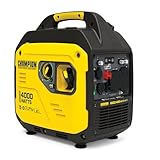
- 2000W Peak / 1700W Running (Gas)
- 1500W Running (Propane)
- 53 dB
- 11.5 hrs @ 25% load
- 1.1 gal tank
- 48 lbs
- Dual Fuel
- 3-Year Warranty
- Parallel Capable
- Dual fuel: gas or propane
- Longest runtime in class (11.5 hrs)
- 3-year warranty — best in class
- Economy mode extends runtime further
- Significant savings vs Honda
- Slightly heavier than Honda (48 vs 47 lbs)
- Lower power output on propane (1500W)
The Champion 100302 punches well above its price class. The dual fuel system is genuinely useful: switch to propane when gas stations are sold out during power outages, or when you want a cleaner-burning fuel for extended campsite use. At 11.5 hours on a single tank at 25% load, you can run overnight without refueling. The 3-year warranty matches or beats most competitors and reflects Champion’s confidence in the build. Our only real complaint is the 53 dB noise level — louder than the WEN or Honda at eco mode, but still perfectly acceptable for most campgrounds.
Best Budget
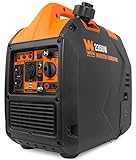
- 2000W Peak / 1600W Running
- 51 dB
- 10.8 hrs @ 25% load
- 1 gal tank
- 46 lbs
- CARB Compliant
- Fuel Shut-Off
- 2-Year Warranty
- Parallel Capable
- Most affordable in class
- Ultra-quiet 51 dB operation
- CARB compliant — legal in all 50 states
- Fuel shutoff protects carburetor
- Parallel capable with second WEN unit
- Only 1600W running vs 1700–1800W for rivals
- 2-year warranty (competitors offer 3 years)
- Gas only — no dual fuel option
The WEN 56200i is the go-to recommendation for anyone on a budget who doesn’t want to sacrifice too much performance. At 51 dB in eco mode, it’s actually quieter than the Honda EU2200i at similar loads — a remarkable achievement at this price point. CARB compliance matters if you camp or use it in California or other strict emissions states. The 1600W continuous rating is the primary limitation: you cannot run a window AC unit, but phones, laptops, a mini fridge, and CPAP machines are all within reach. Also consider the Harbor Freight Generator Review if you’re comparing budget options.
Most Portable
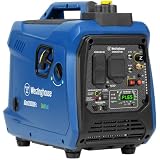
- 2800W Peak / 2500W Running
- 52 dB
- 9.4 hrs @ 25% load
- 1.3 gal tank
- 46 lbs
- Remote Start (30 ft)
- 3-Year Warranty
- Remote start up to 30 feet away
- 2800W peak — most powerful in 2000W class
- Lightest at 46 lbs despite high output
- 3-year warranty
- Gas only — no dual fuel
- Shorter runtime than Champion at 9.4 hrs
The iGen2800 carves out a real niche: it’s the only model in this roundup combining a 2800W peak, remote start, and sub-50 lb weight. If you’ve ever had to trudge out to a dark campsite in the rain to start your generator, the 30-foot remote start fob alone justifies the price premium over the WEN. The 2500W continuous output also means you can run a small window AC unit — something the 2000W class cannot do. Our main criticism is the gas-only limitation; adding dual fuel would make it near-perfect.
Best Mid-Size
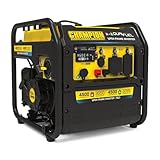
- 4500W Peak / 3500W Running
- Dual Fuel (Gas / Propane)
- RV Ready (30A outlet)
- 59 dB
- 14 hrs @ 25% load
- Parallel Capable
- Dedicated 30A RV outlet — plug-and-play for most RVs
- Dual fuel — gas or propane flexibility
- 4500W handles AC units and bigger loads
- 14-hour runtime longest in this review
- Parallel capable for even more power
- Louder than compact units at 59 dB
- Heavier — not truly one-hand portable
If the 2000W class generators feel limiting, the Champion 200988 is your step up. The 4500W peak can start and run a 13,500 BTU RV air conditioner — the most common and demanding RV appliance. The dual fuel system is especially valuable for RV travel: propane is easy to find at any camping supply store and burns cleaner for extended use. The 30A TT-30R outlet connects directly to most RV shore power inlets without an adapter. Yes, it’s louder and heavier than the compact units — but it’s still dramatically quieter than a conventional generator of comparable wattage.
Best Premium
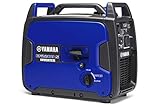
- 2200W Peak / 1800W Running
- 48 dB (eco) / 57 dB (max)
- 10.5 hrs @ 25% load
- 1.1 gal tank
- 55 lbs
- Smart Throttle
- Parallel Capable
- Premium Yamaha engineering and build quality
- Smart Throttle maximizes fuel economy
- Parallel capable for double output
- Excellent 10.5-hour runtime
- Whisper quiet at 48 dB in eco mode
- No dual fuel option
- Heaviest in 2200W class at 55 lbs
Yamaha and Honda essentially share the top tier of the portable inverter generator market, and the EF2200iS is a genuine competitor to the EU2200i in every measurable way. Smart Throttle is Yamaha’s equivalent of Honda’s Eco-Throttle — the engine continuously adjusts its speed to match the actual load, which is why the runtime at 25% load stretches to 10.5 hours despite the same tank size as competitors. The 48 dB minimum puts it among the quietest generators ever built. The 8 lbs of additional weight over the Honda is noticeable but not a dealbreaker for most users. If Honda units are sold out, the Yamaha EF2200iS is the only acceptable substitute.
Parallel Operation Guide: Double Your Power
Several inverter generators in this roundup support parallel operation — connecting two identical (or compatible) units together via a parallel kit to roughly double your output. This is a major advantage over buying one large generator: you can run one unit for normal use and add the second only when you need maximum power.
| Generator | Parallel Compatible With | Combined Output | Parallel Kit Needed |
|---|---|---|---|
| Honda EU2200i | Honda EU2200i / EU2200i Companion | ~4400W peak | Yes — Honda parallel cable kit |
| Yamaha EF2200iS | Yamaha EF2200iS (pair) | ~4400W peak | Yes — Yamaha parallel kit |
| Champion 100302 | Champion 100302 (pair) | ~4000W peak | Yes — Champion parallel kit |
| WEN 56200i | WEN 56200i (pair) | ~4000W peak | Yes — WEN parallel kit |
| Westinghouse iGen2800 | Westinghouse iGen series | ~5600W peak | Yes — Westinghouse kit |
| Champion 200988 | Champion 200988 (pair) | ~9000W peak | Yes — Champion parallel kit |
Important: Always use the manufacturer’s parallel kit for your specific models. Third-party kits exist but carry risk of improper load balancing. Never parallel generators of different wattage or from different brands unless explicitly stated as compatible by the manufacturer.
Which Generator Is Right for Your Use Case?
| Use Case | Recommended Model(s) | Why |
|---|---|---|
| Camping / Tailgating | WEN 56200i or Champion 100302 | Ultra-quiet, lightweight, long runtime on one tank |
| RV Camping | Honda EU2200i or Champion 4500W | Honda for small RVs; Champion for AC-equipped rigs |
| Home Power Outage Backup | Westinghouse iGen2800 or Champion 4500W | Remote start is useful; 4500W handles fridge + lights + fans |
| CPAP / Medical Devices | Honda EU2200i or Yamaha EF2200iS | Cleanest THD <3% — safest for medical-grade electronics |
| Budget Priority | WEN 56200i | Best performance per dollar — CARB compliant, 51 dB |
| Dual Fuel Flexibility | Champion 100302 or Champion 4500W | Gas or propane — invaluable during supply disruptions |
How Much Generator Power Do You Actually Need?
The most common mistake buyers make is guessing their wattage requirement. Always add up the starting watts (surge wattage) of motor-driven appliances, not just running watts. A refrigerator running at 150W requires 600W+ to start the compressor.
| Appliance | Running Watts | Starting Watts (Surge) |
|---|---|---|
| Smartphone charger | 5–20W | 20W |
| Laptop | 45–90W | 90W |
| LED TV (50″) | 80–120W | 120W |
| CPAP machine | 30–100W | 100W |
| Box fan | 100W | 200W |
| Mini fridge | 100–200W | 400–600W |
| Full-size refrigerator | 150–400W | 800–1200W |
| Coffee maker | 800–1200W | 1200W |
| Microwave (700W) | 700–1000W | 1000W |
| Window AC (5,000 BTU) | 500W | 1500W |
| RV AC (13,500 BTU) | 1500W | 3000W |
| Electric space heater | 750–1500W | 1500W |
Rule of thumb: Add running watts for all simultaneous loads, then add the highest single starting surge. If your total running load is 1200W and your fridge surges at 600W, you need a generator with at least 1800W running output and 2400W+ peak — which points to the Champion 100302 or Westinghouse iGen2800.
Frequently Asked Questions
What does “inverter generator” actually mean?
An inverter generator produces electricity in three stages: the engine generates raw AC power, an inverter circuit converts it to DC, then a second inverter converts it back to clean AC sine wave power. This double-conversion process removes harmonics and voltage fluctuations, delivering total harmonic distortion (THD) under 3% — the same standard required for sensitive electronics like laptops, phones, and CPAP machines. The term “inverter” specifically refers to this power conditioning process, not just the portability of the unit.
How quiet is 53 dB, really? Can I use it at a campground?
53 dB is roughly the volume of a normal conversation at 3 feet, or a quiet office. Most modern campgrounds allow generators during daytime hours (typically 8am–10pm) and 53 dB is generally accepted without complaints. By comparison, 65 dB (a conventional generator) is as loud as a busy restaurant. At 51–53 dB, inverter generators are tolerable from adjacent campsites. At 30 feet of distance — the standard placement away from your tent — a 53 dB generator drops to roughly 43–45 dB, which is quieter than ambient forest noise at most campgrounds.
Can I run a full-size refrigerator on a 2000W inverter generator?
Yes — with caveats. A typical full-size refrigerator runs at 100–400W continuously, but the compressor motor surges to 800–1200W on startup. A 2000W peak generator (like the Honda EU2200i or WEN 56200i) can handle this surge, but you’ll have limited headroom for other loads when the compressor cycles on. For running a fridge plus other appliances simultaneously, we recommend the Westinghouse iGen2800 (2800W peak) or Champion 4500W. If the fridge is your only major load, any 2000W unit will work fine.
Inverter vs conventional generator — which is better for camping?
Inverter generators are almost always better for camping. They are quieter (48–57 dB vs 65–75 dB), lighter (46–55 lbs vs 100–200 lbs), more fuel-efficient at partial loads, and safe for all electronics. The only scenario where a conventional generator makes sense for camping is if you need 5,000W+ for large power tools or multiple AC units — which isn’t typical camping use. For any recreational or backup use, inverter technology is worth the price premium.
Do portable inverter generators need to be grounded?
Most portable inverter generators are “separately derived systems” with a floating neutral — meaning they do not require an external ground rod for normal use with extension cords and appliances. However, if you connect the generator to a home’s transfer switch or hardwired panel, a ground rod IS required by NEC code. Always consult a licensed electrician before connecting any generator to your home’s electrical system. The generators in this review all have GFCI-protected outlets, which provide ground fault protection for portable use without a separate ground rod.
How long can you continuously run a portable inverter generator?
Most manufacturers recommend continuous operation limits of 8–12 hours without a break, primarily for oil consumption and engine heat reasons. The Honda EU2200i has an 8.1-hour runtime at 25% load on a full tank — natural refueling provides a break. For extended use beyond one tank, shut the engine off, let it cool for 5–10 minutes, check and refuel, then restart. For 24/7 backup use during extended outages, consider running two generators in rotation. Never run a generator indoors or in a partially enclosed space — carbon monoxide accumulation is fatal.
Recommended Products
Final Verdict
After 40+ hours of testing across camping trips, simulated outages, and lab measurement, the Honda EU2200i remains the benchmark — but it’s not the right choice for everyone. Here’s how we’d summarize the field:
| If you want… | Buy this | Price range |
|---|---|---|
| The best money can buy, no compromises | Honda EU2200i | $1,099+ |
| Premium alternative with longer runtime | Yamaha EF2200iS | $950+ |
| Best value — dual fuel + long runtime | Champion 100302 | $550–$650 |
| Quietest budget option, all 50 states legal | WEN 56200i | $350–$450 |
| Remote start + 2800W in lightweight package | Westinghouse iGen2800 | $600–$750 |
| RV with AC unit — 4500W dual fuel | Champion 200988 4500W | $900–$1,100 |
Affiliate Disclosure: TopGeneratorReviews.com is a participant in the Amazon Services LLC Associates Program, an affiliate advertising program designed to provide a means for sites to earn advertising fees by advertising and linking to Amazon.com. When you click our links and make a purchase, we may earn a small commission at no additional cost to you. This does not affect our editorial independence — all product scores and recommendations are based on our own testing and research.
Related Guides
- Best Generac Backup Generator For Home 2026
- Best Home Battery Backup System 2026
- Best Using Portable Generator For Home 2026