
Battery backup generators, more accurately called portable power stations, have changed what a home power outage looks like. Instead of dragging a gas unit outside, priming it, and running an extension cord through a cracked window, you flip a switch on a silent lithium box that already sits charged in the closet. In 2026 these stations span from a 192Wh unit that keeps phones and a router alive to a 2,010Wh home-backup powerhouse with a 3,000-watt surge, and the best part is they run indoors with zero fumes.
The trade-off is finite capacity: a battery only holds what it holds, so the game is matching watt-hours to the loads you truly need during a blackout. Below are our top picks across the range, followed by a buying framework so you can size a station to your household rather than overpaying for capacity you will never drain.
As an Amazon Associate we earn from qualifying purchases at no extra cost to you.




⚡ Save on Your Next PC — Amazon Prime
Prime members get fast free shipping on the systems above, plus early access to Prime Day & Black Friday PC deals. New members get a 30-day free trial.
Watch: Best Battery Backup Generators for Power Outages — Video Review
How to Choose
- Capacity in watt-hours: This is your reserve tank. Estimate the loads you must keep running (fridge, lights, medical devices) and how many hours you need, then pick a station with 20-30% more than that total.
- Output and surge rating: A 300W station covers electronics; a fridge or space heater needs 1,000-1,800W continuous with headroom for startup surges up to 3,000W.
- Battery chemistry: LiFePO4 is the standard to look for, delivering 3,000+ cycles and better heat tolerance than older lithium-ion, so it survives years of occasional outage duty.
- Recharge options: Look for fast AC charging plus solar input so you can top up during an extended multi-day outage rather than being stuck once empty.
- UPS pass-through: A true UPS mode switches over in milliseconds, protecting a desktop or router from any interruption when grid power drops.
The Best Picks Reviewed
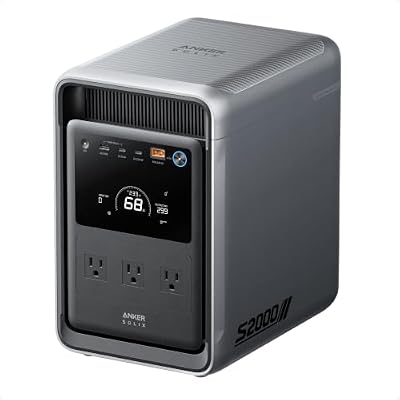
Anker SOLIX S2000 Portable Power Station
With 2,010Wh of storage and a 3,000-watt peak, the SOLIX S2000 is the pick for whole-essentials backup. It can run a full-size fridge, lights, and a laptop for the better part of a day, and its expandable design and fast recharge make it the anchor of a serious home-backup plan for those who lose power often.
Jackery Explorer 1000 v2 Portable Power Station
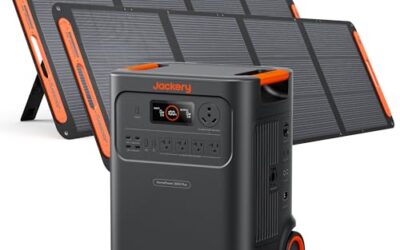
The 1,070Wh Explorer 1000 v2 delivers 1,500W continuous in a package light enough to carry room to room. It comfortably runs a refrigerator through its cycles for 10 or more hours, and Jackery’s reputation for reliable battery management makes it an easy mainstream recommendation for typical households.
Anker SOLIX C1000 Portable Power Station
At 1,056Wh and 1,800W, the C1000 splits the difference between the big S2000 and the mid-size crowd. Its rapid charging refills the battery in about an hour from the wall, which is a genuine advantage when you get a brief window of restored power and want to bank it before the next dip.
Jackery Explorer 300 Portable Power Station
This 292Wh station is the budget-friendly essential for keeping communication alive: phones, a laptop, a Wi-Fi router, and LED lights through a shorter outage. It is small, light, and simple, making it the ideal first battery backup for renters or anyone who only needs to bridge brief interruptions.
LIBRIDS Portable Power Station 640Wh
The LIBRIDS 640Wh offers a 1,200W surge and four AC outlets at a value price, landing squarely in the middle of the field. It is enough to run a mini-fridge or a CPAP overnight while charging several devices, making it a versatile mid-capacity choice for households that want more than phone power without stepping up to a large station.
Frequently Asked Questions
How long will a battery generator power my fridge?
A 1,000Wh LiFePO4 station typically runs an efficient full-size refrigerator for 10-15 hours because the compressor only cycles part of the time. A 2,000Wh unit like the SOLIX S2000 roughly doubles that, and a mini-fridge stretches runtimes even further.
Can I recharge one during an outage?
Yes, that is the key to multi-day resilience. Pair the station with a solar panel to harvest daylight, or top up quickly whenever grid power flickers back. Fast-charging models can bank a full charge in about an hour of restored power.
Are these safe to use indoors?
Completely. Unlike gas generators, battery stations produce no exhaust and no carbon monoxide, so they are designed to sit and run inside your home. That safety is the single biggest reason they have overtaken small gas units for outage backup.
What size do I actually need?
Add up the watt-hours of your must-run loads over the hours you expect to be without power. Phones and a router might need only 200-400Wh; a fridge plus lights over a long night can demand 1,500Wh or more. Buy the smallest unit that clears that total with a cushion.
Final Thoughts
For households that lose power regularly and want to keep a fridge and essentials alive, the Anker SOLIX S2000 is the confident top pick. The Jackery Explorer 1000 v2 and Anker SOLIX C1000 serve the mainstream sweet spot, while the Explorer 300 and LIBRIDS 640Wh keep communication and small loads running on a budget. Size to your real loads, insist on LiFePO4, and add a solar panel if outages in your area stretch past a day.
Top picks from this guide
 JackeryJackery Explorer 300 Portable Power Station,292Wh$239 \xc2\xb7 99/100
 AnkerAnker SOLIX S2000 Portable Power Station, 2,010Wh, 1,500W$650 \xc2\xb7 99/100
 GRECELLPortable Power Station 500W, 519.48Wh/140400mAh Solar Generator Backup$180 \xc2\xb7 99/100
 JackeryJackery Explorer 1000 v2 Portable Power Station,1070Wh,1500W$469 \xc2\xb7 98/100

Write Your Review
No reviews yet. Be the first to share your experience!