
Short answer: Predator is Harbor Freight’s in-house generator brand, and it is genuinely good value. The small inverters are quiet enough for a campsite, the open-frame units are stout enough for home backup, and pricing usually lands well under Honda. The trade-offs are extra weight, thinner dealer support, and less consistent quality control.
- Harbor Freight Predator generator reviews: what the line actually is
- Predator model comparison
- What you want to run, and the watts you need
- Safety: the four rules that matter more than any spec
- Predator vs Honda, Champion, Westinghouse and Generac
- Pricing, warranty and parts
- What commonly goes wrong
- Frequently Asked Questions

Read this before you start any generator: engine exhaust contains carbon monoxide, an odorless gas that kills people in their sleep every storm season. Never run a generator indoors, in a garage (even with the door open), in a carport, in a shed, on a porch, or within 20 feet of any window, door, or vent. Point the exhaust away from the house. A generator that is “just outside the door” is still deadly.
Quick answer: Our top pick in 2026 is the 2,000W inverter — our #1 rated choice. See the full ranked comparison, alternatives and buying advice below.
Harbor Freight Predator generator reviews: what the line actually is
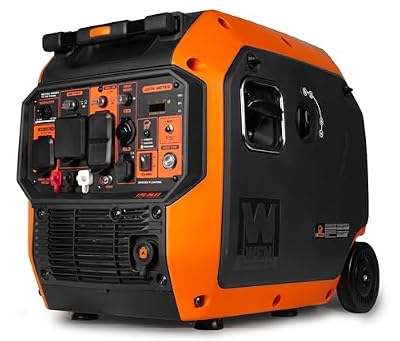
Predator is a house brand, not a factory. Harbor Freight specs the units, has contract manufacturers build them, and sells them without dealer-network markup. That is where the savings and the compromises both come from: engines are clones of proven Honda GX-family designs, castings are heavier, and finish sits a step below the Japanese brands. In exchange you pay a fraction of the price and can buy parts over a counter.
The line splits into four practical tiers, and knowing which tier you are shopping is more than half the decision — see our guide to sizing a generator correctly before you commit to a wattage.
Small inverters: camping, tailgating, job-site tools
The 2,000-watt-class inverter is the one you carry with one hand: roughly 1,600 running watts with a 2,000-watt surge, under 50 lb, quiet enough to talk over. It runs lights, a fan, a laptop, a small fridge, or a coffee maker — one at a time. This is a convenience generator, not a backup generator.
Mid inverters: RV use and the sweet spot
The 3,500-watt-class inverter is the most-recommended Predator for good reason: around 3,000 running watts, electric start, a 30-amp RV outlet on most versions, and long runtimes at part load. It starts and holds a 13,500 BTU rooftop air conditioner, the exact test most RV buyers care about. The 5,000-watt inverter adds headroom for a 15,000 BTU unit plus a residential fridge, at a real weight penalty. Both are inverter generators — clean sine-wave power that is safe for electronics, and variable engine speed that saves fuel.
Big open-frame units: home backup
Past roughly 7,000 running watts you are in open-frame territory: steel roll cage, never-flat wheels, a large engine, and a 240-volt outlet. These are loud, heavy, thirsty machines built to keep a well pump, furnace blower, fridge, and freezer alive through an outage. They are not campsite-friendly and nobody should buy one for an RV. If backup is your goal, read our notes on running a house on a portable generator first.
Dual-fuel and tri-fuel
Several Predator models ship as dual-fuel (gasoline plus propane), and tri-fuel variants add natural gas. Propane is the reason to buy one: it stores indefinitely without stabilizer, it will not gum a carburetor, and it burns cleaner. The cost is output — expect roughly 10% less wattage on propane than gasoline, and a little less again on natural gas. For a generator that sits unused eleven months a year, dual fuel earns its upcharge on storage reliability alone.
Predator model comparison
Figures are manufacturer-rated and rounded; Harbor Freight revises SKUs regularly, so confirm the spec sticker on the unit you are buying. Prices move with promotions and are not listed here for that reason.
| Class | Running / starting watts | Type | Noise (rated, ~23 ft) | Weight | Parallel? | Best for |
|---|---|---|---|---|---|---|
| 2,000W inverter | ~1,600 / 2,000 | Inverter, recoil | Low 50s dB | ~45–50 lb | Yes, with kit | Camping, tailgating, CPAP, tools |
| 3,500W inverter | ~3,000 / 3,500 | Inverter, electric start | Upper 50s dB | ~100 lb | Model-dependent | RV with 13.5k BTU A/C, partial backup |
| 5,000W inverter | ~4,500 / 5,000 | Inverter, electric start | Around 60 dB | ~110–130 lb | Model-dependent | Big RV, quiet home essentials |
| 9,000–9,500W | ~7,250–7,600 / 9,000–9,500 | Open frame or large inverter | Upper 60s–70s dB | ~200–260 lb | No | Home backup with 240V loads |
| 13,000W dual fuel | ~11,000 / 13,000 (gas) | Open frame, electric start | 70s dB | ~250 lb+ | No | Well pump, HVAC, large homes |
Noise is rated at roughly 23 feet at partial load, which is why a “57 dB” generator sounds nothing like 57 dB ten feet from your tent under full load — see our breakdown of generator noise levels.
What you want to run, and the watts you need
Add the running watts of everything that will be on at once, then add the largest single starting surge. Motors — compressors, pumps, air conditioners — pull two to three times their running wattage for a second at startup, and that spike trips generators that looked big enough on paper.
| What you want to run | Running watts (typical) | Starting surge | Generator class that covers it |
|---|---|---|---|
| Phone, laptop, LED lights, CPAP | 150–400 | None | 2,000W inverter |
| Full-size refrigerator | 150–800 | 1,200–2,200 | 2,000W inverter (alone) |
| 13,500 BTU RV air conditioner | 1,300–1,800 | 2,800–3,500 | 3,500W inverter |
| 15,000 BTU RV air conditioner + fridge | 2,200–2,800 | 4,000+ | 5,000W inverter |
| Furnace blower + fridge + lights + Wi-Fi | 1,500–2,500 | 3,000–4,000 | 3,500–5,000W inverter |
| Above, plus 240V well pump (1/2–1 HP) | 3,500–5,500 | 7,000–9,000 | 9,000W+ open frame |
| Most of a house, incl. central A/C | 7,000–10,000 | 12,000+ | 13,000W dual fuel or standby |
One caution on runtime: quoted hours assume 25% or 50% load, and running near the ceiling can halve them. Plan fuel accordingly and store it properly — stale gasoline is the most common reason a stored generator will not start, as covered in our generator maintenance checklist.
Safety: the four rules that matter more than any spec
1. Carbon monoxide. Run the generator outdoors only, at least 20 feet from the house, with the exhaust pointed away from every window, door, and vent. Garages, carports, basements, crawlspaces, sheds, and screened porches are all indoors for this purpose. Install battery-backed CO alarms inside the home on every level. Many newer Predator models include a CO shutoff sensor that kills the engine when it detects a dangerous buildup — buy one that has it, but treat it as a backstop, never as permission to run the unit closer to the house.
2. Never backfeed. Do not plug a generator into a dryer outlet or any wall receptacle with a double-male cord to energize your house wiring. It electrocutes utility linemen, it can kill people in your own home, it bypasses every overcurrent protection in the panel, and it is illegal almost everywhere. The correct answer is a manual transfer switch or interlock kit installed by a licensed electrician. Until that is installed, run appliances on heavy-gauge outdoor-rated extension cords instead.
3. Refuel cold. Shut the engine off and let it cool before adding fuel. Gasoline spilled on a hot muffler ignites instantly. Keep fuel cans well away from the running unit.
4. Keep it dry and grounded. Operate on a dry, level surface under an open-sided generator tent if it is raining — never inside an enclosure. Do not touch the unit with wet hands, and follow the manual’s grounding instructions for your setup.
Predator vs Honda, Champion, Westinghouse and Generac
This is the question buyers are really asking, so here is the blunt version.
vs Honda: Honda’s EU-series inverters are quieter, lighter, smoother, and more reliable across a decade, and cost two to three times as much. If the machine runs hundreds of hours a year, or the noise floor genuinely matters, Honda earns its premium. For forty hours a year, it is hard to justify.
vs Champion: The closest competitor. Champion wins on dual-fuel breadth, remote start availability, and a well-developed online parts operation. Predator wins on walk-in availability — you can have a replacement in your truck the same afternoon — and on the return counter. Performance is close enough that price and availability usually decide it.
vs Westinghouse: Westinghouse competes hard on watts per dollar and often edges Predator on features at the same output, but support is mail-in rather than over a counter, which matters most when something fails mid-outage.
vs Generac: Generac’s portables are respectable but rarely the value leader; the brand’s real strength is permanently installed standby systems with automatic transfer. That is a different product solving a different problem — weigh it against a portable using our portable versus standby comparison.
Pricing, warranty and parts
Predator pricing moves constantly with sales and coupons, so treat any figure quoted online as a snapshot and check current pricing before you shop. The positioning is stable even when the numbers are not: well below Honda at the same output, close to Champion and Westinghouse, and lower still during promotions ahead of storm season. Warranties are shorter than the premium brands and vary by model, so read the card in the box. Parts partly offset that — Harbor Freight stocks common carburetors, recoils, and filters.
What commonly goes wrong
Three failure patterns dominate owner complaints, two of them user-caused. First, carburetor gumming from stored gasoline — stabilize the fuel, run the carb dry, or buy dual fuel and store on propane. Second, overload trips from ignoring startup surge; size for the surge. Third, unit-to-unit variance — a small share arrive defective. Test yours under load inside the return window, and do the break-in oil change before you depend on it.
Frequently Asked Questions
Are Harbor Freight Predator generators any good?
Yes, for most buyers they are strong value. The inverters produce clean sine-wave power safe for electronics, the open-frame units are built heavily enough for storm backup, and the clone engine design is well understood by mechanics. They are louder and heavier than premium equivalents, warranties are shorter, and quality control is more variable, so test any new unit under load inside the return window.
Which Predator generator is best for an RV?
The 3,500-watt-class inverter is the standard recommendation: it reliably starts and holds a 13,500 BTU rooftop air conditioner while running a fridge and lights, and usually includes a 30-amp RV outlet and electric start. With a 15,000 BTU air conditioner, a residential refrigerator, or a second roof unit, step up to the 5,000-watt inverter and accept the extra bulk.
Can I plug a Predator generator into my house?
Only through a manual transfer switch or interlock kit installed by a licensed electrician. Never use a double-male cord into a dryer outlet or wall receptacle. That practice, backfeeding, pushes current onto utility lines where it can electrocute line workers, bypasses your panel’s overcurrent protection, and violates code almost everywhere. Until a transfer switch is installed, run heavy outdoor-rated cords to individual appliances.
How far from the house does a generator need to be?
At least 20 feet, with the exhaust aimed away from the building and clear of every window, door, vent, and air intake. Carbon monoxide is odorless and accumulates fast in any partly enclosed space, so open garages, carports, screened porches, and sheds are all unsafe. Install battery-backed CO alarms on every level, and prefer a model with a CO shutoff sensor.
How much do generators cost at Harbor Freight?
Prices span a wide range from small carry-handle inverters to large dual-fuel open-frame units, and they change constantly with coupons, seasonal promotions, and model revisions, so check current pricing rather than trusting an older quoted figure. What stays consistent is the positioning: Predator undercuts Honda substantially and sits close to Champion and Westinghouse at comparable output.
Ready to decide? Our #1 pick for 2026 is the 2,000W inverter.
Live price & availability on Amazon.
Top picks from this guide
AIVOLTAIVOLT 1600W Super Quiet Inverter Generator 28lbs Portable for Camping$329 \xc2\xb7 99/100 SIOKIUUSIOKIUU 2500W Portable Generator Super Quiet Inverter Generator Ultra Lightweight…$308 \xc2\xb7 97/100
 OxserynOxseryn Power Equipment 4400 Watts Inverter Generator Gas Powered, Portable…$310 \xc2\xb7 95/100
 POXURIOPOXURIO 2550-Watt Portable Inverter Generator for Home Use, 1.06Gallon Large…$350 \xc2\xb7 95/100








Write Your Review
No reviews yet. Be the first to share your experience!