
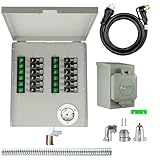
- Top Pick: VEVOR Manual Transfer Switch, 50-Amp 10-Circuit, Prewired Generator Transfer Switch Kit with CS6375 Plug Power Inlet Box, Double-Throw Switch, NEMA 3R, Mechanical Watt Meter, for 12500W Generators
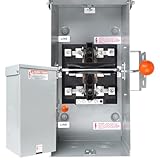
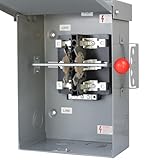
- Best Value: MUJURUR 100A Generator Transfer Switch, 24000W Heavy Duty Double Throw Safety Switch, 120/240V Manual Transfer Switch, Stronger Stability, Enlarged NEMA 3R Enclosure for Outdoor, 10-Year Warranty
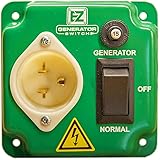
- Premium Choice: EZ GENERATOR SWITCH – The Original, Patented, UL/CSA Approved Manual Transfer Switch – Made in the USA
🛒 Best Price Today on Amazon
Prime members get fast, free shipping on everything above, plus member-only deals. New members get a 30-day free trial — cancel anytime.
- Top Generator Transfer Switches Picks Reviewed Picks for 2026
- Recommended Products
- Why Backfeeding Without a Transfer Switch Can Kill
- Manual Transfer Switches: The Affordable Workhorse
- Automatic Transfer Switches and Interlock Alternatives
- Sizing, Inlets, and Getting the Install Right
- Frequently Asked Questions
- Related Articles
- Related Guides
Top Generator Transfer Switches Picks Reviewed Picks for 2026
Here are our current top generator transfer switches picks reviewed picks, compared on real Amazon owner reviews, price, and features. Live prices update below.
As an Amazon Associate we earn from qualifying purchases at no extra cost to you.



A transfer switch is the missing link between a generator and the circuits you actually care about, replacing the extension-cord spaghetti with one safe connection. It is also the only legal way to feed a generator into household wiring. This 2026 guide covers types, sizing, and what installation really involves.
Recommended Products

Champion 4500-Watt Portable Open Frame Inverter Generator

Jackery Explorer 2000 Plus Portable Power Station, 2042Wh, 3000W AC Output

EF ECOFLOW Portable Power Station DELTA 2 Max 2048Wh, 2400W LiFePO4 Battery
As an Amazon Associate we earn from qualifying purchases. Product prices and availability are accurate as of the date/time indicated.
Why Backfeeding Without a Transfer Switch Can Kill
Plugging a generator into a wall outlet with a double-male cord, the infamous suicide cord, energizes your home’s wiring and pushes current back through the meter into the utility line, where a transformer steps it up to thousands of volts. Line workers repairing what they believe is a dead line have been killed exactly this way, and the practice also bypasses every breaker protecting your generator. A transfer switch makes the dangerous state impossible by mechanically disconnecting utility power before generator power can flow. It is required by the National Electrical Code, insurers expect it, and no storm is worth improvising around it. Budget for the switch as part of the generator purchase, not an afterthought.
Manual Transfer Switches: The Affordable Workhorse
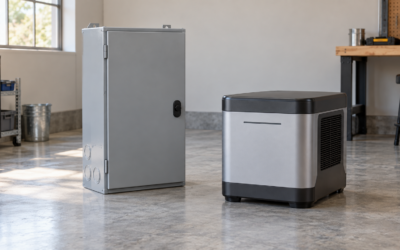
A manual transfer switch mounts beside your main panel and pre-wires 6 to 10 chosen circuits, typically the furnace fan, refrigerator, sump pump, well pump, some lights, and the kitchen outlets. When an outage hits, you roll out the generator, connect one heavy cord to the inlet box, start the engine, and flip each circuit from LINE to GEN. Wattmeters on the face help you balance loads so the generator is not overwhelmed. Installation by an electrician usually takes two to four hours. For households with portable generators in the 5,000 to 8,000W class, this remains the best value in backup power, converting chaos into a five-minute routine.
Automatic Transfer Switches and Interlock Alternatives
An automatic transfer switch monitors utility voltage and swaps to generator power without human hands, the standard arrangement for permanently installed standby generators that self-start. Whole-house ATS units, rated 100 to 200 amps in 2026, manage the entire panel and often include smart load-shedding that delays the AC compressor while the well pump runs. The budget-friendly middle path is an interlock kit: a sliding plate on your main panel that physically prevents the main breaker and the generator backfeed breaker from being on simultaneously. Interlocks cost a fraction of a full switch and let you choose any circuit in the house, at the cost of manual breaker management and discipline during the outage.
Sizing, Inlets, and Getting the Install Right
Match the transfer switch amperage to your generator’s output: a 30-amp switch handles up to 7,500 watts and suits most portables, while 50-amp hardware serves 12,500W machines and large hybrid setups. The outdoor inlet box must match both the cord and the generator outlet, with L14-30 the most common twist-lock standard. Hire a licensed electrician and pull the permit; inspectors check that neutral switching matches your generator’s bonding configuration, a detail that causes nuisance GFCI trips when botched. Once installed, run a full test under load each season, label every circuit clearly, and store the cord beside the inlet so nobody hunts for it in the dark.
Related guides on our site: Solar inverter: Maximize your home energy efficiency now · Generac portable generator: Power your life everywhere · Propane generator: A clean and efficient power source · Gas generator: Reliable power for your home and site · Best solar generator for home backup: Reliable energy.
Frequently Asked Questions
Can I install a transfer switch myself?
Unless you are a licensed electrician, no. The work happens inside your main panel, requires a permit in most jurisdictions, and mistakes endanger your family and utility workers.
What is the difference between a transfer switch and an interlock?
A transfer switch is a separate pre-wired sub-panel for selected circuits, while an interlock modifies your existing panel so the main and generator breakers cannot engage together.
What size transfer switch do I need for a 7,500-watt generator?
A 30-amp transfer switch matches generators up to about 7,500 running watts. Step up to 50-amp hardware only if your generator provides a 50-amp outlet.
Top picks from this guide
Champion Power EquipmentChampion 4500-Watt Portable Open Frame Inverter Generator$569 \xc2\xb7 98/100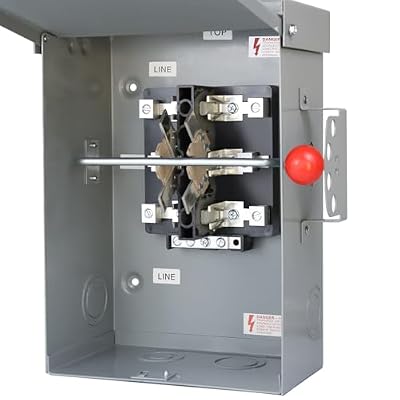 XMK100A Manual Transfer Switch for Generator,Manual Generator Transfer Switch$65 \xc2\xb7 98/100
 MUJURUR100A Generator Transfer Switch, 24000W Heavy Duty Double Throw Switch,…$78 \xc2\xb7 98/100JackeryJackery Explorer 2000 Plus Portable Power Station, 2042Wh, 3000W AC…$899 \xc2\xb7 96/100

Write Your Review
No reviews yet. Be the first to share your experience!