
🛒 Best Price Today on Amazon
Prime members get fast, free shipping on everything above, plus member-only deals. New members get a 30-day free trial — cancel anytime.
- Quick comparison of the leading Icom choices
- Our picks by operating situation
- Icom IC-7300: the best all-round HF transceiver
- Icom IC-705: the portable specialist
- Icom IC-7100: practical when the control head must move
- Icom IC-7610: the better head-to-head choice for serious HF work
- Icom IC-7760: choose power only when the station can use it
- Digital modes, tuner limits and ownership costs
- Durability and common mistakes
- Final verdict
The best Icom HF all-band ham radio transceiver for most operators is the IC-7300, while the IC-705 is the better portable choice, the IC-7610 is the stronger contesting and two-receiver option, and the IC-7760 is aimed at high-power stations that can justify a premium system.
Quick comparison of the leading Icom choices
| Model | Coverage | Maximum transmit power | Internal tuner | Approx. size and weight | Best suited to |
|---|---|---|---|---|---|
| Icom IC-705 | HF, 50, 144 and 430 MHz | 5 W from battery; up to 10 W from external DC | Optional AH-705; no built-in tuner | 200 × 83.5 × 82 mm; about 1.1 kg without battery | Portable, field and low-power operating |
| Icom IC-7300 | HF and 50 MHz | 100 W | Built-in automatic tuner | 240 × 95 × 238 mm; about 4.2 kg | Most home stations and first serious HF setup |
| Icom IC-7100 | HF, 50, 144 and 430 MHz | 100 W on HF/50 MHz; lower output on VHF/UHF | Built-in automatic tuner | Main unit about 167 × 58 × 180 mm; about 3.9 kg system weight | Mobile installations and operators wanting a remote control head |
| Icom IC-7610 | HF and 50 MHz | 100 W | Built-in automatic tuner | 340 × 116 × 300 mm; about 8.1 kg | Contesting, DXing and simultaneous-band monitoring |
| Icom IC-7760 | HF and 50 MHz | 200 W | Built-in automatic tuner | Check the current regional specification; substantially larger and heavier than the IC-7610 | Dedicated high-power stations |
Dimensions and regional specifications can vary slightly, particularly for power output, tuner behavior and included accessories. Confirm the current Icom manual before installation.

Icom IC-7100 HF/50/144/440 MHz Amateur Radio Mobile Transceiver D-Star Capable w/ Touch Screen - Original Icom USA Model
Included for 'Best Icom HF All-Band Ham Radio Transceivers' because the listing specifies Original Icom USA Model, details this guide uses to compare options.
View on Amazon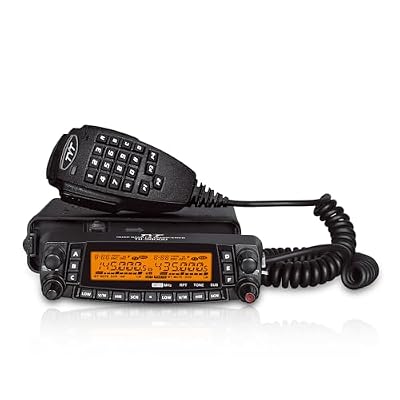
TH-9800D Quad Band 50W VHF 40W UHF Mobile Ham Radio Amateur Transceiver
Included for 'Best Icom HF All-Band Ham Radio Transceivers' as a relevant option in this category; details come from the product listing.
View on Amazon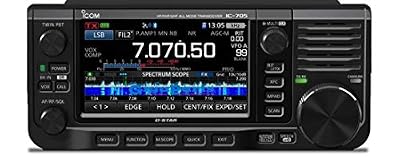
Icom IC-705 HF/VHF/UHF All Mode Portable QRP 5W/10W Transceiver
Included for 'Best Icom HF All-Band Ham Radio Transceivers' as a relevant option in this category; details come from the product listing.
View on Amazon
Icom IC-7300 100W HF/50MHz SDR Amateur Radio Transceiver Bundle (3 Items) with Samlex 30A 13.8VDC Switching Power Supply with Volt/Amp Meters and Ham Guides TM Quick Reference Card!!
Included for 'Best Icom HF All-Band Ham Radio Transceivers' as a relevant option in this category; details come from the product listing.
View on AmazonOur picks by operating situation
| Your situation | Best choice | Why |
|---|---|---|
| Limited budget and one primary HF radio | IC-7300 | 100 W, a useful internal tuner, a large touchscreen and a relatively compact desktop footprint |
| Hiking, travel or battery operation | IC-705 | Very low weight, internal battery support and HF through 70 cm coverage |
| Mobile or awkward operating position | IC-7100 | Remote control head and all-band coverage without needing separate VHF/UHF equipment |
| Contesting or serious DX work | IC-7610 | Dual-receiver architecture, two antenna connections and better operating ergonomics |
| Large antenna system and need for legal-limit-class output | IC-7760 | 200 W output and a station-oriented design, provided the power supply, antenna and local rules support it |
Icom IC-7300: the best all-round HF transceiver
The IC-7300 remains the easiest recommendation for a typical home operator. It covers the HF amateur bands plus 50 MHz, produces 100 W, and includes an automatic antenna tuner. Its direct-sampling receiver and spectrum display make it easier to see band activity than on a conventional small-screen radio.
The control layout is unusually approachable. Most everyday functions are available through the touchscreen, while the main tuning dial and dedicated physical controls remain easy to reach. This makes the IC-7300 suitable for a new HF licensee without making it frustrating for an experienced operator.
Its limitations matter. It is not a dual-receiver contest radio, and its internal tuner is not a substitute for a proper antenna match. The tuner can accommodate many moderately mismatched antennas, but it cannot correct an unsuitable feed line, poor grounding or an antenna that is far outside its design range. A separate external tuner may still be necessary.
For digital modes, the USB connection handles computer control and sound-card audio, reducing the need for a separate interface. Applications such as WSJT-X and fldigi still require correct operating-system audio routing, CAT settings and appropriate transmit levels.
Icom IC-705: the portable specialist
The IC-705 is the most flexible low-power model in this group. It covers HF, 50 MHz, 144 MHz and 430 MHz, includes a color touchscreen, and can operate from an internal battery or an external 13.8-volt supply. At roughly 1.1 kg before the battery, it is far easier to carry than a 100 W desktop transceiver.
The trade-off is output power. Five watts from the battery, or up to 10 W from external DC, can make contacts around the world, but success depends heavily on antenna efficiency, band conditions, operating time and patience. It is a poor choice if you expect a portable radio to perform like a 100 W base station.
The IC-705 does not include an internal antenna tuner. Icom’s AH-705 automatic tuner is a natural companion, but it adds cost, cables and another battery-management task. A resonant portable antenna can be simpler and lighter.
Its wireless and USB connectivity also make it attractive for digital-mode field operation. Before leaving home, configure the computer, test CAT control, charge the battery and confirm that the radio will not transmit accidentally when the software changes bands or modes.
Icom IC-7100: practical when the control head must move
The IC-7100 is distinctive because its control head separates from the main unit and uses a button-and-dial layout rather than the IC-7300’s large touchscreen. It covers HF through 70 cm, making it useful in a vehicle, a compact operating position or a station where the radio body must be mounted out of reach.
Its angled control head is a strength for mobile use, but some operators find the small display and multifunction controls less intuitive than the IC-7300. It is also an older design, so buyers should check availability, firmware support, connector condition and the included separation cables before purchasing.
For someone who needs one radio for HF, 6 meters, 2 meters and 70 cm, the IC-7100 can be more economical than buying separate equipment. It is not the best choice for a large desktop station focused mainly on spectrum visibility and contest ergonomics.
Icom IC-7610: the better head-to-head choice for serious HF work
Compared with the IC-7300, the IC-7610 is larger, heavier and considerably more expensive, but it provides a more capable operating environment. Its dual-receiver design allows an operator to monitor two frequencies or bands, while dual antenna connections and a larger display help during contesting and split-frequency DX operation.
The IC-7610 is still a 100 W radio, so it does not solve a weak-signal problem through transmit power. Its advantage is control: faster band awareness, more effective monitoring and fewer compromises when several stations are active. The physical controls are also better suited to long operating sessions than relying primarily on touchscreen menus.
For digital modes, the USB audio and CAT functions simplify computer integration. A station using multiple software packages should label virtual audio devices and keep a written record of baud rate, CI-V address, PTT method and transmit bandwidth. Many apparent radio faults are configuration conflicts rather than hardware failures.
Icom IC-7760: choose power only when the station can use it
The IC-7760 is designed for operators who specifically need 200 W on HF and 50 MHz. That additional output can provide a modest improvement at the other end of a difficult contact, but it does not compensate for a poor antenna, excessive feed-line loss or unfavorable propagation.
A high-power installation requires more than the transceiver. Allow for a suitable mains circuit, proper ventilation, low-loss coax, an antenna system rated for the duty cycle, and careful compliance with local power limits. Digital modes can create sustained carrier duty cycles that stress antennas and amplifiers more than casual SSB operation.
For most operators, the price difference is better spent on antenna improvements, a rotator, better coax or station grounding. The IC-7760 makes sense when those fundamentals are already in place.
Digital modes, tuner limits and ownership costs
All of these radios can support common computer-assisted modes, but their practical setup differs. The IC-7300, IC-7610 and IC-7760 are natural desktop digital-mode choices because they provide USB connectivity and 100 W or more. The IC-705 is excellent for portable FT8, JS8Call and similar work when battery capacity and transmit duty cycle are managed carefully.
A useful runtime estimate is:
runtime in hours = battery capacity in watt-hours × usable fraction ÷ average radio consumption in watts
For example, a 72 Wh battery used at an estimated 80% usable capacity provides about 57.6 Wh. If an IC-705 station averages 8 W over a mixed receive/transmit session, the theoretical runtime is 7.2 hours. Cold temperatures, USB accessories, battery aging and higher transmit duty cycles reduce that figure, so planning around five to six hours is more sensible than treating 7.2 hours as guaranteed.
For a home station, budget for a regulated power supply, coax, connectors, grounding hardware and an antenna system in addition to the radio. An internal tuner reduces setup complexity, but it does not eliminate the need for a sound antenna installation.
Durability and common mistakes
- Protect connectors: Repeatedly tightening coax, tuner and accessory plugs can damage sockets or cables. Support heavy coax instead of allowing it to hang from the radio.
- Prevent overheating: Keep ventilation openings clear and avoid enclosing a high-duty-cycle radio in a tight shelf.
- Use the correct supply: Desktop models generally expect a stable 13.8-volt supply with adequate current capacity. Voltage drop under transmit can cause resets or distorted output.
- Do not tune blindly: An automatic tuner may find a match at the radio end while substantial RF loss remains in the feed line.
- Check the antenna before digital transmission: FT8 and other modes can transmit repeatedly. Confirm frequency, power, audio level and antenna selection before leaving the station unattended.
- Keep firmware and configuration records: Save important settings before updates and record CI-V addresses and computer audio assignments.
Final verdict
Choose the IC-7300 for the strongest balance of price, power, tuner convenience and control layout. Choose the IC-705 when portability and all-band coverage matter more than output power. Choose the IC-7100 for a compact remote-head installation, the IC-7610 for serious two-frequency HF operation, and the IC-7760 only when a well-equipped station can make practical use of 200 W.








Write Your Review
No reviews yet. Be the first to share your experience!