
🛒 Best Price Today on Amazon
Prime members get fast, free shipping on everything above, plus member-only deals. New members get a 30-day free trial — cancel anytime.
Balanced pool water is not guesswork. Chlorine only sanitizes well inside a narrow pH window, alkalinity keeps that pH from drifting, calcium hardness decides whether water etches plaster or leaves scale, and cyanuric acid shields chlorine from sunlight. A good kit measures all of it, so doses follow numbers instead of hunches.
This guide compares five kits: a titration-based liquid benchmark, dip strips for daily checks, a digital photometer, a full kit built for saltwater pools, and a complete color-match kit with the full balance panel.
As an Amazon Associate, we earn from qualifying purchases.
Quick answer
Short on time? Pick the Taylor K-2006C for trustworthy numbers, if counting drops suits you. Pick the AquaChek Silver 7-Way strips for fast daily checks. Pick the LaMotte ColorQ Pro 7 if you dislike matching colors by eye. Saltwater owners should look at the Taylor K-2006-SALT, which adds a salt titration. The Taylor K-2005 covers the full panel with color matching instead of titration.
Taylor K-2006C Service Complete Test Kit
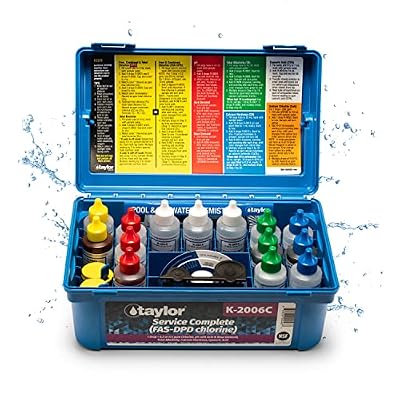
The K-2006C is the liquid reagent benchmark. Its chlorine test uses the FAS-DPD method: a scoop of DPD powder turns the sample pink, and you add the titrant one drop at a time until the pink clears. Each drop equals 0.2 ppm with a 25 mL sample, so the reading is a counted number rather than a shade judged by eye. It also reads combined chlorine, the spent sanitizer behind eye irritation, and stays accurate at levels that bleach out color-match kits.
pH uses a printed comparator; alkalinity, hardness and cyanuric acid use titration and turbidity tubes. The 2 oz bottles are service size, so a season of weekly panels will not empty them. The trade-offs are time and upkeep: a full panel takes several minutes, and reagents expire in about a year.
Specs
- Tests: free and total chlorine, bromine, pH, acid and base demand, total alkalinity, calcium hardness, cyanuric acid
- Chlorine method: FAS-DPD titration, 0.2 ppm per drop with a 25 mL sample
- Reagents: 2 oz bottles with printed expiry dates
- Reading: drop counting, plus a printed comparator for pH
- Extras: Watergram balance wheel, waterproof instructions, molded case
- Weight: 3.78 lb
AquaChek Silver 7-Way Test Strips

Strips trade precision for speed, and the AquaChek Silver is the strongest of that kind. Dip one strip, wait about 15 seconds, and match seven pads against the chart on the bottle: free chlorine, total chlorine, bromine, pH, alkalinity, hardness and cyanuric acid in under a minute.
Be honest about those numbers, though. Each pad reads in wide color blocks, so results land in bands rather than exact figures, and the cyanuric acid pad is the roughest of the seven. Strips also age badly in humidity: keep the cap sealed and the bottle dry. As a daily sanity check backed by a weekly liquid test, this is a sensible system. Used alone for fine balancing, it will eventually mislead you.
Specs
- Tests: free chlorine, total chlorine, bromine, pH, total alkalinity, total hardness, cyanuric acid
- Count: 100 strips per bottle
- Method: dip, wait about 15 seconds, match pads to the chart on the bottle
- Ranges: free chlorine 0-10 ppm, pH 6.2-8.4, cyanuric acid 0-300 ppm
- Shelf life: expiry printed on the bottle; store sealed and dry
LaMotte ColorQ Pro 7 Digital Pool Water Test Kit

The ColorQ Pro 7 removes the human eye from color matching. Fill a tube, add the reagent for the factor you want, and the handheld photometer shines light through the sample and prints the result as a number. Lighting, tired eyes and hard-to-split shades stop mattering, which is why pool shops lean on this style of reader. It covers seven factors, from chlorine and pH to hardness and cyanuric acid.
It is still wet chemistry underneath. Tubes must be clean, volumes consistent and reagents in date, or the digital number will be precisely wrong. The kit mixes LaMotte liquid reagents with TesTabs tablets. There is no salt test, and chlorine readings top out at the stated range. For frequent testers who hate squinting at pink blocks, it earns its place.
Specs
- Tests: free chlorine, total chlorine, bromine, pH, alkalinity, calcium hardness, cyanuric acid
- Method: handheld photometer reading liquid reagents and TesTabs tablets
- Ranges: chlorine 0-10 ppm, pH 6.5-8.5, alkalinity 0-250 ppm, calcium hardness 0-400 ppm, cyanuric acid 0-125 ppm
- Readout: digital numeric display, no color chart
- Refills: LaMotte liquid reagent and TesTabs packs
Taylor K-2006-SALT Complete Test Kit

Saltwater pools need one reading the other kits here cannot give: the salt level itself. A salt cell only makes chlorine inside a narrow band, commonly 2,700 to 3,400 ppm, and guessing wrong leaves it underproducing. The K-2006-SALT adds a chloride titration to the full Taylor panel: add silver nitrate reagent drop by drop until the sample turns a brick-red endpoint color. Each drop equals 200 ppm of salt, a counted figure rather than a strip estimate.
Everything else matches the K-2006 family. Chlorine is FAS-DPD titration at 0.2 ppm resolution, and pH, acid and base demand, alkalinity, hardness and cyanuric acid share the case. The bottles are 0.75 oz home size, so heavy testers refill the FAS-DPD powder and titrant first.
Specs
- Tests: free and combined chlorine, pH, acid and base demand, total alkalinity, calcium hardness, cyanuric acid, chloride (salt)
- Salt method: silver nitrate titration, one drop equals 200 ppm
- Chlorine method: FAS-DPD titration, 0.2 ppm resolution
- Reagents: 0.75 oz bottles with printed expiry dates
- Model: TTK2006SALT
Taylor K-2005 Complete DPD Test Kit

The K-2005 is the complete color-match kit. Thirteen reagents cover nine readings: free and total chlorine, bromine, pH, acid and base demand, total alkalinity, calcium hardness and cyanuric acid. Chlorine and pH are read by matching the pink DPD sample against a printed comparator block; alkalinity, hardness and cyanuric acid use titration and turbidity methods. For many owners this is the easiest full panel to learn.
The honest trade-off sits with that comparator. Color matching is only as good as your lighting and eyesight, the steps between blocks are wider than a titration count, and strong chlorine can bleach the DPD color and read low. That makes it mid-precision, not poor. For weekly balancing with the full panel in one case, it covers the whole job.
Specs
- Tests: free and total chlorine, bromine, pH, acid and base demand, total alkalinity, calcium hardness, cyanuric acid
- Chlorine method: DPD color matching on a high-range comparator
- Reagents: 13 reagents in 0.75 oz bottles
- Reading: printed comparator block, drop-count titration for alkalinity and hardness
- Case: molded storage case with instructions and balance guide
How to choose
Match the kit to your routine. Chlorine and pH move fast and deserve checks two or three times a week; alkalinity, hardness and cyanuric acid drift slowly and suit a weekly panel. If only something fast will get used, strips beat a liquid kit left in the cupboard. If you dose by the numbers, climb the accuracy ladder: titration first, photometer second, color matching third, strips last.
Plan around consumables. Liquid reagents last about a year and carry printed expiry dates. Strips die by humidity more than by age. Count the tests: 100 strips is 100 full checks, while liquid kits are measured in drops, and 2 oz bottles hold well over twice the reagent of 0.75 oz ones. Salt pool owners need a salt reading they trust: a chloride titration or a dedicated meter, not a strip estimate.
FAQ
How often should I test my pool water?
Check chlorine and pH two or three times a week in season; run the full panel weekly or after heavy rain and heavy use.
Why do strips and liquid kits disagree?
Strips read in wide color bands and fade as they age or absorb humidity, while titration counts drops to a sharp endpoint. When the two disagree, trust the liquid result and check the expiry dates on both.
When do reagents and strips go bad?
Most liquid reagents stay reliable for about a year; every bottle carries a printed date. Store kits cool, dark and dry, and replace anything past its date.
Can one kit handle a saltwater pool?
Any full kit reads chlorine, pH and the balance panel in a salt pool, but salt itself needs a chloride test. The K-2006-SALT includes it; the other kits here need a separate salt test.
Verdict
For accuracy above all, the Taylor K-2006C remains the benchmark liquid kit. For daily speed, the AquaChek Silver strips are the practical pick, and the LaMotte ColorQ Pro 7 suits anyone who wants a number without judging colors. Saltwater owners should go straight to the K-2006-SALT, while the Taylor K-2005 gives color-match fans the complete panel in one case.

Write Your Review
No reviews yet. Be the first to share your experience!