
🛒 Best Price Today on Amazon
Prime members get fast, free shipping on everything above, plus member-only deals. New members get a 30-day free trial — cancel anytime.
- Best Stair Runners: Durable Styles for Every Staircase
- Quick picks by staircase and household
- Runner materials compared head-to-head
- Width, pile height, and tread coverage
- Grip and installation: what actually keeps a runner safe
- Cleaning and durability realities
- How to calculate the right length
- Which installation method should you choose?
- Bottom line
Best Stair Runners: Durable Styles for Every Staircase
The best stair runners match your staircase width and traffic level first, then balance durable material, secure grip, manageable cleaning, and an installation method you can live with.
Quick picks by staircase and household
| Situation | Best runner choice | Why it fits | Typical market range |
|---|---|---|---|
| Busy family staircase | Solution-dyed nylon, 26–30 in wide, low pile | Resists crushing, hides moderate soil, and dries relatively quickly after cleaning | $150–$600 for runner material |
| Pets or frequent muddy shoes | Low-pile polypropylene or washable synthetic runner | Usually easier to spot-clean than natural fibers; choose a properly secured design | $100–$450 |
| Quiet, traditional interior | Wool, 24–27 in wide, dense low-to-medium pile | Resilient underfoot with a premium appearance and natural soil resistance | $300–$1,200+ |
| Narrow staircase | 22–24 in runner with 3–4 in exposed tread at each side | Preserves usable foothold without making the stair look crowded | $100–$500 |
| Renter or reversible installation | Thin runner with stair-rated rug pad and removable fastening system | Less permanent than tack strips or direct stapling, although it needs frequent inspection | $80–$350, excluding installation |
Runner materials compared head-to-head
Wool: best for long-term appearance
Wool is a strong choice when appearance, comfort, and longevity matter more than the lowest initial price. Its springy fibers recover better from compression than many inexpensive cut-pile synthetics, so the tread area is less likely to develop a permanently flattened path. Wool also tends to conceal small amounts of dust.
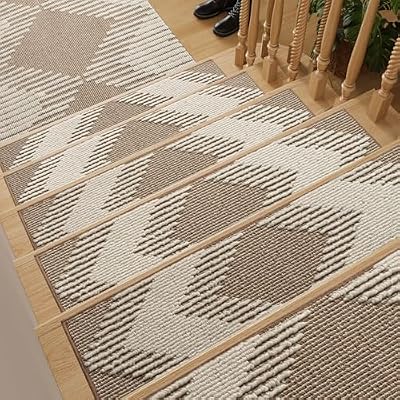
PADOOR 15 Pack Stair Treads Non Slip, 3D Peel and Stick Carpet Stair Treads for Wooden Steps Indoor, Washable Reusable Stair Runner Rugs for Dogs & Kids, Self Adhesive 8"x30" Brown
Included for 'Best Stair Runners: Durable Styles for Every Staircase' because the listing specifies Washable Reusable Stair Runner Rugs for Dogs & Kids and Self Adhesive 8"x30" Brown, details this guide uses to compare options.
View on Amazon
Stair Treads for Wooden Steps 15pcs 8x30in Non-Slip Stairs Carpet Runner
Included for 'Best Stair Runners: Durable Styles for Every Staircase' as a relevant option in this category; details come from the product listing.
View on Amazon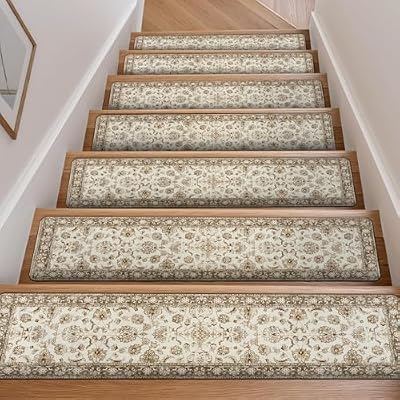
OJIA Vintage Stair Treads Non-Slip Stair Runners for Wooden Steps 15PCS
Included for 'Best Stair Runners: Durable Styles for Every Staircase' as a relevant option in this category; details come from the product listing.
View on Amazon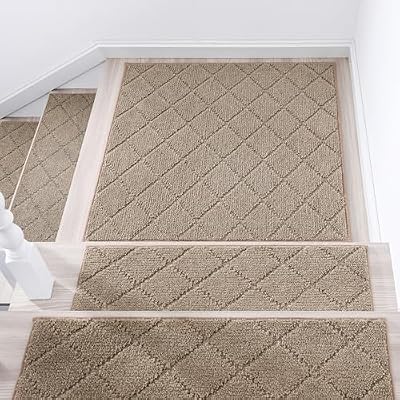
COSY HOMEER Edging Stair Treads Non-Slip Corner Indoor Stair Runner 30"x30"
Included for 'Best Stair Runners: Durable Styles for Every Staircase' as a relevant option in this category; details come from the product listing.
View on AmazonThe trade-offs are cost, possible shedding during the early ownership period, and more careful cleaning. Avoid saturating wool on the stairs; moisture can migrate into the backing and subfloor. Professional cleaning or low-moisture extraction is often the safer approach for major soil.
Nylon: best all-rounder for heavy traffic
Nylon is usually the most practical material for a main staircase used many times each day. It handles abrasion well, springs back from foot traffic, and is available in tightly woven, looped, and patterned constructions. Solution-dyed nylon is especially useful where spills, sunlight, or repeated cleaning are concerns because the color is integrated into the fiber rather than applied only at the surface.
Look for a dense, low pile rather than a tall plush style. A durable fiber can still look worn if a high pile compresses at the center of every tread.
Polypropylene: best for a lower-cost, easy-care runner
Polypropylene is often less expensive than wool or premium nylon and is commonly used in patterned indoor-outdoor-style rugs. It can be a sensible choice for a lightly to moderately used staircase, a temporary update, or a home where spot cleaning is a priority.
It generally has less resilience than nylon, so the pile may crush sooner on heavily used steps. Check that the backing is intended for indoor stairs and that the runner can be fastened securely; a low price does not compensate for a shifting rug.
Sisal, jute, and flatwoven natural fibers
Natural flatweaves provide texture and a tailored appearance, but they require more careful selection for stairs. Coarse fibers can feel rough under bare feet, and loose edges may catch on footwear. Jute in particular can be less forgiving of water and staining. If choosing a natural flatweave, favor a tightly constructed product with bound edges, a stable backing, and a low profile.
Width, pile height, and tread coverage
Most residential stair runners fall between 22 and 30 inches wide. Measure the usable tread from side to side, excluding any curved nosing or decorative molding. A common visual proportion leaves approximately 3 to 5 inches of exposed wood or flooring on both sides of the runner.
For example, a 36-inch-wide tread with a 26-inch runner leaves:
(36 − 26) ÷ 2 = 5 inches of exposed tread on each side.
That proportion gives a centered appearance while retaining a broad walking surface. On a 32-inch staircase, the same 26-inch runner leaves only 3 inches per side. A 22-inch runner would leave 5 inches per side, but it provides less central coverage.
Measure pile height separately from backing thickness. For stairs, a combined thickness of roughly 1/4 to 1/2 inch is usually easier to secure and less likely to interfere with doors, riser transitions, or the edge of the tread. Thick shag and plush runners can create a toe-catching lip at the stair nose.
Coverage is also a style decision. The waterfall method carries the runner over the front edge of each tread and down the riser. The Hollywood method wraps the runner tightly around the tread nose and attaches it at the tread-riser junction, creating a more tailored outline. Waterfall installation can suit patterned or casual runners; Hollywood installation emphasizes the stair shape but requires more accurate cutting and fastening.
Grip and installation: what actually keeps a runner safe
A non-slip backing alone is not a complete stair installation. Stairs generate forward and downward forces that can make a rug creep, especially at the nosing. The most reliable installations combine a correctly sized runner pad or cushion with mechanical fastening.
- Professional tack-strip installation: Creates a clean, secure result and works well for permanent carpet-style runners. It requires accurate placement and may leave holes in the stairs.
- Stapling: Common with waterfall and Hollywood methods. Staples should be placed discreetly and kept clear of the walking surface. It is effective but more difficult to reverse cleanly.
- Adhesive carpet tape: Useful for some smooth, stable surfaces, but heat, dust, and repeated cleaning can reduce adhesion. Use tape specifically rated for the flooring and stair material.
- Stair-rated rug pad with removable fasteners: A reasonable lower-commitment option, provided the pad is cut to each tread and the edges are checked regularly. Ordinary loose area-rug pads are not a substitute.
Do not let the runner cover a loose stair nose, damaged tread, or uneven transition. Repair the substrate first. A runner can conceal a defect visually while leaving the underlying trip hazard unchanged.
Cleaning and durability realities
The first parts to show wear are usually the center of the tread, the front edge of each nosing, and the lower section of the staircase where shoes carry the most grit. Grit acts like abrasive material inside the pile, so frequent vacuuming is more important than waiting for visible discoloration.
- Vacuum at least weekly on a lightly used staircase and several times per week in a busy home.
- Use a vacuum attachment that does not aggressively pull looped fibers or decorative fringe.
- Blot spills instead of rubbing them deeper into the pile.
- Keep moisture controlled; saturated backing can encourage odor, staining beneath the runner, or damage to wood.
- Inspect fasteners, pad movement, curled edges, and exposed staples every few months.
For washable synthetic runners, confirm that the product’s backing and dimensions tolerate washing before buying. A runner may have a washable face but still require a separate pad or professional cleaning. For wool and plant-fiber runners, follow the manufacturer’s cleaning instructions rather than applying a general carpet solution.
How to calculate the right length
Count the treads and risers separately, then add the amount needed to wrap the noses and finish at the top and bottom. As a planning example, suppose a straight staircase has 13 treads, each 10.5 inches deep, and 13 risers, each 7.5 inches high:
13 × (10.5 + 7.5) = 234 inches, or 19.5 feet.
Add approximately 12 to 24 inches for finishing and installation tolerance, producing a target of about 20.5 to 21.5 feet. A landing, curved step, or top-floor transition can require additional material. Measure each tread rather than assuming every stair is identical, especially in older homes.
Which installation method should you choose?
| Priority | Recommended method | What to expect |
|---|---|---|
| Maximum security and polished finish | Professional tack strips or tailored stapled installation | Highest labor cost, but the least movement when correctly fitted |
| DIY project with moderate experience | Waterfall installation with stair-rated pad and discreet fasteners | More forgiving of patterned runners and simpler than wrapping every nose |
| Temporary or rental-friendly update | Precisely cut stair pad plus removable fastening | Requires more frequent inspection and may not suit very high traffic |
| Formal, architectural look | Hollywood installation | Neat, tight contours but demands accurate measurements and careful fastening |
Bottom line
For most busy homes, a low-pile nylon runner around 24 to 28 inches wide offers the strongest balance of wear resistance, cleaning practicality, and tread coverage. Choose wool when long-term appearance and comfort justify the higher budget, polypropylene when initial cost and easy spot cleaning lead the decision, and a tightly woven flatweave only when you are comfortable with its texture and moisture limitations. Whatever the material, prioritize correct sizing, a stair-rated grip system, secured edges, and a pile low enough to avoid catching toes.






Write Your Review
No reviews yet. Be the first to share your experience!