
🛒 Best Price Today on Amazon
Prime members get fast, free shipping on everything above, plus member-only deals. New members get a 30-day free trial — cancel anytime.
Campgrounds have made generator noise a real purchase criterion. Many enforce quiet hours and a 60 dBA ceiling, and fellow campers do not tolerate open-frame generators rattling at 70 dBA. The Champion 4000-watt RV-ready inverter targets RVers who need enough power for a rooftop air conditioner but want to stay within those rules. This review evaluates it on the terms that matter at a campground: AC capacity, noise, and the TT-30 connection.
What RV ready means
RV ready means the generator includes a TT-30R outlet, the standard 30A, 120V receptacle that plugs directly into most travel trailers and smaller motorhomes. It does not mean it can power a 50A rig at full capacity; 50A RVs use a different plug and can draw far more.

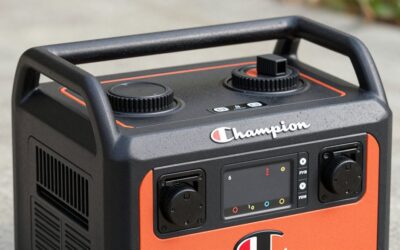
Champion 4000-Watt Dual Fuel RV Ready Portable Inverter Generator
Included for 'Champion 4000 Watt RV Ready Inverter Review: Is It Worth Buying in 2026?' as a relevant option in this category; details come from the product listing.
View on Amazon
Champion 4000-Watt RV Ready Portable Inverter Generator
Included for 'Champion 4000 Watt RV Ready Inverter Review: Is It Worth Buying in 2026?' as a relevant option in this category; details come from the product listing.
View on Amazon
Champion 4500-Watt Electric Start Dual Fuel Portable Inverter Generator
Included for 'Champion 4000 Watt RV Ready Inverter Review: Is It Worth Buying in 2026?' as a relevant option in this category; details come from the product listing.
View on Amazon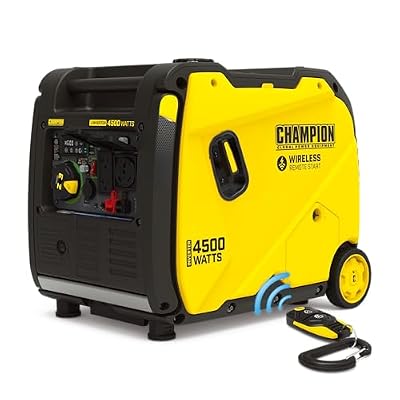
Champion 4500-Watt Wireless Remote Start Portable Inverter Generator
Included for 'Champion 4000 Watt RV Ready Inverter Review: Is It Worth Buying in 2026?' as a relevant option in this category; details come from the product listing.
View on AmazonCapacity against common RV loads
This class is commonly rated around 4,000 starting and 3,500 running watts on gasoline. Confirm the current label.
| RV load | Running watts | Starting watts |
|---|---|---|
| 13,500 BTU rooftop AC | 1,300-1,700W | 2,000-3,500W |
| RV refrigerator on electric | 300-400W | None |
| Microwave | 1,000-1,300W | None |
| Converter charging house batteries | 300-800W | None |
| Water heater on electric | 1,000-1,500W | None |
| Lights, fans, TV | 200-400W | None |
One air conditioner plus the fridge, converter, and lights fits comfortably. Adding the microwave while the AC runs pushes close to the limit, and electric water heating on top is too much. Most RVers switch the water heater to propane when on generator power.
The noise question
Inverter generators throttle the engine to match load, so they are much quieter than open-frame units at partial loads. This class commonly runs in the low-to-mid 60 dBA range at 23 feet under moderate load, lower in economy mode at light load. Open-frame designs are larger and less refined than enclosed suitcase-style inverters, so they tend to be a few decibels louder.
Campground noise reference
| Situation | Typical level at 23 feet |
|---|---|
| Normal conversation | ~60 dBA |
| Inverter at light load, eco mode | ~55-60 dBA |
| Inverter running a rooftop AC | ~62-68 dBA |
| Open-frame generator, half load | ~68-75 dBA |
If you camp mostly in national parks or strict campgrounds, compare decibel ratings carefully and keep a soft-start on your AC to reduce throttle surges.
Open frame versus enclosed inverter
The open-frame design saves money and weight compared with fully enclosed inverters of similar output. The trade-off is higher noise and less protection from weather. For RVers who boondock in dispersed sites or use mostly private campgrounds, the savings are worth it. For national park campers, the quieter enclosed class may be the better purchase.
Fuel and runtime
A tank of roughly 2.9 gallons commonly gives 10 to 17 hours at a quarter load, and roughly 6 to 8 hours at half load. Running a rooftop AC through a hot afternoon and evening typically uses 3 to 5 gallons. Carry fuel in approved containers outside the living area.
Setup at camp
Place the generator on level ground, exhaust pointed away from your RV and neighbors, and at least 20 feet from any RV door, window, or vent when possible. Never run it inside a toy-hauler garage or cargo bay. Test the RV’s CO alarm before every trip. Use a generator lock and chain to deter theft.
Pairing with a soft-start
A soft-start kit on the rooftop AC is one of the best $250 to $400 upgrades an RVer can make. It lowers starting surge so the generator does not need to rev hard, reducing noise spikes and letting it handle AC plus other loads more comfortably.
Altitude and heat reduce output
Western RVers often camp at elevation in summer, which is exactly when generators struggle. Engine output typically drops around 3 to 3.5 percent for every 1,000 feet above sea level, and high air temperatures reduce it further. At 6,000 feet, a generator rated for 3,500 running watts may deliver closer to 2,800 watts. That is still enough for a single rooftop AC with a soft-start, but not with the microwave running too. Some generators offer a high-altitude jet kit for the carburetor; check the manual and install it only if you camp above the recommended elevation regularly.
FAQ
Can this generator run a 50A RV?
It can supply power through an adapter, but only up to its rating of around 3,500 running watts, which means one AC and light loads. It will not provide full 50A capacity.
Will it meet campground noise limits?
Often at light loads in economy mode. Under AC load it may exceed 60 dBA, so check campground rules and position it to direct noise away from neighbors.
Bottom line
The Champion 4000-watt RV-ready inverter is worth buying for trailer and small motorhome owners who need one AC plus basic loads at a moderate price. If you camp mostly in strict, quiet campgrounds, consider an enclosed inverter; if you need two ACs, step up to a larger generator.
Write Your Review
No reviews yet. Be the first to share your experience!