
🛒 Best Price Today on Amazon
Prime members get fast, free shipping on everything above, plus member-only deals. New members get a 30-day free trial — cancel anytime.
“Solar generator” is a marketing name for a portable battery power station paired with solar panels. A gas generator is an engine-driven alternator. They solve the same problem — electricity when the grid is not available — but with opposite strengths. Solar is silent, fume-free and costs nothing to run once purchased; gas delivers high wattage on demand for as long as you have fuel. This guide compares them on output, energy per day, cost, noise, safety, maintenance and the use cases where each one wins.
What you are really buying
Solar generator
A lithium battery measured in watt-hours (commonly 500–6,000Wh), an inverter rated for continuous output (commonly 500–3,600W), an MPPT solar charge controller, and folding or rigid panels. Your daily energy budget equals what the panels collect plus what is left in the battery.

Jackery Solar Generator 300 and 40W Solar Panel,292Wh,300W AC
Included for 'Solar Generator vs Gas Generator: Which Is Right for You?' because the listing specifies 292Wh and 300W AC, details this guide uses to compare options.
View on Amazon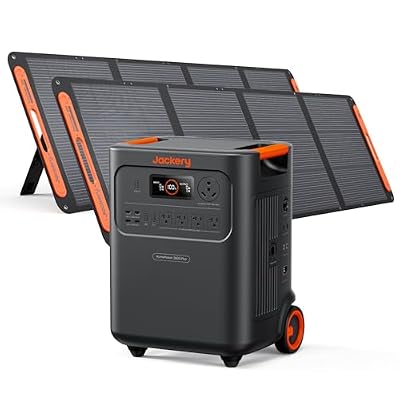
Jackery HomePower 3600 Plus & 2x200W Solar Panels, 3584Wh, 3600W AC Output
Included for 'Solar Generator vs Gas Generator: Which Is Right for You?' because the listing specifies 3584Wh and 3600W AC Output, details this guide uses to compare options.
View on Amazon
Jackery Explorer 1000 v2 Portable Power Station,1070Wh,1500W
Included for 'Solar Generator vs Gas Generator: Which Is Right for You?' because the listing specifies 1070Wh and 1500W, details this guide uses to compare options.
View on Amazon
Jackery Solar Generator 5000 Plus and 2x200W Panels, 5040Wh,7200W AC Output
Included for 'Solar Generator vs Gas Generator: Which Is Right for You?' because the listing specifies 5040Wh and 7200W AC Output, details this guide uses to compare options.
View on AmazonGas generator
A four-stroke engine, fuel tank and alternator. Inverter models produce clean, throttled power; conventional models run at fixed speed. Your daily energy budget is limited only by fuel on hand.
Head-to-head comparison
| Factor | Solar generator | Gas generator |
|---|---|---|
| Continuous output | 500–3,600W typical | 2,000–13,000W typical |
| Daily energy | Battery + 1–3kWh/day from 400–800W of panels | ~4–8kWh per gallon of gasoline (load dependent) |
| Noise | Near silent | 52–75 dBA at 23 ft |
| Indoor use | Yes | Never |
| Running cost | Near zero | Fuel + oil, roughly $0.30–0.80/kWh |
| Upfront cost per kWh stored/produced | $400–1,000 per kWh of battery | $150–600 per kW of output |
Solar harvest math
Panel wattage is a peak rating in ideal light. A practical rule is to multiply panel watts by peak sun hours, then by about 0.75 for real-world losses. In a region averaging 5 peak sun hours, a 400W array yields roughly 400 × 5 × 0.75 ≈ 1,500Wh per day. In winter at 2.5 sun hours, the same array yields about 750Wh.
| Panel array | Summer (5 sun hrs) | Winter (2.5 sun hrs) | What it sustains |
|---|---|---|---|
| 200W | ~750Wh | ~375Wh | Lights, phones, router, CPAP |
| 400W | ~1,500Wh | ~750Wh | Add an efficient fridge in summer |
| 800W | ~3,000Wh | ~1,500Wh | Fridge + freezer + essentials most days |
Where each one wins
Solar wins
- Apartments, condos and anywhere a gas engine is prohibited or unsafe.
- Medical devices such as CPAP and oxygen concentrators overnight.
- Quiet camping, van life and off-grid cabins with modest loads.
- Short grid outages of hours rather than days.
Gas wins
- Well pumps, central AC, electric water heaters and other high-draw loads.
- Multi-day storms with heavy cloud cover.
- Job sites running saws and compressors.
- Lowest upfront cost per watt of output.
Maintenance and lifespan
Lithium iron phosphate batteries commonly deliver 3,000–6,000 cycles before dropping to around 70–80% capacity. Keep them stored at 50–80% charge and top up every few months. Gas generators need oil changes every 50–100 hours, spark plug checks, and careful fuel storage to avoid carburetor problems. A well-maintained engine can last 1,000–3,000 hours depending on type.
The hybrid approach
Many households now combine both: a solar generator for silent overnight power and everyday essentials, plus a small inverter generator to recharge the battery on cloudy days or run a heavy load briefly. Running a generator at a steady charging load for 2–3 hours a day uses far less fuel than running it 24 hours.
Three buyer profiles
The apartment dweller who loses power a few times a year needs a 1,000–2,000Wh solar generator with a 200W panel. That keeps a CPAP, router, phones and a few LED lamps going through a 24-hour outage with zero fumes and no complaints from neighbors. The suburban homeowner with a sump pump and a full-size fridge usually gets more for the money from a 4,000–7,000W gas or dual-fuel generator connected through an interlock, perhaps paired with a small power station for overnight quiet. The weekend camper who stays two or three nights at a time can go either way: a 1,000–1,500Wh station with a 200W panel covers lights, a 12V fridge and fans, while a 2,000W inverter generator handles a microwave or small AC. Being honest about which profile fits you cuts the decision time in half and prevents buying a product sized for someone else’s life.
FAQ
Can a solar generator run a refrigerator?
Yes. A modern fridge averages 100–200W, so a 2,000Wh battery runs it for roughly 8–17 hours, and 400–800W of panels can replace much of that energy on sunny days.
Is a solar generator cheaper than a gas generator over time?
Upfront it costs more per watt, but it has almost no running cost. For light, frequent use it often becomes cheaper over five-plus years; for heavy loads, gas remains cheaper.
Bottom line
Choose a solar generator for quiet, indoor-safe power for modest loads; choose gas for high wattage and long storms. If your budget allows, a battery plus a small inverter generator covers nearly every scenario with less fuel and less noise than gas alone.


Write Your Review
No reviews yet. Be the first to share your experience!