
🛒 Best Price Today on Amazon
Prime members get fast, free shipping on everything above, plus member-only deals. New members get a 30-day free trial — cancel anytime.
- Quick recommendations
- What “60%” removes from your desk
- Comparison: the strongest compact gaming choices
- How the leading boards differ in actual use
- Decision matrix for limited desks
- Wireless performance and latency: what matters
- Programming a 60% keyboard so missing keys stop being a problem
- Durability, cleaning, and ownership costs
- Final verdict
The best 60 gaming keyboards for compact setups are the Wooting 60HE+ for adjustable Hall-effect control, the SteelSeries Apex Pro Mini Wireless for flexible wireless gaming, and the Keychron Q4 Max for a programmable all-rounder; your choice depends on whether speed, battery convenience, or typing quality matters most.
Quick recommendations
- Best for competitive gaming: Wooting 60HE+ — extremely adjustable actuation, rapid-trigger features, and excellent software control, but it is wired and lacks dedicated arrow keys.
- Best wireless gaming option: SteelSeries Apex Pro Mini Wireless — 2.4GHz wireless, Bluetooth, adjustable actuation, and a long quoted battery life.
- Best programmable everyday board: Keychron Q4 Max — QMK/VIA support, hot-swappable switches, an aluminum case, and a more substantial typing feel.
- Best low-profile choice: NuPhy Air60 HE — compact, light, and Hall-effect-based, with a shorter low-profile key design.
- Best value wired option: Corsair K65 RGB Mini — a compact gaming layout with conventional mechanical switches and broad game-software support.
- Best for Logitech owners: Logitech G PRO X 60 LIGHTSPEED — clean wireless integration and a tournament-oriented design, though its customization is less open than QMK/VIA.
What “60%” removes from your desk
A 60% keyboard normally keeps the letter area, number row, modifiers, and Escape key while removing the dedicated function row, arrow cluster, navigation keys, and numpad. It is usually about 29–31 cm wide, compared with roughly 43–45 cm for a full-size keyboard. That saved width can make room for a larger mouse sweep, a second monitor, or a drawing tablet.

Redragon K617 Wired 60% Compact Hot-Swap RGB Gaming Mechanical Keyboard
Included for 'Best 60% Gaming Keyboards for Compact Setups' as a relevant option in this category; details come from the product listing.
View on Amazon
MageGee Portable 60% Mechanical Gaming Keyboard, MK-Box LED Backlit Compact 68 Keys Mini Wired Office Keyboard with Red Switch for Windows Laptop PC Mac - Black/Grey
Included for 'Best 60% Gaming Keyboards for Compact Setups' because the listing specifies Black/Grey, details this guide uses to compare options.
View on Amazon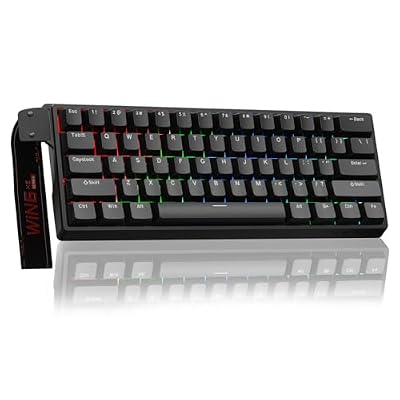
Aula WIN60 HE - 60% Mechanical Gaming Keyboard Wired, Magnetic Switch Hot Swappable, Adjustable Actuation Rapid Trigger Mode, 8000 Hz Polling Rate, RGB Small Keyboard 60 Percent Compact Design for PC
Included for 'Best 60% Gaming Keyboards for Compact Setups' because the listing specifies 60% Mechanical Gaming Keyboard Wired and Magnetic Switch Hot Swappable, details this guide uses to compare options.
View on Amazon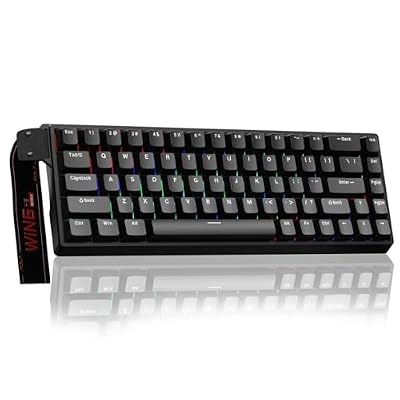
AULA WIN68 HE Mechanical Gaming Keyboard 60%, Hall Effect Magnetic Switch, Fast Trigger Mode Adjustable Actuation, 8000Hz Polling Rate, RGB Backlit, Wired Black Keyboard for Laptop/PC Gamer
Included for 'Best 60% Gaming Keyboards for Compact Setups' because the listing specifies Hall Effect Magnetic Switch and Fast Trigger Mode Adjustable Actuation, details this guide uses to compare options.
View on AmazonThe trade-off is not merely the missing keys. Arrow keys, Home, End, Page Up, and function-row commands become layers accessed with an Fn key. This is manageable for gaming, but less convenient for spreadsheets, coding, video editing, and frequent text navigation. Some 60% boards also use unusual bottom-row sizes, which can make replacement keycaps difficult or expensive.
Comparison: the strongest compact gaming choices
| Keyboard | Connection | Switch system | Programmability | Approx. size / weight | Best fit |
|---|---|---|---|---|---|
| Wooting 60HE+ | USB-C wired | Hall effect, adjustable actuation and rapid trigger | Wootility software; remapping and profiles | About 31.8 × 11.7 cm; about 0.6–0.7 kg depending on case | Competitive FPS |
| SteelSeries Apex Pro Mini Wireless | 2.4GHz, Bluetooth, USB-C | Adjustable OmniPoint 2.0 Hall-effect switches | SteelSeries GG; per-key settings and profiles | About 29.3 × 10.3 cm; about 0.7 kg | Wireless gaming and mixed use |
| Keychron Q4 Max | 2.4GHz, Bluetooth, USB-C | Hot-swappable mechanical switches | QMK/VIA | About 32.7 × 12.1 cm; about 1.7 kg | Typing, gaming, and customization |
| NuPhy Air60 HE | 2.4GHz, Bluetooth, USB-C | Low-profile Hall effect | NuPhy software; adjustable actuation | About 29.3 × 10.6 cm; roughly 0.6 kg | Low-profile setups and portability |
| Corsair K65 RGB Mini | USB-C wired | Cherry MX mechanical options, depending on version | Corsair iCUE; onboard profiles | About 29.4 × 10.5 cm; about 0.6 kg | Conventional gaming features at a lower price |
| Logitech G PRO X 60 LIGHTSPEED | LIGHTSPEED, Bluetooth, USB-C | Hot-swappable GX mechanical switches | G HUB; remapping and game profiles | About 29.3 × 10.3 cm; about 0.6 kg | Portable wireless gaming |
Dimensions and weights can vary slightly by revision, keycap set, and included accessories. The practical size difference is small: the decision usually comes down to switch behavior, wireless reliability, software, and case height rather than a few millimeters of width.
How the leading boards differ in actual use
Wooting 60HE+: best control over movement inputs
The Wooting 60HE+ uses analog Hall-effect sensing rather than a traditional metal-contact switch. You can set actuation points and use rapid-trigger behavior, allowing a key to reset before it travels all the way upward. This is particularly useful for repeated strafing and counter-strafing in competitive shooters.
Its major compromise is simplicity: it is wired, and its 60% layout requires layers for arrows and navigation. Wootility is more gaming-focused than general-purpose firmware, so buyers who want elaborate keyboard macros and open firmware may prefer a QMK/VIA board. It is also worth checking case and plate compatibility before buying replacement parts.
SteelSeries Apex Pro Mini Wireless: the convenient performance pick
The Apex Pro Mini Wireless combines adjustable actuation with 2.4GHz wireless and Bluetooth. The included dongle is the appropriate connection for gaming; Bluetooth is better reserved for laptops and slower-paced use. SteelSeries quotes up to roughly 30 hours with lighting and substantially longer runtimes with lighting reduced or disabled, so actual endurance depends heavily on brightness and polling settings.
The board is a strong choice when switching between a desktop, laptop, and console-like setup matters. Its weakness is software dependence: advanced adjustments are made through SteelSeries GG, and the layout still has all the normal 60% compromises.
Keychron Q4 Max: the best ownership proposition for many people
The Q4 Max is heavier and thicker than gaming-first boards, but that mass reduces movement and gives it a more substantial typing feel. QMK/VIA lets you assign layers, macros, media controls, arrow clusters, and application-specific shortcuts without being tied to a gaming brand’s launcher. Its hot-swappable sockets also make switch replacement practical.
It is not the obvious choice for someone chasing the lowest possible input latency. The Hall-effect models offer more specialized actuation control, while the Q4 Max is a conventional mechanical keyboard with a high-quality enthusiast feature set. Its roughly 1.7 kg weight also makes it less attractive for travel.
NuPhy Air60 HE: compact without the usual tall-keyboard feel
The Air60 HE uses low-profile keycaps and switches, reducing the height of the keyboard and making it easier to carry. Its Hall-effect sensing provides adjustable actuation while the 2.4GHz connection targets gaming use. Low-profile boards can feel faster to reach across, but replacement keycaps and switches are less interchangeable than standard-height mechanical parts.
Decision matrix for limited desks
| Your situation | Choose | Why | Accept the compromise |
|---|---|---|---|
| You play competitive shooters several times a week | Wooting 60HE+ or Apex Pro Mini Wireless | Adjustable actuation and rapid-trigger-style control | Higher price and fewer ordinary typing conveniences |
| You change devices often | Apex Pro Mini Wireless or Logitech G PRO X 60 LIGHTSPEED | 2.4GHz plus Bluetooth and a cable option | Battery charging and proprietary software |
| You type, code, or work as much as you game | Keychron Q4 Max | QMK/VIA layers, hot-swap support, and a solid case | Greater weight and a less gaming-specialized switch system |
| You have a shallow desk or travel regularly | NuPhy Air60 HE | Low-profile construction and compact footprint | Less standard keycap and switch compatibility |
| You want to spend less and do not need wireless | Corsair K65 RGB Mini | Established wired gaming design and broad software support | Traditional switches lack adjustable Hall-effect actuation |
Wireless performance and latency: what matters
For gaming, use the 2.4GHz receiver rather than Bluetooth whenever both are available. A receiver connected directly to the computer, with a short extension cable if necessary, can reduce interference from the computer case and crowded USB ports. Keep the keyboard’s firmware and receiver firmware current, but avoid updating immediately before an important event.
Wired operation removes battery concerns and is still the simplest choice for a stationary PC. Wireless does not automatically mean slower: modern proprietary 2.4GHz systems can feel responsive, but battery-saving modes, signal obstruction, USB interference, and an almost-empty battery can affect consistency. RGB lighting is one of the largest avoidable drains.
Programming a 60% keyboard so missing keys stop being a problem
Before committing to a 60% layout, create a usable second layer:
- Put arrow keys on a familiar cluster such as Fn plus W, A, S, and D, or Fn plus I, J, K, and L.
- Assign Home, End, Page Up, and Page Down nearby rather than scattering them across the layer.
- Place function keys in a logical number-row layer for software shortcuts and games that use F1–F12.
- Save a work layer and a gaming layer, then test both without looking at a reference image.
- Keep an emergency way to access Escape, Backspace, and the arrow keys if a profile fails or software is unavailable.
QMK/VIA is the most flexible approach for users who want keyboard-level remapping. Brand utilities are often easier for lighting and game profiles, but they may need to run in the background for all features to work.
Durability, cleaning, and ownership costs
Keycaps usually show shine first, especially ABS caps under frequently used keys. Stabilizers may become noisy, and wireless batteries gradually lose capacity after repeated charge cycles. Hall-effect switches avoid some traditional contact-wear concerns, but they do not make the keycaps, stabilizers, USB connector, or battery indestructible.
Unplug a wired board before cleaning. Remove loose debris with air held upright, wipe keycaps with a lightly damp microfiber cloth, and never pour cleaner into the switches. For a wireless board, keep the receiver in its storage position during transport and avoid charging from damaged cables. Do not lubricate switches unless you know the construction; contamination can create inconsistent key readings.
Price varies by region and sales cycle, but expect roughly $70–$120 for mainstream wired 60% gaming boards, $120–$180 for premium wireless or Hall-effect models, and about $150–$220 for enthusiast aluminum boards such as the Q4 Max. Budget for a replacement cable, keycap set, or switch pack only if the board supports those parts.
Final verdict
Choose the Wooting 60HE+ if competitive movement control is your priority and wired use is acceptable. Choose the SteelSeries Apex Pro Mini Wireless when wireless convenience and adjustable actuation need to coexist. The Keychron Q4 Max is the more sensible long-term choice for someone who types, customizes, and games on the same keyboard, while the NuPhy Air60 HE is the best match for a low-profile compact setup. Whichever model you buy, plan your Fn layer before removing your full-size keyboard: that small preparation determines whether the space saving feels liberating or inconvenient.
Write Your Review
No reviews yet. Be the first to share your experience!