
🛒 Best Price Today on Amazon
Prime members get fast, free shipping on everything above, plus member-only deals. New members get a 30-day free trial — cancel anytime.
- Quick picks by shooting situation
- Reflector size: the decision that changes the light most
- Surface colors and their actual light effects
- 5-in-1 kits versus single-surface reflectors
- Decision matrix: match the reflector to your working style
- How to choose the right size with a simple coverage check
- Grip options and outdoor safety
- Durability, cleaning, and common ownership problems
- Typical cost and value
- Final recommendation
The best reflectors for photography are usually a 5-in-1 collapsible model in the largest size you can comfortably hold or position: choose 32–43 inches for one-person portraits and small product work, 48–60 inches for full-length portraits and softer outdoor light, and 75 inches or more when you need broad, wraparound fill.
Quick picks by shooting situation
- Best all-purpose choice: a 5-in-1, 43-inch reflector with white, silver, gold, black, and translucent surfaces.
- Best for headshots in a small room: a 32-inch white/silver reflector, preferably with a built-in handle or an attached stand sleeve.
- Best for full-length portraits: a 48- to 60-inch oval or round reflector. The extra area produces more even light from head to toe.
- Best for product photography: a rigid white foam board or a 32-inch reflector with a translucent diffusion panel. Rigid boards are easier to place precisely and do not introduce a circular edge into reflections.
- Best for outdoor work: a 5-in-1 reflector with a strong spring frame, a carrying case, and a separate stand or grip solution.
- Best for dramatic portraits: a black-sided reflector, often called a flag, to remove light rather than add it.
Reflector size: the decision that changes the light most
Size determines both coverage and softness. A small reflector can brighten an eye socket or product edge, but it creates a narrower beam and requires more accurate positioning. A large reflector is easier to aim at a person, fills more of the subject, and produces a gentler transition between highlight and shadow.

WELLMAKING 32'' Reflector Photography with tilt Adapter for Studio Outdoor
Included for 'Best Reflectors for Photography: Find the Right Size' as a relevant option in this category; details come from the product listing.
View on Amazon
NEEWER 43 Inch/110 Centimeter Light Reflector Diffuser 5 in 1 Collapsible Multi Disc with Bag - Translucent, Silver, Gold, White, and Black for Studio Photography Lighting Outdoor
Included for 'Best Reflectors for Photography: Find the Right Size' because the listing specifies Translucent and Silver, details this guide uses to compare options.
View on Amazon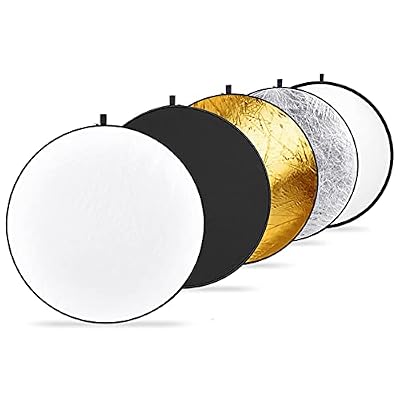
NEEWER 32 Inch/80 Centimeter Light Reflector Light Diffuser 5 in 1 Collapsible Multi Disc with Bag - Translucent, Silver, Gold, White, and Black for Studio Photography Lighting and Outdoor Lighting
Included for 'Best Reflectors for Photography: Find the Right Size' because the listing specifies Translucent and Silver, details this guide uses to compare options.
View on Amazon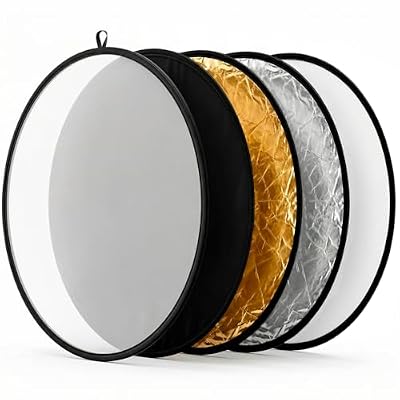
QWORK 22 Inch (60 cm) 5-in-1 Collapsible Light Reflector & Diffuser - Translucent, Silver, Gold, White, Black, Multi Disc Photography Reflector for Studio Outdoor Photography
Included for 'Best Reflectors for Photography: Find the Right Size' because the listing specifies Translucent and Silver, details this guide uses to compare options.
View on Amazon| Reflector size | Typical folded length | Approximate weight | Best use | Main limitation |
|---|---|---|---|---|
| 20–24 inches | 8–12 inches | 250–500 g | Close-up portraits, tabletop products, travel | Limited coverage; light falls off quickly |
| 32 inches | 11–15 inches | 400–800 g | Headshots, small products, one-person operation | Usually too small for full-length subjects |
| 43 inches | 14–18 inches | 600–1,100 g | Half-length portraits and general-purpose work | Can be awkward in tight rooms or strong wind |
| 48–60 inches | 16–22 inches | 900 g–1.8 kg | Full-length portraits, group shots, broad fill | Often needs a stand or assistant |
| 75–80 inches | 25–32 inches | 1.8–3.5 kg | Large groups, fashion, very soft window-like fill | Expensive, harder to transport, highly wind-sensitive |
These figures are typical ranges rather than specifications for one particular model. Frame thickness, fabric layers, shape, and the number of included covers can change weight substantially.
Surface colors and their actual light effects
White: the safest portrait surface
White produces soft, low-contrast fill. It is the best starting surface for natural-looking portraits because it brightens shadows without creating a strong color shift. Place it close to the shadow side of the face and angle it toward the subject, not directly at the sun or light source. White is also useful for products with glossy finishes because its reflection is broad and less harsh than silver.
Silver: more output and sharper contrast
Silver reflects substantially more light than white, making it useful when the subject is far from the reflector, the sun is weak, or a flash is being bounced into it. It can restore bright catchlights outdoors, but it may create hard highlights on skin and shiny products. Keep silver farther away than white and feather it so the brightest part does not point straight at the subject’s face.
Gold: warm, sometimes too warm
Gold adds warmth to skin and can imitate late-afternoon sunlight. It is most convincing when used sparingly in cool shade. On neutral products, white backgrounds, or pale clothing, the color cast can be difficult to correct. A striped white-and-gold surface gives a gentler warming effect than a fully gold panel and can be a practical compromise for portraits.
Translucent: diffusion rather than reflection
A translucent panel goes between the light source and the subject. It softens direct sun or a small flash, reducing squinting and hard-edged shadows. It does not bounce much light back toward the subject, so it solves a different problem from white or silver. In a 5-in-1 kit, the translucent core is often the most useful panel for outdoor portraits.
Black: negative fill and control
Black absorbs light and deepens shadows. It is valuable when a portrait looks flat because light is bouncing from a nearby wall, pavement, or bright sky. For product photography, black can create a clean dark reflection along the edge of glass, metal, or glossy packaging. This surface is often overlooked, but it provides control that adding more light cannot.
5-in-1 kits versus single-surface reflectors
A 5-in-1 kit normally consists of a spring-loaded frame, a translucent center, and a reversible cover offering white, silver, gold, and black surfaces. It is the most economical option when your assignments vary. The trade-off is bulk: the cover can slip, the frame can twist, and changing surfaces takes time when a subject is waiting.
A single-surface reflector is faster. A white panel stays ready for portraits, while a silver panel is predictable for flash work. Rigid foam board is particularly effective for products because it remains flat and can be cut to custom shapes. It is inexpensive, but it is not foldable and its edges can become damaged during transport.
Brands such as Lastolite by Manfrotto, Westcott, Profoto, Neewer, and Godox offer reflector products or related lighting-control accessories in various sizes and formats. Brand availability and construction vary by model, so inspect the frame stitching, cover tension, handle attachment, and storage dimensions rather than choosing on brand name alone.
Decision matrix: match the reflector to your working style
| Your situation | Recommended choice | Why |
|---|---|---|
| Budget-conscious beginner | 32- or 43-inch 5-in-1 kit | One purchase covers fill, diffusion, warmth, and negative fill |
| Frequent portraits with an assistant | 48- to 60-inch white/silver reflector | Broader, softer coverage with faster surface changes |
| Solo photographer | 32- to 43-inch model with handle or stand sleeve | Manageable with one hand and less likely to act like a sail |
| Small studio or apartment | 32-inch reflector or rigid boards | Fits between the subject and nearby walls without blocking movement |
| Full-time outdoor work | 48- to 60-inch kit plus a weighted stand | Useful coverage, replaceable covers, and safer positioning in wind |
| Mostly tabletop products | White and black rigid boards, plus a small translucent panel | Precise edge control is more valuable than foldability |
How to choose the right size with a simple coverage check
For a portrait, measure the subject’s visible height in the frame and select a reflector whose longest dimension is at least half that height if you want reasonably even fill. For example, if a seated portrait shows 90 cm from head to waist, a 43-inch reflector is about 109 cm long and can cover the subject comfortably. A 24-inch panel is only about 61 cm, so it will brighten the face but leave the chest and lower clothing less affected.
This is not a strict optical rule: distance, lens angle, and reflector shape also matter. Nevertheless, it explains why a small panel can appear powerful in a headshot but disappointing in a standing portrait.
Grip options and outdoor safety
Built-in handles are convenient for a 20- to 43-inch reflector, especially for a photographer working alone. They are less useful with a large panel because holding the reflector for a long session becomes tiring and makes the light position inconsistent.
For 48-inch and larger reflectors, look for a reinforced edge, a frame compatible with a reflector holder, or a sleeve that accepts a crossbar. A dedicated reflector arm on a light stand is more stable than a generic clamp. Add a sandbag or other substantial weight to the stand, and never leave a large reflector unattended outdoors. Wind can overturn a stand even when the reflector feels light indoors.
Durability, cleaning, and common ownership problems
- Frame fatigue: repeated folding can weaken spring steel. Fold using the manufacturer’s method rather than twisting randomly, and store the reflector in its circular shape.
- Loose covers: stretched or poorly fitted covers create wrinkles that produce uneven reflections. Replace covers when the fabric no longer sits taut.
- Dirty white fabric: fingerprints and dust reduce consistency. Use a soft, dry brush first; follow the care label before attempting gentle spot cleaning.
- Silver creases: deep folds can create irregular bright spots. Avoid storing heavy equipment on top of the reflector.
- Color contamination: gold surfaces can tint skin and products. Check a test frame before a full session, particularly with white clothing or neutral backgrounds.
- Overexposure: silver placed too close to a face can produce bright forehead and cheek highlights. Move it back, switch to white, or feather the reflection.
Typical cost and value
Small single-surface panels commonly fall in the general market range of $15–$40. Entry-level 5-in-1 kits typically cost about $20–$70, while larger, better-finished kits often range from $70–$180 or more. Premium frames and replacement covers can cost extra, but replaceable covers may extend the life of the frame.
As a value example, a $45 43-inch kit used for 30 portrait sessions costs $1.50 per session before replacement or transport costs. If you work mainly in a studio and use a $20 rigid white board for 100 product sessions, its cost is about $0.20 per session, although it takes more storage space and may need replacing sooner.
Final recommendation
For most photographers, the best reflectors for photography are a 43-inch 5-in-1 kit for versatility and a 48- to 60-inch white reflector for softer full-length portraits. Choose 32 inches when portability and solo operation matter most; choose rigid boards when precise product reflections matter more than folding convenience. Prioritize a taut cover, a reliable frame, manageable folded dimensions, and a safe grip system over extra color surfaces you are unlikely to use.
Write Your Review
No reviews yet. Be the first to share your experience!