
🛒 Best Price Today on Amazon
Prime members get fast, free shipping on everything above, plus member-only deals. New members get a 30-day free trial — cancel anytime.
The best GaN chargers are the ones whose wattage and port layout match your devices: choose 30W for a phone, 65W for most laptops, and 100W or more when charging a laptop alongside several accessories.
Quick picks by charging situation
- Best compact phone charger: Anker Nano 3 30W. Its single USB-C port is a good match for phones, earbuds, tablets, and handheld consoles.
- Best everyday laptop charger: Anker 735 Charger, also known as Nano II 65W. It combines two USB-C ports with one USB-A port and is suitable for most USB-C laptops.
- Best small multi-device charger: UGREEN Nexode 65W 3-Port GaN Charger. It is useful when you need two USB-C connections plus USB-A without moving between chargers.
- Best desk charger for several devices: Belkin BoostCharge Pro 4-Port GaN Charger 108W. Its higher output is better suited to a laptop, tablet, phone, and accessories charging at once.
- Best high-output travel option: Satechi 145W USB-C 4-Port GaN Charger. It is a better fit for two laptops or a laptop and several high-draw devices, although it is larger than compact single-port models.
What wattage do you actually need?
Charger wattage is a ceiling, not an amount that is forced into the device. A 65W charger can safely charge a phone that normally draws 20W; the phone negotiates the lower amount it supports. The important question is whether the charger can sustain the required output while other ports are occupied.

Anker USB Charger Block, 67W GaN Wall Charger, 3-Port Compact Fast Charging
Included for 'Best GaN Chargers for Fast, Compact Charging' because the listing specifies 67W GaN Wall Charger and 3-Port Compact Fast Charging, details this guide uses to compare options.
View on Amazon
Anker 140W Max 4-Port GaN Charging Blocks,Smart Display for MacBook Charger
Included for 'Best GaN Chargers for Fast, Compact Charging' because the listing specifies Smart Display for MacBook Charger, details this guide uses to compare options.
View on Amazon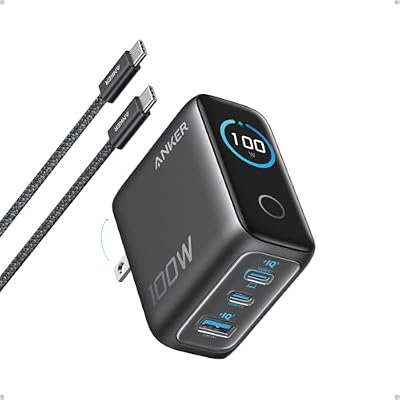
Anker 100W Max USB C Charger, 3-Port GaN Phone Charger with Smart Display
Included for 'Best GaN Chargers for Fast, Compact Charging' because the listing specifies 3-Port GaN Phone Charger with Smart Display, details this guide uses to compare options.
View on Amazon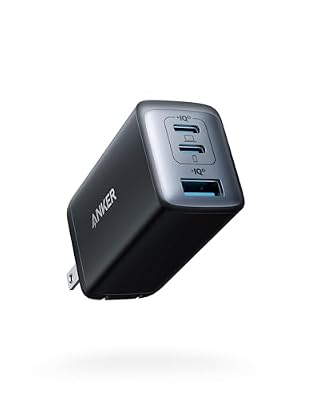
Anker 65W Max 3-Port USB C Charger Block, Compact Foldable Phone Charger
Included for 'Best GaN Chargers for Fast, Compact Charging' because the listing specifies Compact Foldable Phone Charger, details this guide uses to compare options.
View on Amazon| Device or combination | Recommended charger | Why |
|---|---|---|
| Phone and earbuds | 30W, 1 USB-C port | Smallest practical option; enough for fast phone charging and a low-power accessory |
| Phone, tablet, or handheld console | 45W to 65W | Provides headroom for tablets and gaming devices without becoming unnecessarily bulky |
| USB-C ultrabook | 65W, preferably 67W or higher | Matches many 13- to 14-inch laptops while leaving some capacity for accessories |
| Performance laptop | 100W to 140W | Better for laptops specified above 65W, especially during demanding workloads |
| Laptop plus phone and watch | 100W to 140W, 3 or 4 ports | Allows the laptop to retain a useful share of the output while smaller devices charge |
| Two USB-C laptops | 140W or more | Needed when both computers can draw substantial power at the same time |
Check the wattage printed on your original laptop adapter before buying. A 65W charger may run a 65W laptop, but it can leave little capacity for charging a phone and may charge slowly while the laptop is under load. For a 100W laptop, choose a charger with at least 100W total output and a USB-C port rated for 100W or more.
Best GaN chargers compared
| Charger | Maximum output | Ports | Approximate size and weight | Best use |
|---|---|---|---|---|
| Anker Nano 3 30W | 30W | 1 USB-C | About 38 × 31 × 31 mm; about 40 g | Phone-first travel kit |
| Anker 735 Nano II | 65W | 2 USB-C, 1 USB-A | About 66 × 38 × 29 mm; about 132 g | One laptop plus small devices |
| UGREEN Nexode 65W 3-Port | 65W | 2 USB-C, 1 USB-A | About 66 × 40 × 31 mm; about 125 g | Compact multi-device charging |
| Belkin BoostCharge Pro 4-Port | 108W | 3 USB-C, 1 USB-A | About 100 × 65 × 31 mm; about 310 g | Desk or shared family charging |
| Satechi 145W 4-Port | 145W | 4 USB-C | About 100 × 75 × 28 mm; about 300 g | Two laptops and several USB-C devices |
Dimensions and weight vary slightly by regional plug version and revision, so treat the figures as useful comparisons rather than measurements for a tightly fitted travel pouch. The pattern is more important: single-port chargers are dramatically smaller, while multi-port models trade pocketability for simultaneous charging.
Anker Nano 3 30W: smallest sensible choice
This is the right pick when your main device is a phone. Its 30W USB-C output covers fast charging for many current phones and is also adequate for earbuds, e-readers, compact tablets, and handheld consoles. The limitation is obvious: there is no second port, so charging a phone and earbuds requires a splitter or a second charger, neither of which is ideal.
Anker 735 Nano II versus UGREEN Nexode 65W
These two chargers occupy the practical middle ground. Both offer two USB-C ports and one USB-A port, with roughly 65W total output. That is enough for a USB-C laptop and smaller devices, but port-sharing rules matter. When several devices are connected, the primary USB-C port may receive around 45W to 65W while the remaining output is divided between the other ports. A laptop that expects 65W may therefore charge slowly when a phone and watch are connected.
The Anker is a strong choice when you prefer a compact, established travel charger with a familiar two-C-one-A arrangement. The UGREEN is appealing when its current pricing is lower or when its power-allocation behavior better matches your devices. Neither is a replacement for a 100W-class charger if you regularly run a demanding laptop from battery power.
Belkin BoostCharge Pro 108W: better for a permanent workspace
A 108W four-port charger is more useful on a desk than in a pocket. It can serve a laptop, tablet, phone, and low-power accessory without occupying four wall outlets. Its main advantage is not merely the maximum number; it is the extra power reserve. If the laptop receives 65W and the other devices together use 25W, a 108W charger still has useful margin.
The downside is size, weight, and heat. A larger charger with several active ports can become noticeably warm, particularly when operating near its limit. That is normal for compact power electronics, but it should have open space around its vents or casing rather than being buried under clothing or papers.
Satechi 145W: for high-demand USB-C setups
The Satechi 145W model makes sense for people carrying two USB-C laptops, or a laptop, tablet, phone, and high-capacity power bank. Its four USB-C ports are convenient for modern gear but less flexible if you still depend on USB-A cables. It is also overkill for a phone-only kit: the extra capacity adds cost and bulk without making a 20W phone charge faster.
How to match ports to your devices
- List each device’s input requirement. Use the original adapter label or the manufacturer’s specifications. Record both wattage and connector type.
- Identify your simultaneous-use scenario. Add the devices you charge at the same time, not every device you own.
- Add headroom. For a 65W laptop, choose 65W for occasional single-device charging, but 100W or more if a phone and accessories will share the charger regularly.
- Check USB-C cable ratings. A 100W charger cannot deliver 100W through a cable rated only for 60W. For outputs above 100W, use a properly rated 5A USB-C cable with an electronic marker.
- Confirm the port allocation. Look for the manufacturer’s table showing output with two, three, or four ports occupied. “100W total” does not mean every USB-C port supplies 100W.
For example, imagine a 65W laptop, a phone that normally uses 25W, and earbuds using 5W. The theoretical total is 95W. A 65W charger can power all three, but it cannot provide the laptop’s full rated input while the other devices are connected. A 100W charger gives 5W of nominal spare capacity, while a 120W or 140W model provides more comfortable headroom for charging fluctuations.
Heat, size, and real-world trade-offs
GaN components allow chargers to be smaller than many older silicon-based designs, but GaN does not eliminate heat. Heat rises with electrical load, conversion losses, and poor airflow. A charger that feels warm while charging a laptop is usually operating normally; an unusually hot casing, repeated charging interruptions, buzzing, or a hot-plastic smell is a reason to unplug it and contact the manufacturer.
Small chargers are easiest to pack but often have one port and less thermal mass. Larger multi-port chargers can spread the load and provide more output, yet they may block adjacent outlets or become inconvenient on trains and in hotel rooms. Models with folding plugs are particularly travel-friendly, while desk-oriented units with fixed cables or a longer AC cord can be easier to position behind furniture.
Ownership and durability details that matter
- The cable often fails first. Repeated bending at the connector can cause intermittent charging before the charger itself wears out. Replace damaged or loose cables rather than continuing to use them.
- Dust affects fit and heat. Inspect USB ports occasionally and remove lint with the charger unplugged. Do not push metal objects into a port or use liquid cleaner.
- Avoid enclosed heat. Do not charge under pillows, inside a packed bag, or against a radiator. High temperature can reduce long-term component life.
- Do not assume every USB-C port is identical. Some ports support high-wattage USB Power Delivery, while others are limited to lower output or different charging protocols.
- Buy certified equipment. Look for USB Power Delivery support, appropriate regional safety certification, over-voltage and over-temperature protection, and a warranty from a recognizable manufacturer.
Final buying decision
Choose the Anker Nano 3 30W if minimum size matters and you mainly charge a phone. Choose the Anker 735 or UGREEN Nexode 65W if you need one compact charger for a laptop and accessories. Move to the Belkin 108W class for a shared desk or frequent three-device charging, and choose a 140W-class four-port model only when you truly have multiple high-draw USB-C devices. The best GaN chargers are not the ones with the largest number on the box; they are the ones that preserve enough wattage on the correct ports for the devices you use together.

Write Your Review
No reviews yet. Be the first to share your experience!