
🛒 Best Price Today on Amazon
Prime members get fast, free shipping on everything above, plus member-only deals. New members get a 30-day free trial — cancel anytime.
- Best outdoor griddles by cooking situation
- How much cooking surface do you really need?
- Head-to-head: 30-inch versus 36-inch griddles
- Burner output and heat zones
- Grease management is a practical differentiator
- Propane, natural gas, and portable fuel
- Seasoning needs and weather resistance
- Decision matrix for choosing your griddle
- What wears out first?
- Final recommendation
The best outdoor griddles depend on how much food you cook, whether you need precise heat zones, and how willing you are to manage seasoning and weather protection: for most backyards, a 30- to 36-inch propane model with two or more burners offers the best balance of capacity, control, and value.
Best outdoor griddles by cooking situation
| Best for | Recommended type or model | Why it fits | Main compromise |
|---|---|---|---|
| Large families and frequent entertaining | Blackstone 36-inch, four-burner griddle | About 720 square inches of cooking space and independent heat zones | Large footprint, heavy body, and more steel to protect from rust |
| Smaller patios and everyday meals | Weber Slate 30-inch, three-burner griddle | About 540 square inches, strong heat control, and a rust-resistant carbon-steel cooking surface | Usually costs more than basic two-burner griddles |
| High heat and flexible outdoor cooking | Traeger Flatrock 3-burner griddle | Large cooking area, three heat zones, and a design aimed at even heat distribution | Less compact and commonly priced in the premium range |
| Portable cooking for camping or tailgating | 22-inch tabletop propane griddle | Typically 300 to 350 square inches with a removable or folding stand | Limited space for simultaneous foods and smaller grease capacity |
| Lower-cost entry point | 28-inch, two-burner propane griddle | Usually 450 to 500 square inches and adequate for two to four people | Fewer independent temperature zones and thinner components on some models |
How much cooking surface do you really need?
Manufacturers measure griddle area in square inches, but the useful question is how many foods must cook at once. A 22-inch griddle is suitable for breakfast for two to four people, but its surface becomes crowded when pancakes, bacon, and eggs need separate areas. A 28- or 30-inch model is more practical for a family of four. A 36-inch griddle is the better choice for six or more people, meal preparation, or parties.

Blackstone® 1883 Original 28" Omnivore Griddle with Hood, Black
Included for 'Best Outdoor Griddles for Backyard Cooking' because the listing specifies Black, details this guide uses to compare options.
View on Amazon
Royal Gourmet PD4001 4 Burner Propane Gas Griddle, Removable Standing Cart
Included for 'Best Outdoor Griddles for Backyard Cooking' because the listing specifies Removable Standing Cart, details this guide uses to compare options.
View on Amazon
Royal Gourmet GB4000P 4 Burner Propane Gas Griddle, Hard Cover, Side Tables
Included for 'Best Outdoor Griddles for Backyard Cooking' because the listing specifies Hard Cover and Side Tables, details this guide uses to compare options.
View on Amazon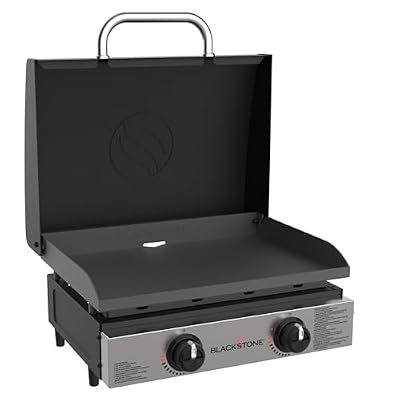
Blackstone® 1813 Original 22" Tabletop Griddle with Hood
Included for 'Best Outdoor Griddles for Backyard Cooking' as a relevant option in this category; details come from the product listing.
View on AmazonAs a rough planning calculation, allow 100 to 130 square inches per person when cooking a complete meal with several foods. Four diners therefore need approximately 400 to 520 square inches. That does not mean a 28-inch griddle will always be full, because food can be moved to a cooler zone, but it explains why a 30-inch model feels substantially less cramped than a tabletop unit.
Measure more than the cooktop. A full-size griddle may be roughly 55 to 65 inches wide with side shelves extended, and it needs clearance for the propane cylinder, lid, walking space, and safe ventilation. On a narrow deck, a 28- or 30-inch model can be easier to use even if a 36-inch model offers better capacity.
Head-to-head: 30-inch versus 36-inch griddles
30-inch models
A 30-inch griddle generally provides around 500 to 600 square inches and three burners. That is enough for multiple steaks, a large batch of vegetables, or breakfast for a family. Three burners create a useful hot-middle or hot-side arrangement, allowing you to sear on one section while keeping cooked food warm elsewhere. These units are often easier to move and may use less propane during shorter cooking sessions.
36-inch models
A 36-inch griddle commonly offers about 700 to 750 square inches and four burners. Its advantage is not simply cooking more individual portions; it is the ability to run several different temperatures at once. You can cook pancakes on medium heat, crisp potatoes on medium-high heat, and hold finished food on low without transferring anything indoors.
The trade-off is ownership effort. Larger griddles take longer to heat, need more propane during extended sessions, and expose more steel to humidity. If you typically cook for two people, the extra area may become a cleaning and rust-prevention burden rather than a benefit.
Burner output and heat zones
Look at total BTU output, but do not treat the largest number as an automatic winner. Common full-size propane griddles fall roughly between 30,000 and 60,000 BTU per hour. More output can shorten preheating and help recover heat after cold food is added, while burner placement and the thickness of the cooktop determine how evenly that energy is distributed.
- Two burners: Usually provide left and right heat zones. They are simple and economical, but the temperature difference between areas may be limited.
- Three burners: Offer more useful control for a family-size griddle, especially when cooking delicate and high-heat foods simultaneously.
- Four burners: Best for a 36-inch surface and large meals. They allow narrow, predictable zones but add more controls and potential ignition points.
For burgers, steaks, and stir-fried food, strong heat recovery matters. For eggs, fish, and pancakes, controllability matters more than maximum output. A thick carbon-steel plate can smooth out burner hot spots, but it also takes longer to preheat and consumes more fuel.
Grease management is a practical differentiator
Most outdoor griddles use a slight slope and a front or side grease channel leading to a cup or drawer. A wide opening that can be scraped into from several directions is easier to live with than a narrow drain hidden behind the cooking surface. Check whether the grease cup can be removed while the shelves remain attached and whether disposable liners are available for that design.
Grease capacity matters when cooking bacon, smash burgers, or fatty sausages. A small cup may require emptying during a large meal. Never leave grease in the cup between uses: it attracts insects, can turn rancid, and may spill when the griddle is moved. Let the grease cool, scrape the surface, and dispose of it according to local waste rules rather than pouring it into a drain.
Propane, natural gas, and portable fuel
Propane is the most flexible fuel for freestanding griddles. A standard 20-pound cylinder is widely available and usually provides enough fuel for several cooking sessions, although consumption varies with wind, temperature, burner output, and preheating time. A rough planning estimate is 1 to 2 pounds of propane per hour for a large griddle running at moderate to high heat. At 1.5 pounds per hour, a 20-pound cylinder represents about 13 hours of burner operation, not 13 cooking sessions.
Natural-gas griddles can be convenient where a properly installed outdoor gas connection already exists. They are not automatically convertible, however. Buy a natural-gas version or an approved conversion kit designed for that exact model, and use a qualified professional for gas-line work. Tabletop models may use a small disposable cylinder or an adapter for a larger propane tank; adapters should match the manufacturer’s requirements.
Seasoning needs and weather resistance
Traditional carbon-steel griddles need seasoning. After assembly, wash away manufacturing residue, dry the plate completely, apply a very thin coat of high-smoke-point cooking oil, heat until it smokes, and repeat several times. Thin layers bond more reliably than one thick, sticky layer. After cooking, scrape away residue, wipe the surface, add a light protective film of oil, and allow it to cool before covering.
Some modern griddles arrive with a pre-seasoned or rust-resistant carbon-steel surface, which reduces initial work but does not eliminate maintenance. Carbon steel can rust when left damp, particularly around the grease channel, welded seams, fasteners, and underside of the plate. Stainless-steel shelves and coated frames resist weather better than painted mild steel, but they do not make the entire appliance weatherproof.
A fitted cover is useful, yet it should not trap moisture against a warm or wet griddle. Let the appliance cool and dry first. In rainy or humid climates, a ventilated storage location or covered patio is better than leaving the unit exposed year-round. Inspect the hose, regulator, burner ports, ignition wires, and wheels at the start of each season.
Decision matrix for choosing your griddle
| Your situation | Target specification | Reason |
|---|---|---|
| Two people, limited storage | 22-inch tabletop or compact 28-inch model; 300 to 500 square inches | Enough area without paying for a large surface that is difficult to store |
| Family of four, weekly use | 28- to 30-inch; 450 to 600 square inches; two or three burners | Balances capacity, fuel use, and manageable cleanup |
| Frequent parties or meal prep | 36-inch; about 700 square inches; four burners | Provides separate hot, medium, and holding zones |
| Rainy climate or uncovered storage | Rust-resistant cooktop, robust cover, protected storage plan | Weather management will affect lifespan more than a small BTU difference |
| Camping and tailgating | Tabletop model under roughly 60 pounds, with locking lid or compact stand | Prioritizes transport over maximum heat-zone control |
What wears out first?
Igniters, burner ports, grease cups, wheels, and regulators usually deserve more attention than the cooking plate. A click igniter may fail after repeated moisture exposure even when the burners remain usable; many models include a manual lighting procedure, but follow the specific safety instructions. Burner holes can clog with grease or insect debris, and scraping them with a sharp object can enlarge the openings and distort the flame.
Common mistakes include preheating an empty griddle on maximum heat for too long, using excessive oil during seasoning, cutting directly on the cooking surface, and putting a wet cover over warm steel. Avoid abrasive cleaning that removes seasoning unnecessarily. If the surface develops light rust, remove it, dry the plate thoroughly, and rebuild the seasoning rather than continuing to cook over loose corrosion.
Final recommendation
Choose a 30-inch, three-burner propane griddle if you want one dependable backyard appliance for regular family meals. Move up to a 36-inch four-burner model when cooking capacity and multiple heat zones matter more than footprint and maintenance. Choose a 22-inch tabletop unit for transport or occasional use, and prioritize a rust-resistant surface, accessible grease management, and a realistic storage plan over headline BTU output. The best outdoor griddle is the one whose size, fuel system, and upkeep match how often you will actually cook outdoors.





Write Your Review
No reviews yet. Be the first to share your experience!