
🛒 Best Price Today on Amazon
Prime members get fast, free shipping on everything above, plus member-only deals. New members get a 30-day free trial — cancel anytime.
- Quick picks by room and situation
- What makes a smart mirror worth buying?
- Best smart mirror types for each room
- Display size, lighting, and humidity: the specifications that decide the purchase
- Installation reality: plug-in, hardwired, or recessed
- Smart-home compatibility without marketing surprises
- Ownership costs and common mistakes
- Final buying decision
The best smart mirrors for most homes are a bathroom-rated illuminated mirror with adjustable color temperature, a wall-mounted model sized to the vanity, or a compact tabletop mirror such as the Simplehuman Sensor Mirror Hi-Fi when magnification and voice-free convenience matter more than a large screen.
Quick picks by room and situation
| Situation | Best choice | Look for | Typical 2026 price range |
|---|---|---|---|
| Primary bathroom | Hardwired illuminated bathroom smart mirror | IP44 or better, anti-fog pad, 24–48 inch width, dimmable LEDs | $500–$1,500 |
| Small bathroom or rental | Plug-in LED mirror with wall brackets | 16–24 inch width, light plug, shallow depth, low installation complexity | $150–$500 |
| Bedroom or dressing area | Tabletop smart mirror | 5x magnification, rechargeable battery, adjustable brightness | $150–$350 |
| Connected home and entertainment | Display-integrated bathroom mirror | Wi-Fi, app support, privacy controls, streaming or casting compatibility | $800–$3,000+ |
| Makeup or detail grooming | Compact magnifying mirror | 5x to 10x optical magnification, high color-rendering LEDs, stable base | $100–$300 |
What makes a smart mirror worth buying?
A smart mirror may combine an ordinary mirror with LED lighting, magnification, a clock, weather information, a Bluetooth speaker, a touchscreen, or a hidden display. These features are not equally useful. For most buyers, lighting quality and reliable installation matter more than a large screen.

LIFX Smart LED Mirror - Matter, Color Changing, Anti-Fog, Dimmable
Included for 'Best Smart Mirrors for Every Room' because the listing specifies Matter and Color Changing, details this guide uses to compare options.
View on Amazon
24x32 Inch LED Smart Bathroom Mirror with 21.5" Hidden Touchscreen System
Included for 'Best Smart Mirrors for Every Room' as a relevant option in this category; details come from the product listing.
View on Amazon
LAWADA 55x30 LED Bathroom Mirror with Lights, Smart Anti-Fog, Motion Sensor
Included for 'Best Smart Mirrors for Every Room' because the listing specifies Smart Anti-Fog and Motion Sensor, details this guide uses to compare options.
View on Amazon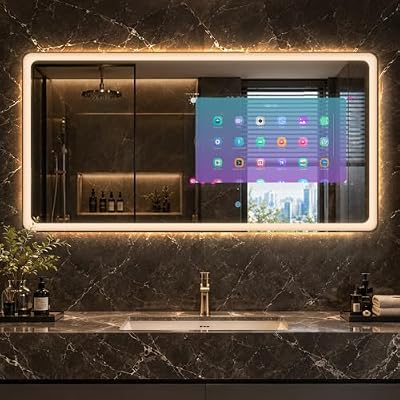
39"x20" Smart Mirror with 22"Touchscreen TV, Android WiFi Mounted Bathroom
Included for 'Best Smart Mirrors for Every Room' because the listing specifies Android WiFi Mounted Bathroom, details this guide uses to compare options.
View on AmazonPrioritize a high color-rendering index, ideally CRI 90 or higher, so skin tones and clothing colors appear more naturally. Adjustable color temperature is also valuable: approximately 2,700–3,000K gives warm evening light, while 4,000–5,000K is closer to bright daylight. A dimmer prevents the mirror from becoming uncomfortable at night.
Best smart mirror types for each room
Best for a primary bathroom: a hardwired illuminated mirror
A wall-mounted mirror with perimeter LEDs offers the most useful combination of size, even lighting, and a clean appearance. Choose a width that is slightly narrower than the vanity. For a 60-inch vanity, a 48- to 54-inch mirror usually leaves balanced space at both ends; for a 36-inch vanity, a 24- to 30-inch mirror is generally easier to proportion.
Bathroom models should have a sealed electrical assembly and a stated moisture-resistance rating. IP44 is a useful minimum target for splash-prone areas, although the rating does not make a mirror suitable for direct shower spray. An anti-fog heating pad is worthwhile if the room becomes steamy, but it consumes electricity and usually clears only the central viewing area rather than every corner.
Electric Mirror is one established specialist in display-integrated and illuminated bathroom mirrors. Its products are aimed at premium installations, where concealed wiring, built-in displays, and custom dimensions justify a higher price.
Best for a bedroom: a tabletop mirror with lighting and magnification
A tabletop model is easier to relocate and does not require bathroom electrical work. The Simplehuman Sensor Mirror line, including the Sensor Mirror Hi-Fi, is a strong option for this use because it combines automatic lighting with magnification, and selected models add an integrated speaker. It is better suited to a vanity or dressing table than to a humid bathroom wall.
For makeup or detailed grooming, 5x magnification is usually more versatile than 10x. Higher magnification shows a smaller field of view and makes it harder to maintain a natural distance from the mirror. A rechargeable battery is convenient, but check the claimed runtime and whether the mirror can operate while charging.
Best for a small bathroom: a plug-in LED mirror
A compact plug-in model reduces installation cost and is practical where opening a wall is not desirable. The compromise is a visible cable, a nearby outlet, and generally less protection against humidity than a purpose-built hardwired bathroom mirror.
Measure the outlet location, wall clearance, and door swing before ordering. A mirror that is only 2 inches deeper than expected can interfere with a medicine cabinet or narrow walkway. Choose a model with a physical light switch or capacitive control that remains usable when the surface is damp.
Best for a connected home: a concealed-display mirror
Display mirrors can show clocks, weather, calendars, video, or smart-home information behind partially transparent glass. They are most useful when the display is readable from the normal standing position and can be completely disabled when the mirror is being used as a mirror.
Compatibility deserves careful scrutiny. “Smart” does not automatically mean Apple Home, Google Home, or Alexa support. Verify whether the device supports direct control, voice commands through a separate speaker, casting, or only a proprietary app. Also check how long the manufacturer promises software updates. A display that loses app support may continue reflecting and lighting, but its headline feature can become obsolete.
Display size, lighting, and humidity: the specifications that decide the purchase
| Specification | Good target | Why it matters |
|---|---|---|
| Mirror width | 6–12 inches narrower than the vanity | Preserves visual balance and clearance |
| Display size | 10–15 inches for glanceable information | Readable without allowing the screen to dominate the mirror |
| LED color range | 2,700–6,500K adjustable | Supports warm ambient light and daylight-like grooming light |
| Color rendering | CRI 90+ | More dependable appearance of skin, makeup, and clothing |
| Magnification | 5x for general detail work | A useful balance between enlargement and viewing area |
| Humidity resistance | IP44 minimum where splash exposure is possible | Helps protect against water splashes; not a license to install in a shower |
| Tabletop battery | 5–20 hours per charge | Reduces cable clutter while allowing weekly charging |
Installation reality: plug-in, hardwired, or recessed
Plug-in installation is the simplest: mount the brackets, connect the cable, and keep the power adapter outside splash zones. It is suitable for renters and for mirrors used in bedrooms or hallways.
Hardwired installation produces a cleaner result but should normally be handled by a qualified electrician. The circuit, junction box, wall structure, and local bathroom electrical rules all matter. Many illuminated mirrors need a dedicated wall switch or a correctly positioned junction box; assuming that an existing light-box location will line up can create expensive rework.
Recessed installation gives a built-in appearance but requires more planning. Confirm the wall is not carrying plumbing, electrical cables, or structural framing where the recess will go. A surface-mounted mirror is often the better value if the wall is tiled or if the bathroom may be remodeled later.
Smart-home compatibility without marketing surprises
- Wi-Fi: Check whether the mirror uses 2.4 GHz, 5 GHz, or both. Some bathroom devices work only on 2.4 GHz networks.
- Voice control: Determine whether voice commands control lighting and displays directly or merely launch a manufacturer skill.
- Privacy: For a camera-equipped mirror, look for a physical shutter, microphone mute, local processing options, and a clear account-deletion procedure.
- Offline use: The mirror should retain basic reflection and lighting functions if the internet or app is unavailable.
- Updates: A dated processor, unsupported app, or discontinued cloud service can shorten the useful life of an expensive display.
Ownership costs and common mistakes
LEDs usually last longer than the mirror’s control electronics, power supply, or touch switch. If a hardwired light module fails, replacement may require removing the mirror; ask whether the LED driver and heating pad are separately replaceable before buying.
Cleaning is also more specialized than it appears. Spray glass cleaner onto a microfiber cloth rather than directly onto the mirror, and keep liquid away from speaker grilles, touch controls, seams, and the lower edge. Abrasive pads can damage anti-fog coatings and printed markings.
A useful cost calculation is the electricity used by an illuminated mirror. Suppose a 40-watt mirror runs for 45 minutes each day: 0.04 kW × 0.75 hours × 365 equals about 10.95 kWh per year. At $0.20 per kWh, that is roughly $2.19 annually for lighting. The installation and replacement parts—not electricity—usually determine the long-term cost.
Do not mount a standard bedroom mirror directly beside a shower simply because it has bright LEDs. Moisture resistance, sealed electronics, and correct electrical placement matter more than a low purchase price.
Final buying decision
Choose the Simplehuman Sensor Mirror Hi-Fi or a similar tabletop model when you want dependable close-up lighting without wall work. Choose a hardwired, IP-rated illuminated mirror for a frequently used bathroom. Choose a compact plug-in mirror for a rental or small space. Select a display-integrated model only when its software support, privacy controls, and smart-home compatibility are documented clearly enough to justify the extra cost.









Write Your Review
No reviews yet. Be the first to share your experience!