
🛒 Best Price Today on Amazon
Prime members get fast, free shipping on everything above, plus member-only deals. New members get a 30-day free trial — cancel anytime.
- Quick answer
- S7 25 ft fan-out cord: the straightforward four-outlet split
- Yodotek 25 ft breaker cord: four outlets with built-in protection
- Kanayu 10 ft splitter: four outlets plus a twist-lock pass-through
- KJTMA 1.5 ft adapter: a short splitter with a 20-amp breaker
- AC WORKS TT30W515: the splitter for TT-30 generator outlets
- How to Choose
- Who should skip
- FAQ
- Final Verdict
When the power goes out, a mid-size portable generator usually has one 30-amp twist-lock outlet and more appliances waiting than that single outlet can serve directly. A splitter cord solves the socket shortage: it plugs into that one outlet and fans out into several household-style receptacles, so the refrigerator, freezer, sump pump, and lamps can each plug in without a daisy chain of ordinary extension cords. Choosing the right one comes down to the plug, the outlets, and the load.
One rule governs everything that follows: a splitter adds outlets, never capacity. The combined load on every receptacle still has to stay within the generator outlet’s rating and the cord’s rating, whichever is lower. These cords feed standalone appliances only — never a home’s circuits — and a generator must never be connected to house wiring through an improvised cord. The generator itself stays outdoors, and every connection stays dry. The five cords below cover the common 30-amp setups.
As an Amazon Associate, we earn from qualifying purchases.
Quick answer
Choose a generator splitter cord by matching the plug first: most 30-amp generator outlets are L14-30 twist-lock, while some use the TT-30 RV-style plug. A splitter adds outlets, never capacity, so the combined load on every receptacle must stay within the generator outlet and cord ratings. Pick the length and breaker protection that fit your setup.
S7 25 ft fan-out cord: the straightforward four-outlet split
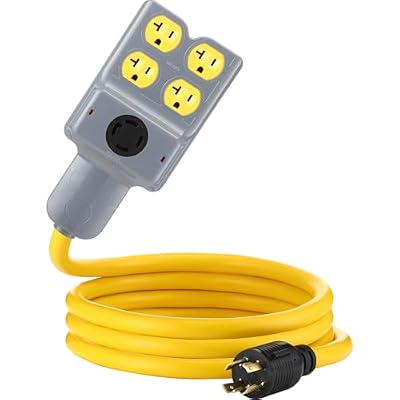
The S7 is the plain, full-length option for a generator with an L14-30 outlet. Its twist-locking plug seats in the generator socket and stays put, and the cord runs 25 feet out to four 5-20R receptacles. The listing rates it at 30 amps and 125/250 volts with a 7,500-watt maximum, built on 10 gauge copper wire, and describes the cable as UL listed and water and weather resistant.
There is no built-in breaker, so overload protection rests on the generator’s own breaker and on your load math. That makes the S7 a sensible default for the usual outage set, provided the running watts of everything plugged in stay under what the outlet can supply. For protection built into the cord itself, look at the next picks.
| Brand | Product | ASIN | Key specs |
|---|---|---|---|
| S7 | 25 Feet Heavy Duty Generator Adaptor Extension Cord | B08GHGMYGK | L14-30P to four 5-20R; 30 Amp, 125/250 Volts; 7,500 Watts max; 25 ft; 10 gauge copper; no built-in breaker |




Yodotek 25 ft breaker cord: four outlets with built-in protection
The Yodotek follows the same shape as the S7 — L14-30P twist-lock plug, 25 feet of 10 gauge cable, four 5-20R receptacles — but adds a built-in surge protector breaker at the receptacle end. That breaker is the reason to pick it: if the combined load climbs too high, the cord’s own protection trips instead of relying only on the generator. It is rated at 30 amps and 7,500 watts and described as water resistant.
Two cautions come straight from the listing. The maker states no separate amp rating for the breaker, so treat it as general overload protection rather than a precise limit. And the listing states this cord is not UL listed, which matters to buyers who require a listed cord. The four receptacles are standard 20-amp outlets that accept ordinary household plugs.
| Brand | Product | ASIN | Key specs |
|---|---|---|---|
| Yodotek | 25Ft Generator Cord with Surge Protector Breaker | B08FBFLCBX | L14-30P to four 5-20R; 30 Amps; 7,500 Watts max; 25 ft; 10 gauge; built-in surge protector breaker |
Kanayu 10 ft splitter: four outlets plus a twist-lock pass-through
The Kanayu is the pick when the generator sits closer to where power is used and one load still needs a twist-lock connection. Alongside four household receptacles rated at 125 volts, it carries one L14-30R pass-through receptacle, so a twist-lock extension cord or another 30-amp device can continue downstream instead of competing for the single outlet. The cord is rated 30 amps at 125/250 volts and 7,500 watts, uses 10 gauge pure copper wire, and wears a flame-retardant PVC sleeve.
At 10 feet it is a placement cord, not a distance cord: the generator still stays outdoors, well away from windows and doors, and the shorter run means less cable to manage. There is no built-in breaker. One buying caution: this listing also sells 3 ft and 6 ft sizes, and this pick is the 10 ft version, so confirm the selected size before ordering.
| Brand | Product | ASIN | Key specs |
|---|---|---|---|
| Kanayu | 10 ft Generator Adapter Extension Cord | B0DPK4W7VB | L14-30P to four 5-20R/5-15R plus one L14-30R pass-through; 30 Amp, 125/250V; 7,500 Watts; 10 ft; 10 gauge; no built-in breaker |
KJTMA 1.5 ft adapter: a short splitter with a 20-amp breaker
The KJTMA is not really a cord at all but a short distribution adapter, a foot and a half long, that turns one L14-30P connection into four household outlets. Its distinguishing feature is a built-in 20-amp circuit breaker, which caps the household-outlet side at 20 amps total regardless of the 30-amp outlet behind it. That hard cap makes it a tidy choice for a cluster of smaller loads — lights, a television, device chargers, a fan — where a firm ceiling is a feature, not a limitation.
Because it is so short, appliances still need their own cords to reach it, and the setup only makes sense where the generator can sit close to where power is used — always outdoors. The listing states no wire gauge, so judge it by its breaker and input rating. Respect the 20-amp cap: a space heater plus a microwave will trip it quickly.
| Brand | Product | ASIN | Key specs |
|---|---|---|---|
| KJTMA | 30 Amp to 20Amp Generator Distribution Adapter | B0F9Z1M8YW | L14-30P to four 5-20R/15R; 30 Amp input; built-in 20 Amp circuit breaker; 1.5 ft; gauge not stated |
AC WORKS TT30W515: the splitter for TT-30 generator outlets
Not every 30-amp generator outlet is an L14-30. Some generators use the TT-30, the three-prong RV-style outlet in the 120-volt class, and none of the cords above will fit it. The AC WORKS adapter is built for exactly that case: a TT-30P plug on one end and three 5-15R household receptacles on the other, on a 25 ft 10/3 STW cord. It is rated at 30 amps, with no built-in breaker.
Three outlets instead of four is the trade here, in 15-amp style, so this cord suits a lighter outage set — a refrigerator, lights, and chargers — rather than heavy appliance pairs. Plugs and receptacles are never interchangeable between the TT-30 and L14-30 families, and no plug should ever be modified to force a fit. If your generator’s outlet is the four-prong twist-lock type, choose an L14-30 pick above instead.
| Brand | Product | ASIN | Key specs |
|---|---|---|---|
| AC WORKS | TT30W515 Tri-Outlet Adapter, 25 ft | B084WRC3XV | TT-30P to three 5-15R; 30 Amps; 25 ft; 10/3 STW cable; no built-in breaker |
How to Choose
Start with the plug, because nothing else matters if it does not match. Read the label on your generator’s 30-amp outlet: a four-prong twist-lock is an L14-30, and a three-prong RV-style outlet is a TT-30. The two families are not interchangeable. Next, count outlets: a 5-20R receptacle accepts both 15-amp and 20-amp household plugs, which makes the four-outlet cords above the flexible default.
Then do the load math before the outage, not during it. Add up the running watts of everything planned, remember that motors such as sump pumps and refrigerator compressors draw a brief surge when they start, and keep the combined load within the lower of the generator outlet’s rating and the cord’s rating. On L14-30 fan-outs, spread larger loads across receptacles rather than stacking them on one side, and respect any built-in breaker, such as the 20-amp cap on the KJTMA adapter. Choose the shortest cord that lets the generator sit outdoors, well away from the home, with exhaust pointed away from windows, doors, and vents. Keep every connection dry and raised off wet ground, never through standing water.
Finally, hold the safety line. A splitter cord feeds standalone appliances plugged directly into it. Powering a home’s circuits takes a properly installed transfer switch or interlock and an inlet box, fitted by a qualified electrician under local code. Never plug a generator into a wall outlet, and never use a male-to-male cord: those cords are a known electrocution and fire hazard that regulators have recalled repeatedly.
Who should skip
Skip a splitter cord entirely if your goal is to power lights and outlets through your home’s wiring — that job belongs to a transfer switch setup. Skip one if your generator only has standard 15- or 20-amp outlets; a heavy-duty outdoor extension cord is the simpler tool there. Skip one if your real problem is total power rather than socket count — no splitter raises what the generator can supply, so the answer is shedding loads or a larger generator. And RV owners who need TT-30 receptacles on the far end should look at RV adapters instead, since every pick here ends in household receptacles.
FAQ
Does a splitter cord give my generator more power?
No. A splitter cord adds places to plug in, never capacity. The combined load on all of its receptacles is still limited by the generator outlet’s rating and the cord’s rating, whichever is lower. If your appliances need more than that limit together, run fewer at once or use a larger generator.
Can I use a splitter cord to power my house through a wall outlet?
Never. Feeding power into house wiring through an outlet, sometimes called backfeeding, can electrocute household members and utility workers and start fires, and male-to-male cords sold for that purpose are a recalled hazard. Whole-home power requires a properly installed transfer switch or interlock and an inlet box, which is a different setup entirely.
What is the difference between L14-30 and TT-30 plugs?
The L14-30 is a four-prong twist-lock plug rated for 125/250-volt service, common on mid-size portable generators. The TT-30 is a three-prong plug in the 120-volt class, borrowed from the RV world and fitted to some generators instead. They serve the same 30-amp role but are physically different and not interchangeable, so match the cord to your generator’s actual outlet.
How many appliances can I run from one splitter cord?
As many as fit within the load limit. Add the running watts of each appliance, allow headroom for motor starting surges, and keep the total under the lower of the outlet and cord ratings — and under any built-in breaker, such as 20 amps total on the KJTMA adapter. In practice that means one or two heavy appliances plus lights and chargers, not everything at once.
Final Verdict
For most 30-amp generators with an L14-30 outlet, the S7 is the simple default and the Yodotek adds breaker protection in the same shape. The Kanayu earns its place when a twist-lock pass-through matters, the KJTMA suits a tight cluster of small loads with a firm 20-amp ceiling, and the AC WORKS is the pick when your generator speaks TT-30 instead. Whichever you choose, match the plug, add up the watts, keep the generator outdoors and the connections dry, and follow the maker’s directions and local code.





Write Your Review
No reviews yet. Be the first to share your experience!