
🛒 Best Price Today on Amazon
Prime members get fast, free shipping on everything above, plus member-only deals. New members get a 30-day free trial — cancel anytime.
When the power goes out or a boil-water notice lands, stored jugs run down faster than most households expect, and a small filter stretches a freshwater supply for days longer. The two designs worth stocking split by how the water moves: gravity filters hang and drain on their own, while squeeze filters push water through only when you squeeze a pouch or bottle. This guide compares two gravity systems against three squeeze filters, all built around hollow-fiber membranes, and explains where each style earns its place in an emergency kit.
One limit applies to every pick here, and it is worth stating before any product names: all five are bacteria and protozoa filters. They physically remove bacteria, protozoa and, as listed, microplastics, silt and sand. None of them removes viruses, dissolved chemicals, pesticides, heavy metals or salt, and none of them is a purifier. Treat them as protection for stored water, rainwater or a doubtful tap supply during an outage, never as a way to make any water source safe.
As an Amazon Associate, we earn from qualifying purchases.
Quick answer
Gravity filters win for hands-free volume: hang the bag and let water run through while you do other outage jobs. Squeeze filters win for speed, size and personal use: fill, squeeze, drink. All five picks here remove bacteria and protozoa only. None removes viruses or chemicals, so match the tool to the water risk.
Platypus GravityWorks 4-Liter
The GravityWorks is the group option on the gravity side. A 4-liter dirty reservoir hangs above a 4-liter clean reservoir, so one fill treats a 4-liter batch while you do something else. Note that the 8-liter figure in listings is total system capacity across both bags, not an 8-liter batch. Its 0.2 micron hollow fiber cartridge flows at up to 1.75 liters per minute, and the maker rates the cartridge for up to 1,500 liters depending on water quality. Cleaning is the easiest in this guide: backflush by lifting the clean reservoir above the dirty one and letting clean water run back through the cartridge, with no syringe and no extra tool. Platypus is blunt about cold storage: never allow the cartridge to freeze, because freezing permanently damages the internal fibers and the damage cannot be seen.
| Brand | Product | ASIN | Key specs |
|---|---|---|---|
| Platypus | GravityWorks Group Camping Water Filter System, 4-Liter | B0CV9RPT8Y | 0.2 micron hollow fiber; 4L dirty and 4L clean reservoirs; up to 1.75 L/min; cartridge life up to 1,500 L; backflush by reversing reservoirs, no tools |


LifeStraw Peak Series Gravity Filter System, 3L
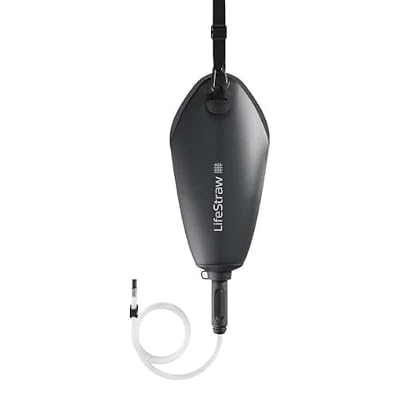
LifeStraw’s gravity entry is a single 3-liter bag rather than a two-reservoir system. Fill it, hang it, and filtered water runs through the included 47-inch hose into your own bottle or pot, or cap the bag with its leak-proof cap for storage. The 0.2 micron membrane meets US EPA and NSF P231 standards for the removal of bacteria and parasites, per the maker. A backwash syringe is included, the maker advises backwashing after use, and when the filter reaches the end of its life it simply stops flowing, which is a useful fail-safe. At 8.1 ounces it is light for a gravity system. Keep it firmly in the filter category: this is the Peak gravity filter, not a purifier, and it does not remove viruses.
| Brand | Product | ASIN | Key specs |
|---|---|---|---|
| LifeStraw | Peak Series Gravity Filter System, 3L, Dark Mountain Gray | B09SBPPFW2 | 0.2 micron membrane; 3L bag; 47 in (1.2 m) hose; backwash syringe included; 8.1 oz (228 g); stops flowing at end of filter life |
Sawyer Squeeze SP129
The SP129 is the workhorse squeeze pick. Its 0.1 micron absolute hollow fiber membrane carries Sawyer’s standard claims of removing 99.99999 percent of bacteria and 99.9999 percent of protozoa, plus microplastics, and it flows at up to 1.7 liters per minute. Two 32-ounce pouches come in the kit, and the filter also threads onto standard 28 mm bottles and can run inline on a hydration pack. That common thread is a real resilience point: a torn pouch does not end the filter’s usefulness. Sawyer rates the filter at up to 100,000 gallons, but read that as a laboratory maker rating rather than a household promise; the company itself says there is no defined end of life with proper backwashing, the included syringe restores up to 98 percent of flow, and a lifetime limited warranty covers the filter. Sawyer’s freeze rule is the strictest here: a wetted filter that froze must be replaced, and freezing one voids the warranty.
| Brand | Product | ASIN | Key specs |
|---|---|---|---|
| Sawyer | Squeeze SP129 Water Filtration System | B00B1OSU4W | 0.1 micron absolute; up to 1.7 L/min; two 32-oz pouches included; fits standard 28 mm bottles; backwash syringe included; filter life maker-rated up to 100,000 gallons |
Katadyn BeFree 1.0L
The BeFree pairs its 0.1 micron EZ-Clean membrane with its own 1.0-liter HydraPak flask, and it is the fastest squeeze pick here at up to 2 liters per minute. Katadyn rates the filter for up to 1,000 liters. Cleaning needs no tools at all: shake the filled flask or swish the filter in water to clear debris, because there is no backflushing and no syringe. The trade-off is the flask itself. The filter uses a 42 mm thread that fits only its own HydraPak flask, so ordinary 28 mm bottles do not fit; puncture the flask and the system is out of action until it is replaced. Katadyn also warns against using the filter in freezing conditions or if water has frozen inside it, since a frozen membrane can let microorganisms pass through.
| Brand | Product | ASIN | Key specs |
|---|---|---|---|
| Katadyn | BeFree 1.0L Water Filter (8018006) | B075X5R67T | 0.1 micron EZ-Clean membrane; up to 2 L/min; 1.0L HydraPak flask; filter life up to 1,000 L; shake or swish to clean, no backflush tools; 42 mm flask thread only |
LifeStraw Peak Series Collapsible Squeeze, 1L
LifeStraw’s squeeze bottle wraps a 0.2 micron membrane in a 1-liter collapsible bottle built from thicker material than the brand’s earlier bottles, with a tethered cap. LifeStraw states that the filter protects against bacteria, parasites and microplastics and meets US EPA and NSF P231 standards for bacteria and parasite removal, and the maker states a flow of up to 3 liters per minute for this bottle. The filter is rated for up to 2,000 liters (500 gallons) and, like the gravity model, stops flowing at the end of its life. A backwash accessory is included, and the maker advises backwashing after each use or whenever flow drops. This pick is the Mountain Blue 1-liter version. The same freeze rule applies: ice inside a wet membrane can expand the pores and silently ruin it, so a filter that froze wet gets replaced, not trusted.
| Brand | Product | ASIN | Key specs |
|---|---|---|---|
| LifeStraw | Peak Series Collapsible Squeeze Bottle Water Filter System, 1L | B09SBNDKXG | 0.2 micron membrane; 1L collapsible bottle; up to 3 L/min as maker stated; filter life up to 2,000 L (500 gallons); backwash accessory included; 110 g (3.9 oz) |
How to Choose
Start with group size and patience. Gravity systems filter batches hands-free, which suits a household drawing water all day during an outage, but they need a hanging point and a clean receiving container; the LifeStraw bag feeds your own bottles and pots, while the Platypus keeps dirty and clean water in separate reservoirs. Squeeze filters are immediate and personal, but output is one pouch or bottle at a time and the effort is continuous, which gets tedious for a whole family.
Next, be honest about cleaning discipline. Every pick needs regular backwashing or rinsing exactly as its maker directs, and the methods differ: reservoir reversal for the Platypus, a syringe for the Sawyer and the LifeStraw gravity bag, an included accessory for the LifeStraw squeeze, and a simple shake or swish for the Katadyn. Silty water shortens every cleaning interval sharply, so let sediment settle and pre-filter cloudy water through a clean cloth before it reaches the membrane. Follow each maker’s flushing and storage directions rather than improvising.
Finally, plan storage before the emergency. A hollow-fiber filter that has been used never fully dries out, and if that trapped water freezes, ice can damage the fibers invisibly: flow may look normal while protection is gone. Store the kit indoors where it cannot freeze, and treat any previously used filter that may have frozen as finished. Replace it rather than trust it.
Who should skip
Skip all five if your water risk includes viruses. None of these filters removes them; virus protection calls for a purifier-class product or for boiling or disinfecting water following official guidance. Skip them, too, for chemically contaminated water, such as floodwater carrying fuel or solvents or runoff with agricultural chemicals: no pick here helps with that, and stored potable water plus official guidance is the right answer. If your goal is better-tasting water, skip this category as well, because none of the five has a carbon stage for taste. And if backwashing, careful storage and freeze protection sound like upkeep that will not happen, stored bottled water is the more honest prep.
FAQ
Do any of these filters remove viruses?
No. All five are hollow-fiber microfilters that remove bacteria and protozoa; viruses pass through them. If viruses are part of your risk, use a purifier-class product or boil or disinfect the water following official guidance instead.
Can I store my filter in the garage or car over winter?
Only where it cannot freeze. A wetted hollow-fiber filter that freezes can be permanently damaged in ways that cannot be seen, and the makers direct that such a filter be replaced. Store the kit indoors above freezing and follow the maker’s storage directions.
Which style suits a family during a long outage?
Gravity, for most households. A hanging system filters a batch at a time with no hand effort, which adds up over days. A squeeze filter still earns a place in a go-bag or personal kit, and many households keep one of each.
Why does the flow slow down, and how do I restore it?
Sediment and silt clog the fibers. Backwash or rinse using the method and tools the maker specifies for your model, and pre-filter cloudy water through a clean cloth after letting sediment settle, so the membrane clogs more slowly in the first place.
Final Verdict
Gravity and squeeze filters solve different halves of the same problem. Choose gravity for volume and patience: the Platypus offers the easiest cleaning and separated dirty and clean reservoirs, while the LifeStraw bag is lighter and feeds containers you already own. Choose squeeze for speed and size: the Sawyer brings the most versatile thread and the longest maker rating, the Katadyn is the fastest but tied to its own flask, and the LifeStraw bottle is a simple all-in-one. Whichever style you pick, it only earns its place in the kit if it is maintained by the book and stored where it can never freeze.


Write Your Review
No reviews yet. Be the first to share your experience!