
🛒 Best Price Today on Amazon
Prime members get fast, free shipping on everything above, plus member-only deals. New members get a 30-day free trial — cancel anytime.
A welding setup that lives on the floor is a setup that trips you. The machine sits in one corner, the cylinder leans against a wall, and leads snake across the concrete. A proper cart puts welder, tank, and daily gear on one rolling frame, so the whole station moves to the work.
The five carts below cover the main layouts shops use: a basic open cart, a drawer cart, a heavy dual-tank frame, a lockable cabinet cart, and a cart with cable hooks. Each holds a cylinder at the back, chained upright, because a falling cylinder with a damaged valve can punch through a wall.
As an Amazon Associate, we earn from qualifying purchases.
Quick answer
For most home shops, the Garvee Welding Cart with 4 Drawers balances shelves and small-parts storage best. For a large machine or two tanks, step up to the VEVOR 3-Tier Welding Cart. The DIYHOME suits a small inverter welder, the VEVOR Welding Cart with 2 Drawers and Lockable Cabinet suits shared shops, and the Weldpro 3-Tier Welding Cart is the pick when leads need hooks.
DIYHOME 3-Tier Welding Cart with Tilt Top

This is the basic pattern most welding carts follow: no drawers, no cabinet, nothing to complicate assembly. Three open trays stack above a rear cylinder shelf, and the top tray tilts so welder controls face up toward you. That tray measures about 18 by 11 inches, suiting compact inverter MIG and TIG machines better than full-size units.
Open shelves keep wire, clamps, gloves, and a helmet visible, the middle tray takes a small plasma cutter or tool bag, and the bottom tray carries heavy items low, where weight helps stability. Dust and grit settle on open trays, though, and small items need their own box. Measure your welder footprint first, because a machine overhanging the tilt tray will rock in use.
Specs
– Three open steel trays, tilting top shelf
– Top tray about 18 x 11 in, middle about 15.4 x 11 in
– Bottom tray about 27.6 x 11.4 in
– Rear shelf holds one gas cylinder upright
– Four wheels, 360-degree swivel movement
– Fits MIG, TIG, ARC, and MMA machines, plasma cutters
Garvee Welding Cart with 4 Drawers

The Garvee answers the most common complaint about open carts: there is nowhere sensible to put the small stuff. Three open shelves carry the machine and larger tools, while four drawers swallow contact tips, nozzles, drive rolls, and clamps. The Q235 steel frame allows 270 lb parked and 230 lb while rolling.
Static load is what the cart holds parked; dynamic load is what it should carry while moving, and the moving figure is lower because bumps multiply force on shelves and casters. A mid-size MIG welder, one chained cylinder, and full drawers stay inside both limits. The body measures about 28 by 11.4 by 23.6 inches, and rear slots with stainless steel chains hold the tank.
Specs
– Q235 steel frame, black finish
– 270 lb static limit, 230 lb dynamic limit
– Three open shelves plus four drawers
– Cylinder slots with stainless steel chains
– Size about 28 x 11.4 x 23.6 in
– Item weight about 40.3 lb
VEVOR 3-Tier Welding Cart, 400 lb Capacity
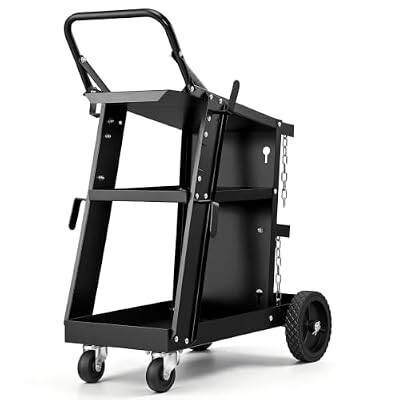
For large machines, frame strength and tank room decide the purchase. This VEVOR carries the highest figures in this group, a 400 lb static limit and a 370 lb dynamic limit, and the back takes two gas cylinders side by side, each held by its own stainless steel safety chain.
Dual tank room changes how a shop works: a MIG setup and a TIG bottle can share one station. Rear wheels measure 7 inches against 2.9 inch front swivel casters, and those larger wheels let a loaded cart roll over cords, floor seams, and thresholds without a dead stop. Spread machines across trays rather than stacking them, because thin shelves bow when a cutter sits on a welder.
Specs
– 400 lb static limit, 370 lb dynamic limit
– Two cylinder slots, two stainless steel chains
– Trays about 11 x 18.1 in, lower 28 x 11.4 in
– Front casters 2.9 in, rear wheels 7 in
– Item weight about 24.2 lb
VEVOR Welding Cart with 2 Drawers and Lockable Cabinet

In shared workshops, welding gear walks away or gets buried. This VEVOR variant answers with a lockable cabinet under two drawers. The machine sits on the open top tray while helmets, meters, and the better tools lock underneath, within a 350 lb static limit and 300 lb while rolling.
The cabinet measures about 17.3 by 14 by 11.8 inches, enough for a helmet and a small tool case, and each drawer runs about 15.6 by 9.8 by 5.9 inches. Four side brackets hold guns and pliers, the rear takes two gas cylinders with safety chains, and the cart stands about 36.4 inches tall. The trade-off is bulk: this cart parks in a bay and rolls within it.
Specs
– 350 lb static limit, 300 lb dynamic limit
– Two drawers, lockable cabinet 17.3 x 14 x 11.8 in
– Upper tray about 13.6 x 17.7 in
– Two cylinder slots with stainless steel chains
– Front casters 2.9 in, rear wheels 7 in
– Overall size about 18.3 x 36.2 x 36.4 in
Weldpro 3-Tier Welding Cart

Leads and cables are the part of a welding station that cart makers forget, and the Weldpro deals with them head-on. Hooks on both sides give the MIG gun lead, ground cable, and power cord a hanging home, four side brackets keep torches and pliers off the trays, and a bottom storage box takes caps, gloves, and rods.
The frame is high-strength steel plate with a textured finish and a 400 lb load limit. The upper and middle trays measure about 20.9 inches long, and the rear rack holds a bottle up to 125 cubic feet with two stainless steel chains plus upper and lower holding points. The long trays were sized around Weldpro welders and plasma cutters, though any matching footprint sits the same way. A lead left on the floor gets driven over and cut, so hooks earn their keep.
Specs
– Load limit 400 lb, steel plate frame
– Dual side hooks for cables and leads
– Bottom storage box, four side tool brackets
– Rack holds bottles up to 125 cubic feet
– Two stainless steel safety chains
– Model L25007, item weight about 41.1 lb
How to choose
Add up the real load first. Total load means the machine, a full tank, the cutter if it rides along, and every drawer of gear, and that total must stay under the dynamic limit, not just the static one, if the cart rolls loaded.
Check the rear wheels next. Rear wheel diameter decides whether a loaded cart crosses cords, hoses, and thresholds or stops dead against them; seven inch rear wheels handle shop floors well. Then match storage to your habits: trays, drawers, a cabinet, or hooks. Confirm the top tray against your welder footprint and the slots against your bottle diameter first.
FAQ
How should a gas cylinder sit on a welding cart?
Upright, in the rear rack, with the chain fastened across it every time, including short moves. A cylinder that tips and lands on its valve can shear the valve off, and escaping gas can drive the bottle like a rocket. Keep the cap on whenever the regulator is removed.
Can one cart carry a welder and a plasma cutter together?
Yes, if the combined weight stays under the dynamic load limit and each machine sits flat on its own tray. Stacking a cutter on a welder concentrates weight on one shelf and can bow thin steel, so use separate levels, heavier machine lower.
What size tank fits these carts?
Most slots take common shop bottles; the Weldpro rack fits bottles up to 125 cubic feet. Measure your bottle diameter against the slot width in the listing first, because tall bottles can exceed rack height even when the diameter fits.
Do welding carts need assembly?
Expect basic bolt-together assembly on all five carts. Tighten caster and axle hardware again after the first loaded week, since new bolts settle under weight, and check chain links for stretch then too.
Verdict
Pick the Garvee for the best blend of shelves and drawers, the VEVOR 3-Tier when load limit and dual tanks lead the decision, and the Weldpro when cable hooks and a storage box solve your daily mess. The DIYHOME covers the basic open-cart job for a compact inverter welder, and the VEVOR cabinet cart earns its place wherever gear must lock away. Chain the cylinder upright, respect the dynamic limit, and let the big rear wheels work over cords and thresholds.

Write Your Review
No reviews yet. Be the first to share your experience!