
🛒 Best Price Today on Amazon
Prime members get fast, free shipping on everything above, plus member-only deals. New members get a 30-day free trial — cancel anytime.
A machinist square is the reference tool that half the jobs in a generator shop quietly depend on. Squaring a drill press table to the spindle, checking a milled head face against a bore, laying out a bolt pattern on a mounting pad, or confirming a fixture is true before welding all come down to one fixed 90 degree angle you can trust. Unlike a carpentry square, it is built as an instrument: hardened steel, faces ground flat, and a published squareness tolerance in microns.
As an Amazon Associate, we earn from qualifying purchases.
Quick answer
For most benches, the PEC Tools 7000-S-4 set covers the useful sizes in one case, with hardened, ground squares made in the USA. The Kinex 4026-12-154T set suits buyers who want a documented DIN 875 Grade 1 tolerance. For inspection-grade work in tight spaces, the small Kinex 4026-02-006 is built to DIN 875 Grade 0. The Groz 01000 is a compact 2 inch workshop-grade square, and the PEC wide seat square stands on its own broad beam for machine setup.
1. PEC Tools 7000-S-4 Solid Square Set
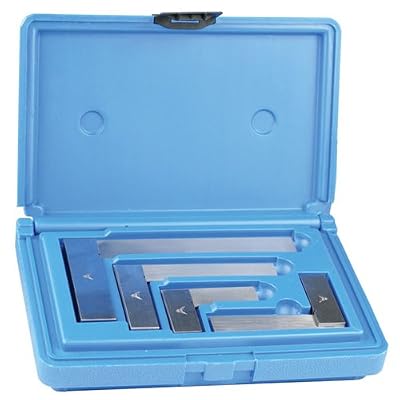
This four-piece set anchors a shop that does layout and setup daily. The 2, 3, 4 and 6 inch squares are machined from hardened alloy tool steel, with inside and outside faces precision ground so both angles read true. PEC holds the set to a genuine 90 degrees within plus or minus 0.0006 inch, a figure the maker prints rather than hides, and a relief notch at the inner corner clears burrs so the square seats fully.
The sizes nest in one fitted case: the 2 inch for small parts, the 4 inch for bench layout, the 6 inch when a blade must span a head face. The blades carry no graduations, correct for a reference square meant for checking and scribing, not measuring.
Specs
– Sizes: 2, 3, 4 and 6 inch blades
– Material: hardened alloy tool steel
– Squareness: true 90 degrees within ±0.0006 inch
– Faces: precision ground inside and outside
– Detail: inner-corner relief notch for burr clearance
– Storage: fitted protective case, made in the USA
2. Kinex 4026-12-154T Four-Piece Solid Square Set

Kinex, a Czech maker of measuring instruments, builds this set to the German DIN 875 Grade 1 standard and states the deviation plainly: square within 18 microns, about 0.0007 inch. The four solid squares run 2-3/8, 3, 4 and 6 inches (60, 75, 100 and 150 mm), each machined from a single steel blank, so no riveted joint can loosen and quietly ruin the angle.
A one-piece square behaves the same way every time you pick it up, which is what you want when squaring a milling vise, truing a fixture, or checking a machined face on an engine block. The metric-friendly sizing suits shops working on imported generator engines, and the tolerance is stated in a recognized standard rather than marketing language.
Specs
– Sizes: 2-3/8, 3, 4 and 6 inch (60, 75, 100, 150 mm)
– Standard: DIN 875 Grade 1
– Squareness: within 18 microns (0.0007 inch)
– Construction: solid one-piece steel blanks
– Model: 4026-12-154T
– Maker: Kinex Measuring, Czech Republic
3. Kinex 4026-02-006 Solid Machinist Square, DIN 875 Grade 0
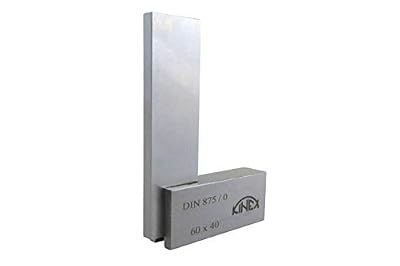
This little square is the inspection-grade option. At 2-3/8 by 1-5/8 inches (60 by 40 mm) it works in tight spaces, yet Kinex builds it to DIN 875 Grade 0, square within 6 microns, roughly 0.0002 inch. That is the grade for verifying other tools and checking precision-ground parts.
It is a solid one-piece square with ground reference faces, and the compact beam lets it stand on an edge for hands-free checks against the light. Handle it carefully: one drop onto concrete can move it by more than its entire tolerance band. Kept in its box, it serves as the truth standard for your measuring kit.
Specs
– Size: 2-3/8 x 1-5/8 inch (60 x 40 mm)
– Standard: DIN 875 Grade 0
– Squareness: within 6 microns (0.0002 inch)
– Construction: solid one-piece steel blank
– Faces: ground reference edges
– Model: 4026-02-006
4. Groz 01000 Precision Steel Square, 2 Inch

Groz builds this 2 inch square to BS 939 Grade B, the British workshop grade, with a stated squareness of 16 microns, about 0.00063 inch. That is respectable for everyday setup work: aligning a saw fence, checking a drill press table, squaring small brackets, or verifying a ground face on a pump housing.
The hardened blade resists the nicks that soften an unhardened edge, and the ground faces register cleanly against a reference edge. At this size it lives in an apron pocket or toolbox tray, ready for the quick check you would skip if you had to fetch a bigger instrument.
Specs
– Size: 2 inch blade
– Standard: BS 939 Grade B (workshop grade)
– Squareness: 16 microns (about 0.00063 inch)
– Blade: hardened precision steel
– Faces: ground beam and blade
– Model: 01000
5. PEC Tools Wide Seat Machinist Square, 4 x 3 Inch

Most solid squares have a beam only slightly wider than the blade. This PEC design spreads the beam into a wide seat, so the square stands upright on its own base. That matters during machine setup: stand it on a mill table or lathe bed and it stays put while you bring a part or vise jaw up to the blade, both hands free.
The 4 inch blade with a 3 inch beam is ground from hardened steel, held to a true 90 degree angle, and the broad faces resist rocking. It also works laid flat for layout, scribing lines across plate for generator enclosures and mounting brackets. If your squaring happens mostly at machines, the wide seat is the practical shape.
Specs
– Size: 4 inch blade x 3 inch beam
– Type: wide seat (wide beam) engineer square
– Material: ground hardened steel
– Angle: true 90 degrees, precision ground faces
– Weight: 5.9 ounces
– Maker: PEC Tools
How to choose
Size first. Small 2 and 3 inch squares suit tight work inside a vise or on small parts. The 4 and 6 inch sizes are the bench workhorses, long enough to read across a head face or a drill press table. Squares of 9 and 12 inches exist for large machine tables but are clumsy at the bench, so most shops cover 2 to 6 inches.
Understand the grades. DIN 875 ranks squares by permitted deviation, each step roughly doubling the allowance. Grade 0 is inspection grade, around 7 microns at 100 mm, for the toolroom and for checking other tools. Grade 1, around 14 microns, is the precision workshop grade most machinists need. Grade 2 is the general workshop grade, fine for fabrication. BS 939 Grade B, on the Groz above, is the British workshop grade; Grade A is its inspection counterpart.
Hardened and ground, with honest edges. Choose hardened steel with ground faces over soft or stamped squares. Some blades carry beveled edges: the thin edge makes line contact with the work, so a sliver of light shows clearly when a part is out of square, which is why inspection squares favor them.
Run the flip test. Scribe a fine line along the blade against a known straight edge, flip the square over, and scribe a second line beside the first. Parallel lines mean the square is true; a wedge shows twice the actual error.
Store it like an instrument. Wipe it with a light film of oil, keep it in its case, and never use it as a scraper or pry. Ground edges nick easily, and a nicked edge damages finished faces.
FAQ
What size machinist square suits most bench work?
A 4 or 6 inch square handles most layout and setup jobs. Add a 2 inch square for small parts and tight corners.
Is DIN 875 Grade 1 accurate enough for engine work?
Yes. Grade 1 holds roughly 14 microns at 100 mm, far tighter than checking head faces, squaring fixtures, or setting up machine tables demands.
Can a machinist square replace a combination square?
They do different jobs. A combination square measures and marks with a sliding blade, which can shift. A solid machinist square holds one fixed, certified 90 degrees, more reliably. Most shops own both.
How often should I check my square against a master?
Run the flip test whenever the square has been dropped, and once or twice a year in normal use.
Verdict
For one purchase that covers a generator shop, the PEC 7000-S-4 set is the balanced choice: four hardened, ground sizes with a published tolerance and a proper case. Choose the Kinex set for a DIN 875 Grade 1 document trail, the small Kinex Grade 0 square for inspection work, the Groz 2 inch as an honest pocket square, and the PEC wide seat for machine setup work.


Write Your Review
No reviews yet. Be the first to share your experience!