
Our Short List of 3
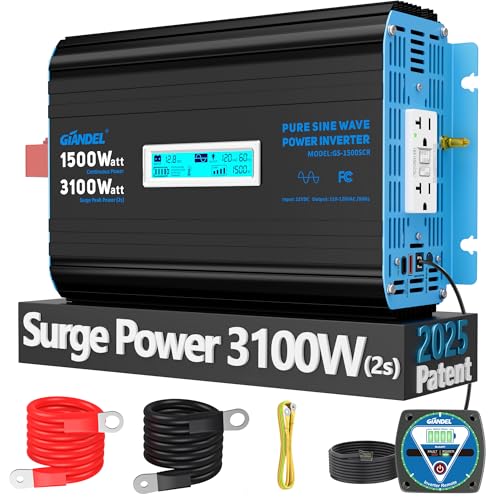
- Best for: Running laptops, TVs, and other sensitive electronics from a battery bank, especially in boats, RVs, or anywhere GFCI protection is valuable.
- Continuous power: 1500W
- Surge power: 3100W for 2 seconds
- Input: 12V DC
- Output: 110-120V AC, 60 Hz, pure sine wave

- Best for: Permanent installations in vehicles, boats, and off-grid systems where the inverter is wired in once and used daily.
- Model: KR1500 (KR1500-12)
- Continuous power: 1500W
- Peak power: 3000W
- Waveform: Modified sine wave

- Best for: Occasional and portable use in a car, truck, or RV where a display, extra outlets, and included cables matter more than clean sine output.
- Continuous power: 1500W
- Peak power: 3000W
- Waveform: Modified sine wave
- Input: DC 11-15V
All 3 Picks at a Glance
| Product | Specs | Action |
|---|---|---|
| 1. Giandel GS-1500SCR Pure Sine Wave Inverter |
| Check price on Amazon |
| 2. Krieger KR1500 Power Inverter |
| Check price on Amazon |
| 3. Ampeak 1500W Power Inverter |
| Check price on Amazon |
🛒 Best Price Today on Amazon
Prime members get fast, free shipping on everything above, plus member-only deals. New members get a 30-day free trial — cancel anytime.
A 1500 watt inverter turns a 12-volt battery into household AC power for the loads that sit in the middle of the range: a refrigerator during an outage, power tools at a work site, or a small off-grid cabin setup. It is a popular size because it runs those mid-size loads without the cost, cable size, and battery bank that a 3000 watt unit demands. Every inverter below is a standalone DC-to-AC unit rated at exactly 1500 watts continuous on its listing, not an inverter generator and not a power station.
The three picks split along the decisions that actually matter at this size. One is a pure sine wave model with GFCI outlets and fast USB charging, one is a modified sine wave unit built for permanent hardwired installation, and one is a portable modified sine wave inverter with an LCD display and a lighter socket for smaller loads. Match the waveform and the installation style to your loads first, and the rest of the spec sheet falls into place.
Quick Picks
As an Amazon Associate we earn from qualifying purchases.
| Product | Best for | Key spec from title |
|---|---|---|
| Giandel GS-1500SCR Pure Sine Wave Inverter | Sensitive electronics and GFCI protection | 1500W pure sine wave, dual GFCI outlets |
| Krieger KR1500 Power Inverter | Permanent hardwired installations | 1500W continuous, 3000W peak, installation kit |
| Ampeak 1500W Power Inverter | Portable use with a display and USB ports | 1500W continuous, 3 AC outlets, LCD display |
How to Choose
Pure Sine Wave or Modified Sine Wave
The waveform decides what you can run safely. Pure sine wave output matches household electricity, so it suits laptops, TVs, audio gear, medical devices, and anything with a motor speed control or a sensitive power supply. Modified sine wave inverters cost less and run simple loads like lights, fans, and basic tools well, but some chargers buzz, some motors run hotter, and a few devices refuse to work at all. If your load list includes electronics you would not want to replace, the pure sine wave model is the safer default even at the same wattage.
Continuous Watts, Surge Watts, and Your Battery
The 1500 watt figure is the continuous rating: what the inverter can supply indefinitely. Surge rating, usually around double, covers the brief startup draw of motors and compressors, and it lasts seconds, not minutes. Just as important is the battery side. Pulling 1500 watts from a 12-volt battery means well over 100 amps of DC current, so a single small battery will sag quickly under a full load. Plan the battery bank and cable run for the loads you will actually sustain, and treat the full 1500 watts as headroom rather than a cruising speed.
Outlets, USB, and Protection Features
Count the outlets your setup genuinely needs, then look at what kind they are. GFCI outlets add ground-fault protection that matters in damp locations like boats, garages, and outdoor work. USB ports vary widely: basic ports charge phones slowly, while USB-C Power Delivery and Quick Charge ports can run a laptop or fast-charge a phone without a separate brick. Protection circuits for overload, overheating, low battery, and short circuits are standard on decent units, and a remote switch is worth having when the inverter is mounted somewhere you cannot easily reach.
Portable Clamp-On or Hardwired Installation
Portable inverters connect with clamps or a lighter socket and move between vehicles, which suits occasional use. The lighter socket, though, is only good for small loads, so full power always requires a direct battery connection with appropriately sized cables. Hardwired models bolt in permanently with an installation kit and are the better choice for an RV, boat, or solar setup that runs every day. Decide honestly how you will use the inverter: a permanent setup done with clamps and loose cables is both inconvenient and a safety compromise.
The 3 Best Options
1. Giandel GS-1500SCR Pure Sine Wave Inverter
- Best for: Running laptops, TVs, and other sensitive electronics from a battery bank, especially in boats, RVs, or anywhere GFCI protection is valuable.
- Continuous power: 1500W
- Surge power: 3100W for 2 seconds
- Input: 12V DC
- Output: 110-120V AC, 60 Hz, pure sine wave
Running laptops, TVs, and other sensitive electronics from a battery bank, especially in boats, RVs, or anywhere GFCI protection is valuable.
Idle current draw is listed at up to 0.95A, so switch it off between uses on a small battery bank rather than leaving it in standby.
The Giandel GS-1500SCR is the full-featured option: 1500 watts continuous of pure sine wave output with a stated total harmonic distortion under 3%, which is the clean-power figure sensitive electronics want. Its two AC outlets are 20-amp GFCI receptacles, a combination rarely found at this size, and charging is covered by a USB-C Power Delivery port rated at 36 watts plus a Quick Charge 3.0 USB-A port. A wired remote with a 15-foot cable is included for mounted installations, and the unit carries UL 458 and FCC listings, which matters for a device that lives connected to a battery bank.
2. Krieger KR1500 Power Inverter
- Best for: Permanent installations in vehicles, boats, and off-grid systems where the inverter is wired in once and used daily.
- Model: KR1500 (KR1500-12)
- Continuous power: 1500W
- Peak power: 3000W
- Waveform: Modified sine wave
Permanent installations in vehicles, boats, and off-grid systems where the inverter is wired in once and used daily.
Modified sine wave output is not the right choice for sensitive electronics or some motor-driven tools, and hardwiring means installation takes more than clipping on clamps.
The Krieger KR1500 is built for installation rather than portability. It supplies 1500 watts continuous and 3000 watts peak of modified sine wave power through dual AC outlets, and it ships with an installation kit intended for a permanent hardwired connection to a 12-volt battery system. That makes it a natural fit for a work truck, boat, or off-grid setup where the inverter stays mounted and wired rather than being clamped on when needed. Krieger lists the unit as ETL approved to UL standard 458, the safety standard for power inverters, which is a credential worth checking on any unit you plan to hardwire.
3. Ampeak 1500W Power Inverter
- Best for: Occasional and portable use in a car, truck, or RV where a display, extra outlets, and included cables matter more than clean sine output.
- Continuous power: 1500W
- Peak power: 3000W
- Waveform: Modified sine wave
- Input: DC 11-15V
Occasional and portable use in a car, truck, or RV where a display, extra outlets, and included cables matter more than clean sine output.
Modified sine wave output limits it for sensitive electronics, and the included cables are short, so the inverter needs to sit close to the battery.
The Ampeak is the portable all-rounder of the three. It delivers 1500 watts continuous and 3000 watts peak of modified sine wave power through three AC outlets, more outlets than the other two picks, and adds an LCD display that shows input voltage and load status so you can see what the battery is doing. Dual USB ports rated at 3.1 amps each handle phone charging, and the package includes 6AWG battery cables. A cigarette lighter socket connection is also provided for light loads, though as with any inverter this size, full output requires the direct battery cables, not the socket.
Which One Fits Your Situation
You Run a Laptop, TV, or Medical Device From a Battery
Choose the Giandel GS-1500SCR. Pure sine wave output with low stated distortion is the specification that protects sensitive power supplies, and its USB-C Power Delivery port can charge a modern laptop directly. The GFCI outlets add a layer of protection that is genuinely useful in the damp places battery banks tend to live, and the wired remote means a mounted unit does not need to be within arm’s reach to switch on.
You Are Wiring an Inverter Into a Truck, Boat, or Cabin
Choose the Krieger KR1500. It is the only pick here designed around a permanent hardwired installation, with the kit included and an ETL listing to UL 458 behind it. Modified sine wave output is acceptable for the tools, lights, and simple appliances that dominate work and off-grid loads. Wire it once, mount it somewhere ventilated, and it becomes part of the vehicle or system rather than another loose device to store.
You Need Occasional Backup or Road-Trip Power
Choose the Ampeak. Three AC outlets, a readable LCD, USB charging, and included battery cables make it the easiest of the three to pull out during an outage or take on the road. Keep expectations aligned with modified sine wave output and connect the battery cables directly for anything beyond a small load, since the lighter socket cannot carry anywhere near the inverter’s full rating.
You Are Building a Small Solar Setup
Any 1500 watt inverter can anchor a small solar system, but the Giandel’s pure sine output and remote switch suit a fixed installation best, while the Krieger’s hardwire kit suits a system that will never move. Size the battery bank for your daily watt-hours rather than the inverter’s peak, keep the DC cable run as short as the layout allows, and remember the inverter’s own idle draw comes out of the same batteries every hour it stays on.
Common Mistakes
- Buying by peak watts instead of the continuous rating, then finding the inverter shuts down on loads it supposedly handles.
- Running a 1500 watt inverter from a cigarette lighter socket, which cannot supply anywhere near that power.
- Using cables that are too thin or too long, causing voltage drop, heat, and nuisance shutdowns under load.
- Plugging sensitive electronics into a modified sine wave inverter without checking the device maker’s guidance.
- Leaving the inverter switched on in standby, quietly draining the battery through its idle current draw.
Frequently Asked Questions
Can a 1500 watt inverter run a refrigerator?
Usually yes, provided the surge rating covers the compressor’s startup draw. A typical household refrigerator runs at a few hundred watts but can demand several times that for a moment at startup, which is what the 3000 watt-plus surge figures on these units are for. Confirm your refrigerator’s starting requirement, and size the battery bank for how long you need it to run, not just whether it starts.
How long will a 1500 watt inverter run on one battery?
It depends on the load and the battery’s usable capacity. A single 12-volt battery under a sustained load near 1500 watts will be drained quickly, in well under an hour of full output, because the DC current draw is very high. Lighter loads stretch runtime proportionally. For outage or off-grid use, most people pair an inverter this size with a bank of two or more deep-cycle batteries.
Is pure sine wave worth it over modified sine wave?
For simple resistive and basic motor loads, modified sine wave works and costs less. For laptops, modern TVs, audio equipment, variable-speed tools, and anything with a sophisticated charger or power supply, pure sine wave is the safer choice and avoids buzzing, excess heat, and occasional outright incompatibility. If your load list is mixed and includes electronics you value, pure sine is the sensible default.
Can I leave a 1500 watt inverter connected to my vehicle battery?
You can, but switch it off when it is not powering anything. Inverters draw idle current even with no load attached, and at this size that draw can flatten a starting battery over a day or two. For regular use, hardwired models with a remote switch make it easy to power down completely, and a battery isolator or a separate deep-cycle battery protects your ability to start the vehicle.







Write Your Review
No reviews yet. Be the first to share your experience!