
Our Short List of 3

- Capacity: 16 fl oz
- Bottle: hardened clear glass, pinch-waist shape
- Feeding ports: 4 flower-shaped ports with perches
- Ant defense: built-in ant moat in the cap

- Capacity: 12 oz
- Feeding ports: 4, set into the cover
- Ant defense: built-in ant moat in the center
- Perch: raised wrap-around HighView perch
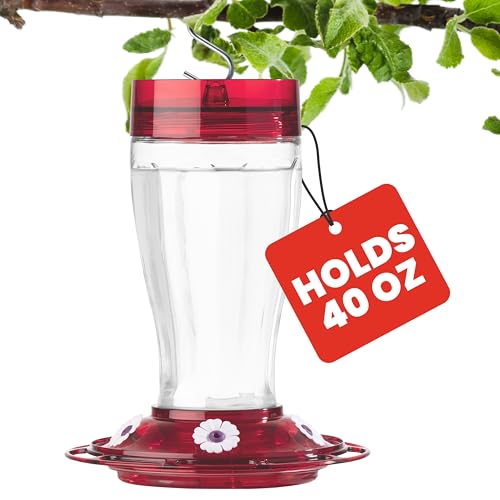
- Capacity: 40 fl oz
- Bottle: glass with wide-mouth opening
- Feeding stations: 5 flower-shaped ports
- Bee defense: bee guards fitted to the ports
All 4 Picks at a Glance
| Product | Specs | Action |
|---|---|---|
| Perky-Pet Pinch-Waist Glass Hummingbird Feeder 210PB |
| Check price on Amazon |
| Aspects HummZinger HighView Hummingbird Feeder |
| Check price on Amazon |
| More Birds Big Gulp Hummingbird Feeder |
| Check price on Amazon |
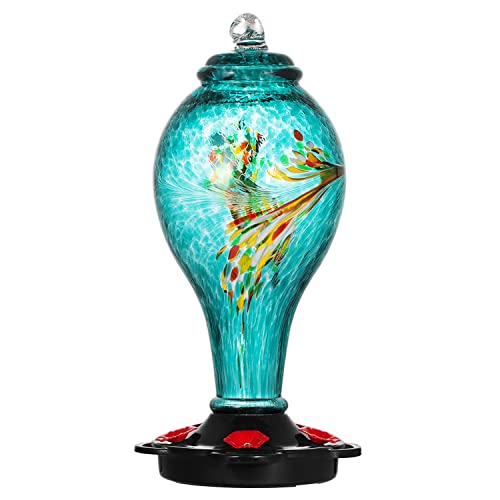 LUJII Hand Blown Glass Hummingbird Feeder |
| Check price on Amazon |
🛒 Best Price Today on Amazon
Prime members get fast, free shipping on everything above, plus member-only deals. New members get a 30-day free trial — cancel anytime.
A good hummingbird feeder has three jobs: keep nectar fresh, keep ants and bees out of it, and come apart quickly for washing. The designs that manage all three look quite different. Bottle feeders hold nectar in an inverted reservoir above the ports, dish feeders keep it in a shallow bowl below them, and window models trade capacity for close-up viewing.
This guide covers the five styles most yards actually need: a classic glass bottle, a saucer feeder with a built-in ant moat, a window-mounted feeder on suction cups, a large 40 oz feeder for busy gardens, and a hand blown glass feeder that doubles as garden decor. Every pick runs on plain homemade nectar and comes apart for scrubbing.
As an Amazon Associate, we earn from qualifying purchases.
Quick answer
- Classic glass bottle: Perky-Pet Pinch-Waist Glass Hummingbird Feeder 210PB
- Dish feeder with ant moat: Aspects HummZinger HighView Hummingbird Feeder
- Window viewing: Perky-Pet Window-Mounted Glass Hummingbird Feeder 455-2
- Large capacity: More Birds Big Gulp Hummingbird Feeder
- Decorative hand blown glass: LUJII Hand Blown Glass Hummingbird Feeder
Perky-Pet Pinch-Waist Glass Hummingbird Feeder 210PB
- Capacity: 16 fl oz
- Bottle: hardened clear glass, pinch-waist shape
- Feeding ports: 4 flower-shaped ports with perches
- Ant defense: built-in ant moat in the cap
The pinch-waist bottle is the shape most people picture when they think of a hummingbird feeder, and this version keeps the formula simple. A hardened glass reservoir holds 16 oz of nectar, the wide mouth makes filling and scrubbing the inside far easier than narrow-neck bottles, and the base twists apart so the four flower ports and perches can be washed properly. Built-in bee guards sit over the ports, and the cap carries a small ant moat you fill with plain water.
Like every inverted bottle design, it can weep a little when hot sun warms the air trapped inside and pushes liquid out. Hang it in light shade and that habit mostly disappears. Glass also asks for care in freezing weather, so bring it in on hard frost nights.
Aspects HummZinger HighView Hummingbird Feeder
- Capacity: 12 oz
- Feeding ports: 4, set into the cover
- Ant defense: built-in ant moat in the center
- Perch: raised wrap-around HighView perch
The HummZinger takes the opposite approach to a bottle feeder. Nectar sits in a shallow polycarbonate dish beneath a bright red cover, so there is no vacuum reservoir to expand in the heat and push liquid out. That single choice makes this the most leak-resistant feeder in the group, and the usual fix for sticky patios and wasps under a dripping bottle.
The raised perch ring circles the dish and lifts feeding birds up where you can see them from above. The center of the cover holds a built-in ant moat, the cover lifts straight off, and the whole feeder is only two pieces, so a full wash takes minutes. Capacity is a modest 12 oz with four ports, which suits most gardens fine, because nectar should be replaced every few days in warm weather anyway.
Perky-Pet Window-Mounted Glass Hummingbird Feeder 455-2
Nothing else on this list puts a feeding hummingbird a few inches from your face. This feeder has a flat-backed tempered glass reservoir that presses against the outside of a window and holds there on two suction cups, for close-up viewing from inside the house. It holds 14 oz and feeds through two sculpted flower ports, each with a perch.
Suction cups hold well on clean, smooth glass and poorly on dirty or textured panes, so wipe the window with vinegar and dry it fully before mounting, then press each cup firmly from the center outward. Because the feeder sits so close to the glass, birds approach slowly and cannot build up the speed that makes window collisions dangerous.
Specs
- Capacity: 14 fl oz
- Reservoir: tempered clear glass, flat-backed
- Mounting: two suction cups for window glass
- Feeding ports: 2 sculpted flower ports
More Birds Big Gulp Hummingbird Feeder
- Capacity: 40 fl oz
- Bottle: glass with wide-mouth opening
- Feeding stations: 5 flower-shaped ports
- Bee defense: bee guards fitted to the ports
When a yard sits on a busy route at the peak of the season, a 16 oz feeder can be empty by the second day. The Big Gulp answers with a 40 oz glass bottle and five feeding stations spaced around a circular perch, so several birds can drink at once. The wide mouth makes the big bottle manageable to fill and scrub, and the base includes bee guards plus a built-in ant moat.
The honest catch is freshness. Forty ounces only helps if your birds actually drink it down, because nectar still needs changing every two to three days in hot weather, sooner if it turns cloudy. Full, it is also the heaviest feeder here, so hang it from a solid hook or a firmly set shepherd’s crook, not a thin branch.
LUJII Hand Blown Glass Hummingbird Feeder
- Capacity: 36 fl oz
- Reservoir: hand blown glass, each piece slightly unique
- Feeding stations: 5 metal flower stations
- Finish: color worked into the glass, not painted on
Most feeders are tools first and ornaments second. This one reverses that order without giving up the practical parts. The reservoir is hand blown glass, so the swirls of color run through the material itself rather than sitting on the surface as paint. It holds 36 oz, feeds through five metal flower stations, and uses a sealed base that limits dripping.
Thick glass is heavier than it looks, so give it a sturdy hook and partial shade, which also keeps the metal feeding flowers from getting hot in full sun. Wash it by hand with warm water and a bottle brush, and handle it with care over concrete. As a gift or a patio focal point, it does what none of the plastic feeders here can.
How to choose
Match capacity to your bird traffic, not your hopes. Nectar spoils quickly, every two to three days in summer heat and roughly twice a week in mild weather, so a feeder holding more than your birds drink in that window wastes sugar water. Quiet yards do better with 12 to 16 oz; busy yards can use 36 to 40 oz.
Pick the body style next. Saucer feeders hold nectar below the ports and rarely leak, while bottle feeders show the level at a glance. Glass washes cleaner and resists staining; polycarbonate survives drops that would end a glass bottle. Whatever the style, insist on an ant moat and favor feeders that come fully apart, because unscrubbed feeders grow mold. Hang it in light shade, four to five feet up, near flowers, away from dense shrubs where cats hide.
FAQ
How do I make nectar, and does it need red dye?
Mix one part plain white sugar with four parts water, warm it so the sugar dissolves fully, let it cool, and fill. That ratio matches flower nectar. Never use honey, which can carry fungal spores, and skip brown or powdered sugar. Red dye is unnecessary and best avoided: the red parts of the feeder already do the attracting.
How often should I clean the feeder?
Empty and wash it every time you change the nectar, every two to three days in hot weather and at least weekly in cool weather. Hot water and a small brush handle routine cleaning; for black mold, soak the parts in one part white vinegar to four parts water, scrub, and rinse well.
Why are bees and wasps crowding my feeder?
Usually because nectar reaches the outside of the ports, from a dripping bottle feeder or ports set too close to the liquid surface. A saucer feeder, bee guards, and shade all help. Moving the feeder a few feet also works: bees give up on a relocated feeder, while hummingbirds find it within hours.
Where is the best place to hang a feeder?
In light shade, four to five feet above the ground, near the flowers hummingbirds visit. Shade keeps nectar fresh longer and slows dripping. If you hang a second feeder, place it out of sight of the first so one territorial bird cannot guard both.
Verdict
For most gardens, the Aspects HummZinger HighView is the easiest feeder to live with: it rarely leaks, washes in minutes, and its moat ends most ant problems. Choose the Perky-Pet Pinch-Waist for the classic glass bottle shape, the window-mounted 455-2 for close-up viewing, the More Birds Big Gulp when a crowd empties smaller feeders in a day, and the LUJII hand blown glass feeder when the feeder itself should be part of the garden’s look. Keep the nectar plain, change it often, and any of the five will serve your birds well.

Write Your Review
No reviews yet. Be the first to share your experience!