
Our Short List of 3

- Best for: Home mechanics and small shops that diagnose fuel delivery problems regularly.
- Brand: OTC
- Model: OTC 5630
- Type: fuel pressure test kit
- UPC: 07318100156304
- Best for: Owners who want a compact tester for occasional fuel pressure checks.
- Brand: Actron
- Model: Actron CP7818
- Type: fuel pressure tester kit
- Best for: Technicians who diagnose higher-pressure fuel systems and direct-injection engines.
- Brand: BETOOLL
- Gauge range: 0-140 PSI
- Type: fuel pressure tester
All 4 Picks at a Glance
| Product | Specs | Action |
|---|---|---|
| OTC 5630 Fuel Pressure Test Kit |
| Check price on Amazon |
| Actron CP7818 Fuel Pressure Tester Kit |
| Check price on Amazon |
| BETOOLL Pro Fuel Pressure Tester |
| Check price on Amazon |
 BETOOLL Fuel Pressure Tester |
| Check price on Amazon |
🛒 Best Price Today on Amazon
Prime members get fast, free shipping on everything above, plus member-only deals. New members get a 30-day free trial — cancel anytime.
A fuel pressure gauge kit answers one question quickly: is the fuel system delivering the pressure the engine expects, or is a weak pump, a clogged filter, or a failing regulator behind the hard start. Without a gauge, that diagnosis turns into guessing and replacing parts one at a time, which costs more than the kit and often misses the fault entirely. A kit that fits the test port and reads the right range turns a vague symptom into a number, and that number tells the owner whether the fuel system is healthy or where to look next.
This guide is for home mechanics who diagnose their own cars and trucks, and for small-shop technicians who want a reliable kit for routine fuel system checks. The kits below were chosen from the names and specifications on their Amazon pages, with attention to gauge range, included adapters, hose construction, and how clearly the dial reads under the hood.
Quick Picks
As an Amazon Associate we earn from qualifying purchases.
| Product | Best for | Key spec from title |
|---|---|---|
| OTC 5630 Fuel Pressure Test Kit | General fuel pressure diagnosis on gasoline vehicles | Fuel pressure test kit |
| Actron CP7818 Fuel Pressure Tester Kit | A compact tester for quick checks | Fuel pressure tester kit |
| BETOOLL Pro Fuel Pressure Tester | Higher-pressure fuel systems | 0-140 PSI gauge |
| BETOOLL Fuel Pressure Tester | Everyday checks on standard systems | 0-100 PSI gauge |
How to Choose
Match the gauge range to the system
The gauge range decides whether the reading is useful or misleading, so check the fuel pressure the vehicle is supposed to hold before choosing a kit. Most port-injected gasoline engines run in a range that a 0-100 PSI gauge covers comfortably, and a gauge that reads far above the expected pressure crowds the numbers into a small part of the dial. Direct-injection and some high-pressure systems need a gauge that reaches further, which is where a 0-140 PSI gauge earns its place. A gauge with the right range gives a clear needle position at the expected pressure, and that clarity is what makes a diagnosis trustworthy rather than a guess.
Check the adapters before you buy
A pressure gauge is only useful if it connects to the test port, so the adapter set matters as much as the gauge itself. Most gasoline vehicles have a Schrader test port on the fuel rail, and a kit should include the fitting that screws onto it without leaking. Some vehicles, especially older GM models with throttle-body injection, need a dedicated adapter that a basic kit may not include, so check the listing for the adapter set and compare it with the vehicle. Buying the kit and then discovering the fitting does not match wastes a trip and a diagnosis, so confirm the fit first.
Look at the hose and fittings
The hose carries pressurized fuel to the gauge, so its construction is a safety matter as much as a convenience one. A hose with a braided cover and solid brass fittings resists kinking and leaking better than a plain rubber line with thin connectors, and a relief valve on the gauge lets fuel bleed off safely after the test. Check that the hose is long enough to route the gauge where it can be read while the engine runs, because a short hose forces the gauge into a hot or cramped spot. A kit with a proper relief valve and sturdy fittings is easier and safer to use.
Read the gauge clearly under the hood
A gauge that cannot be read in a dim engine bay is a poor tool, so look for a dial with large numerals and a clear scale. A gauge with a protective boot survives being set down on a fender or dropped on a garage floor, and a dial that is easy to read at arm’s length lets the pressure be checked while the engine runs. Some gauges include a rubber guard around the case, which also helps grip the gauge with greasy hands. Clarity and durability matter because the gauge is read in awkward positions, often with the engine running and the light poor, so choose one that stays legible.
The 4 Best Options
OTC 5630 Fuel Pressure Test Kit
- Best for: Home mechanics and small shops that diagnose fuel delivery problems regularly.
- Brand: OTC
- Model: OTC 5630
- Type: fuel pressure test kit
- UPC: 07318100156304
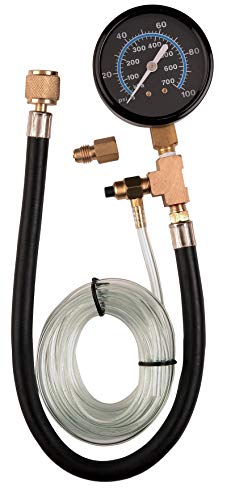
Home mechanics and small shops that diagnose fuel delivery problems regularly.
Confirm the included adapters match the test port on the vehicle before ordering, since adapter sets vary.
The OTC 5630 is the established name in this group, and it fits buyers who want a fuel pressure kit from a brand that has supplied professional technicians for decades. The kit is built around a gauge and hose set for testing fuel pressure on gasoline vehicles, and its long presence on the market means adapters and replacement parts are easy to find. It suits a home mechanic who diagnoses fuel delivery problems regularly and wants a kit that will still be supported years from now, rather than a one-season tool.
Watch out for: Confirm the included adapters match the test port on the vehicle before ordering, since adapter sets vary.
Actron CP7818 Fuel Pressure Tester Kit
- Best for: Owners who want a compact tester for occasional fuel pressure checks.
- Brand: Actron
- Model: Actron CP7818
- Type: fuel pressure tester kit
Owners who want a compact tester for occasional fuel pressure checks.
Check the adapter fit for the vehicle, since a compact kit may include fewer adapters than a full set.
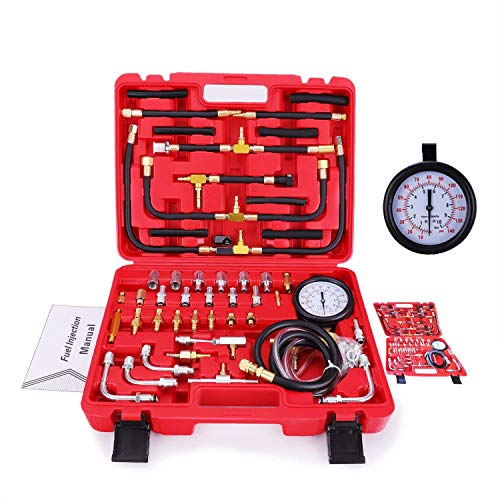
The Actron CP7818 suits buyers who want a compact tester for quick fuel pressure checks without a large case of adapters. The kit is a fuel pressure tester built for straightforward diagnosis, and its smaller footprint makes it easy to keep in a toolbox or carry to a vehicle that will not start. It fits owners who check fuel pressure occasionally and want a simple tool that connects, reads, and stores without fuss, and who would rather have a small kit they actually use than a large one that stays on the shelf.
Watch out for: Check the adapter fit for the vehicle, since a compact kit may include fewer adapters than a full set.
BETOOLL Pro Fuel Pressure Tester
- Best for: Technicians who diagnose higher-pressure fuel systems and direct-injection engines.
- Brand: BETOOLL
- Gauge range: 0-140 PSI
- Type: fuel pressure tester
Technicians who diagnose higher-pressure fuel systems and direct-injection engines.
A wide-range gauge gives less precise readings at low pressures, so match the range to the system being tested.
The BETOOLL Pro tester suits buyers who work on higher-pressure fuel systems, because its gauge reads to 140 PSI and covers systems that a 100 PSI gauge cannot. The kit is a fuel pressure tester with a wider range, and that extra headroom makes it useful for direct-injection and other high-pressure setups where the expected pressure sits above the range of a standard gauge. It fits technicians who see a mix of vehicles and want one gauge that covers the higher end without buying a second kit for those jobs.
Watch out for: A wide-range gauge gives less precise readings at low pressures, so match the range to the system being tested.
BETOOLL Fuel Pressure Tester
- Best for: Owners testing fuel pressure on standard port-injected gasoline vehicles.
- Brand: BETOOLL
- Gauge range: 0-100 PSI
- Type: professional fuel injection pressure tester gauge kit with hose
Owners testing fuel pressure on standard port-injected gasoline vehicles.
The 100 PSI limit does not cover high-pressure direct-injection systems, so check the expected pressure first.
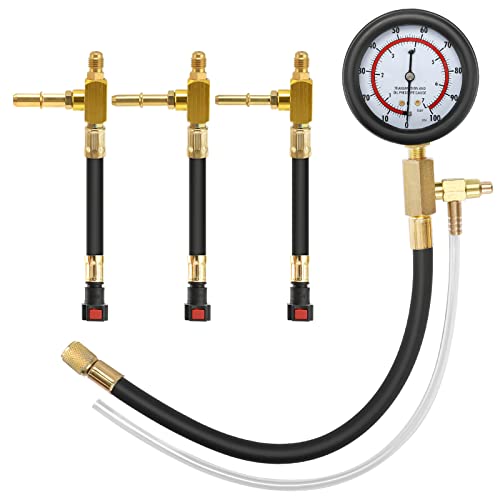
The BETOOLL fuel pressure tester suits buyers who want a straightforward kit for everyday checks on standard gasoline systems. Its gauge reads to 100 PSI, which covers the expected pressure of most port-injected engines, and the kit is described as a professional fuel injection pressure tester gauge kit with a hose. It fits owners who test fuel pressure on one or two family vehicles and want a complete kit without paying for a range they will never use, and the included hose makes the hookup simple.
Watch out for: The 100 PSI limit does not cover high-pressure direct-injection systems, so check the expected pressure first.
Which One Fits Your Situation
Diagnosing a hard start on a family car
Choose the BETOOLL fuel pressure tester, because its 0-100 PSI gauge covers the expected pressure of most port-injected engines and the kit includes a hose for a straightforward hookup. Connect it to the fuel rail test port, turn the key, and compare the reading with the expected pressure. A low reading points to the pump or filter, while a reading that falls quickly points to a leaking injector or regulator.
Checking a direct-injection engine
Choose the BETOOLL Pro tester, because its 0-140 PSI gauge reaches the higher pressures that direct-injection systems use. A standard 100 PSI gauge cannot read those pressures, so the wider range is not optional here. Connect it to the low-pressure side test point the maker specifies, and compare the reading with the expected value before condemning the pump or any other part.
Building a toolbox for regular diagnosis
Choose the OTC 5630, because it comes from a long-established tool brand and its kit format suits repeated use in a home garage or small shop. Keep the adapters organized in the case, check the hose and fittings before each use, and store the gauge where it will not be knocked around. A kit that is used often should be one that is easy to find parts for.
A quick check on a vehicle that will not start
Choose the Actron CP7818, because its compact size makes it easy to carry to the vehicle and connect quickly. A no-start diagnosis needs a fast answer about fuel pressure, and a small tester that reads the rail pressure tells the owner whether to look at the fuel system or move on to spark and compression.
Common Mistakes
- Buying a gauge whose range does not cover the expected fuel pressure, which makes the reading useless and the diagnosis a guess.
- Forgetting to check whether the kit includes the adapter for the vehicle’s test port before ordering.
- Testing fuel pressure without a relief valve or a rag to catch spilled fuel, which creates a fire risk in the engine bay.
- Condemning the fuel pump on one low reading without checking the filter, the regulator, and the wiring first.
- Storing the gauge loose in a toolbox where the dial can be cracked, the hose kinked, or the fittings damaged.
Frequently Asked Questions
What fuel pressure should my car have?
The expected fuel pressure varies by vehicle and fuel system, and the correct figure is in the service manual for that model. Most port-injected gasoline engines run in a range that a 0-100 PSI gauge covers, while direct-injection systems run higher. Never guess the figure from another vehicle, because the same engine family can use different pressures.
Can I test fuel pressure without a Schrader valve?
Some vehicles have no Schrader test port on the fuel rail, and those need a T-fitting installed in the fuel line. A kit that only connects to a Schrader valve cannot test those vehicles, so check the fuel rail. Installing a T-fitting means opening the fuel line, so relieve the pressure and work in a ventilated area.
Is a fuel pressure gauge kit safe to use at home?
A fuel pressure gauge kit is safe when used with care, because it connects to a pressurized fuel line and fuel can spray if a fitting leaks. Work outdoors, keep ignition sources away, and wear eye protection. Use the relief valve to bleed pressure before removing the gauge, and wipe up spilled fuel right away.
Why does fuel pressure drop after I turn the engine off?
Fuel pressure normally falls slowly after the engine stops, but a fast drop points to a leaking injector, a faulty check valve in the pump, or a failing pressure regulator. Watch the gauge for several minutes after shutting the engine off. A rapid drop to zero within a minute usually means a leak in the system.

Write Your Review
No reviews yet. Be the first to share your experience!