
🛒 Best Price Today on Amazon
Prime members get fast, free shipping on everything above, plus member-only deals. New members get a 30-day free trial — cancel anytime.
A carbureted Chevy 350 starts hard on cold mornings, stalls in traffic, and needs constant choke and idle attention, while electronic fuel injection sorts all of that out on its own. A throttle-body EFI kit bolts onto the 4150 intake flange in place of the four-barrel carburetor, adds injectors, sensors, and an ECU that learns as you drive, and turns a temperamental small-block into a turn-key engine. The two kits below both fit a Chevy 350, but they take different paths to the same result: one is a complete master kit with an inline pump, and the other pairs a 600-horsepower throttle body with an in-tank fuel module.
Both kits are self-tuning, so neither needs a laptop or a dyno session to run well. Your choice comes down to horsepower support, fuel delivery, and how complete you want the box to be. Check the flange, the fuel system, and the ignition setup before you order, and the conversion will go smoothly.
Quick Picks
As an Amazon Associate we earn from qualifying purchases.
| Product | Best for | Key spec |
|---|---|---|
| Holley Sniper EFI 550-510K | Complete master kit with inline pump | 800 CFM, up to 650 HP |
| FiTech 36202 Go EFI 4 | 600 HP with in-tank fuel module | Go Fuel in-tank module included |
How to Choose
Match the flange and the intake
Most throttle-body EFI kits bolt onto a standard four-barrel intake in place of a square-bore carburetor, and both kits in this guide fit a 4150 flange. Confirm whether your manifold uses a 4150-style square-bore flange, a spread-bore flange, or a two-barrel flange before you order. The Sniper kit also fits spread-bore manifolds, with a sealing plate recommended for that layout. A 4150 kit needs an adapter for a two-barrel intake, and an adapter can change hood clearance and linkage geometry, so measure the space above the intake and check the throttle linkage travel before you commit to a kit.
Match horsepower support to the build
Match the kit to your engine output with room to spare, because the injectors set the practical ceiling for the whole system. The Holley Sniper kit uses four 100 lb/hr injectors and lists support for up to 650 horsepower naturally aspirated, which covers a built small-block. The FiTech Go EFI 4 is rated at 600 horsepower and suits engines from 200 to 650 horsepower, so it covers a stock 350 and a mild performance build. A modified engine near the top of a small kit will run out of fuel at wide-open throttle, so pick the kit that leaves headroom for the cam, heads, or intake you already plan to add.
Plan the fuel system first
EFI needs steady high-pressure fuel, which a mechanical carburetor pump cannot provide, so the fuel system deserves planning before the throttle body goes on. The Sniper master kit brings an inline pump into the box, which mounts outside the tank with hose, filters, and a return line. The FiTech kit takes the other path with a Go Fuel in-tank module that drops into the tank for quieter operation and a cleaner engine bay. Either way, allow time for clean hose routing away from exhaust heat, fit filtration before and after the pump, and secure every connection with a proper ground before the first start.
Check timing control and the tuning interface
Self-tuning kits use a wideband oxygen sensor to learn fuel corrections as you drive: you answer a setup wizard and the ECU builds its fuel map from there. A handheld controller gives you gauges at the vehicle and handles setup without a laptop. Some kits only manage fuel, while others can control ignition timing with a compatible distributor and ignition box. A fuel-only kit works with a stock distributor and is simpler to install. If you plan to adjust timing or fan control later, confirm the kit supports those features first, so you do not buy a second system to get them.
The 2 Best Options
Holley Sniper EFI 550-510K
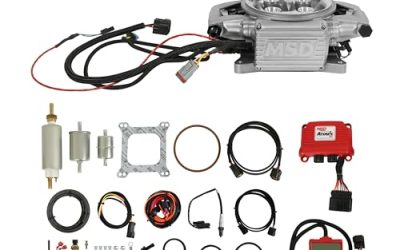
The Holley Sniper 550-510K is the original Sniper master kit, and it remains the most complete single-box conversion for a carbureted Chevy 350. Its 800-CFM throttle body bolts onto a 4150 flange or a spread-bore manifold with an adapter, and four 100 lb/hr injectors support up to 650 horsepower naturally aspirated. The master kit includes the inline fuel pump hardware, a handheld EFI monitor, and a 3.5-inch touchscreen with an integrated fuel pressure regulator. The throttle-body-mounted ECU keeps wiring short, and the self-tuning operation learns fuel corrections as you drive. It is the kit to pick when you want every part for the conversion in one box.
Specs
- 800 CFM throttle body, shiny finish
- Four 100 lb/hr injectors at 58.5 PSI
- Supports up to 650 HP naturally aspirated
- Fuel pressure: 58.5 PSI
- Flange: dual bolt pattern, fits 4150 flange and spread-bore manifolds
- Height: 3.28 in
- Inlet and outlet: 9/16-18 female O-ring (AN 6)
- 2-bar MAP sensor
- Throttle-body-mounted ECU
- Master kit with inline fuel pump and handheld EFI monitor
Best for: owners who want the most complete single-box conversion for a carbureted 350.
Watch out for: the Amazon listing is sold by a third-party seller, so confirm the seller and the contents list before ordering, and note the Sniper 2 is the newer generation of this kit.
FiTech 36202 Go EFI 4

The FiTech 36202 is the Go EFI 4 600-horsepower system bundled with a Go Fuel in-tank module, and it suits a Chevy 350 owner who wants quiet fuel delivery without an external pump and long hose runs. The throttle-body system is rated for 600 horsepower and suits engines from 200 to 650 horsepower, so it covers a stock 350 and a mild performance build with room to spare. The in-tank module drops into the fuel tank, which keeps the pump quiet and the engine bay clean. Self-tuning operation learns fuel corrections as you drive, and the system has been on the market since May 2025.
Specs
- Go EFI 4 self-tuning fuel injection system, 600 HP
- Suits engines from 200 to 650 HP
- Go Fuel in-tank fuel module included
- Four-barrel throttle-body system
- Self-tuning operation
- Manufacturer part number: 36202
Best for: owners who want a quiet in-tank pump and a 600-horsepower ceiling for a stock or mild 350.
Watch out for: confirm the in-tank module fits your fuel tank depth and opening before ordering.
Which One Fits Your Situation
You want everything in one box
Pick the Holley Sniper 550-510K when you want the throttle body, the inline fuel pump hardware, the handheld monitor, and the sensors together in a single master kit. It suits a first conversion where you do not want to match a pump, lines, and fittings separately. The 800-CFM throttle body and 650-horsepower ceiling leave room for a built small-block, and the shiny finish suits an engine bay you want to show off.
You want the quietest fuel system
Pick the FiTech 36202 when pump noise and hose clutter bother you. The Go Fuel in-tank module lives inside the tank, which cuts pump noise, shortens external plumbing, and gives the engine bay a cleaner look than an inline pump with long hose runs. It still covers a stock 350 and a mild performance build, so you give up nothing in horsepower support to get the quieter install.
Your 350 is stock or mildly built
Pick either kit when your 350 is close to stock or mildly built, since both cover that range with room to spare. The FiTech suits engines from 200 to 650 horsepower, and the Sniper supports up to 650 horsepower naturally aspirated. The deciding factor is fuel delivery: choose the inline pump master kit for a simple external install, or the in-tank module for a quieter setup. Both kits are self-tuning, so the install is the same either way.
You are converting for the first time
Pick either kit when this is your first EFI conversion, since both are self-tuning and neither needs a laptop to run well. Start with the flange and the intake, then plan the fuel system, then check the oxygen sensor placement before the first start. Read the contents list on the listing so you know what is in the box, and budget time for hose routing and wiring rather than rushing the install.
Common Mistakes
- Ordering by flange size alone while forgetting hood clearance and linkage travel.
- Under-sizing the fuel pump, or reusing a mechanical carburetor pump that cannot hold EFI pressure.
- Reusing old rubber hose that cannot handle EFI pressure.
- Placing the wideband oxygen sensor where an exhaust leak can corrupt the self-learning corrections.
- Skipping the fuel pressure check on the first start.
Frequently Asked Questions
Will a throttle-body EFI kit fit a stock Chevy 350 intake?
Yes, if the intake uses a standard 4150 square-bore flange, which most four-barrel Chevy 350 intakes do. The throttle body bolts on in place of the carburetor, using the same bolt pattern. Spread-bore intakes need a sealing plate or an adapter, and a two-barrel intake needs an adapter as well. Measure the flange and the hood clearance before you order, and confirm the linkage lines up with the throttle body.
Do I need a new fuel pump for EFI?
Yes, EFI needs steady high-pressure fuel that a mechanical carburetor pump cannot supply. The Sniper master kit in this guide includes an inline pump, while the FiTech kit includes an in-tank module, so both cover the pump in the box. If you buy a base kit without a fuel system, you will need to add a pump, lines, filtration, and a regulator separately before the system can run.
Can I keep my stock distributor with an EFI conversion kit?
Yes, a fuel-only EFI kit works with a stock distributor and is simpler to install, since the ECU manages fuel while the distributor handles spark as before. Kits that control ignition timing need a compatible distributor and ignition box, which adds wiring but gives the ECU authority over timing. Check the listing to see whether your kit manages fuel only or fuel and timing together.
Are EFI conversion kits legal for street use?
It depends on the kit and where the vehicle is registered. Many EFI conversion kits are sold for uncontrolled vehicles, racing use, or pre-emissions classics, and some carry CARB approval while others do not. Rules vary by state and vehicle year, so check the emissions note on the listing before buying. A kit that suits a weekend hot rod may not suit a daily driver that must pass inspection.


Write Your Review
No reviews yet. Be the first to share your experience!