
Our Short List of 3

- View on Amazon: https://www.amazon.com/dp/B01IWCP7XC

- View on Amazon: https://www.amazon.com/dp/B0DLDKHL7B

- View on Amazon: https://www.amazon.com/dp/B09Y2TR6GY
All 5 Picks at a Glance
| Product | Specs | Action |
|---|---|---|
| 1. TERA PUMP TRFA01 2nd Gen — Best Overall |
| Check price on Amazon |
| 2. Deway Automatic Fuel Transfer Pump with Hand Nozzle — Best Control |
| Check price on Amazon |
| 3. SEDY Electric Hand Pump 83000 — Best Dual Battery Format |
| Check price on Amazon |
 4. BestCosy Portable Transfer Pump 66459 — Best Value Design |
| Check price on Amazon |
 5. HORUSDY Electric Fuel Transfer Pump — Best Simple Pump |
| Check price on Amazon |
🛒 Best Price Today on Amazon
Prime members get fast, free shipping on everything above, plus member-only deals. New members get a 30-day free trial — cancel anytime.
- How to Choose a Battery Powered Transfer Pump
- Comparison at a Glance
- 1. TERA PUMP TRFA01 2nd Gen — Best Overall
- 2. Deway Automatic Fuel Transfer Pump with Hand Nozzle — Best Control
- 3. SEDY Electric Hand Pump 83000 — Best Dual Battery Format
- 4. BestCosy Portable Transfer Pump 66459 — Best Value Design
- 5. HORUSDY Electric Fuel Transfer Pump — Best Simple Pump
- How to Use a Battery Powered Transfer Pump
- Frequently Asked Questions
- Conclusion
Disclosure: As an Amazon Associate, we earn from qualifying purchases.
A battery powered transfer pump solves one of the most awkward jobs in generator ownership: getting fuel out of a heavy can and into a tank without lifting, tilting, and spilling. The pump drops into the can, the hose goes into the tank, and a set of batteries does the lifting. For anyone who refuels a portable generator, a lawn mower, an ATV, a boat, or a vehicle in the field, that simple change turns a two-person wrestling match into a one-button job.
It helps to be clear about what this guide covers, because the name sounds close to a different part. A generator fuel pump is a small engine component that feeds fuel from a generator tank to its carburetor. It lives inside the machine and is matched to a specific engine family. A battery powered transfer pump is a portable tool. It moves fuel or water from one container to another, it runs on AA or D batteries, and it works with any can it fits. The two products share the word pump and little else, and this guide covers only the portable transfer pump.
The five pumps below are all the same type: portable, battery powered transfer pumps that move gasoline, diesel, kerosene, and non-potable water from a can or drum into a tank. None of them needs a wall outlet, a vehicle battery connection, or a manual siphon. The differences that matter are flow rate, battery type, hose length, can fit, and whether the pump stops itself when the receiving tank fills.
How to Choose a Battery Powered Transfer Pump
Flow rate sets the pace of every refill
Flow rate, measured in gallons per minute, decides how long a refill takes and how the pump feels in use. A pump rated at 2.2 gallons per minute moves a five-gallon can in a little over two minutes. A pump rated at 3 gallons per minute finishes the same job in under two minutes. That gap sounds small on paper, and in practice it is small for a single mower tank. It grows when the job is a large generator tank, a boat tank, or several machines in a row.
Battery type decides convenience and running cost
Most portable transfer pumps run on disposable batteries, and the two common formats are AA and D cells. AA batteries are easy to find and easy to carry as spares, and a pump that runs on four AA cells is light and compact. D cells hold more energy, so a D-powered pump generally moves more liquid per set of batteries, and it suits heavy or frequent use. Several pumps in this guide accept either format through a battery conversion adapter, which is a practical advantage: use AA cells when that is what the drawer holds, and switch to D cells for a long day of refueling.
Hose length, suction tube, and can adapters
A transfer pump has two lengths that matter: the suction tube that reaches into the source can, and the discharge hose that reaches into the receiving tank. A short suction tube cannot reach the bottom of a tall can, which leaves fuel behind. A short discharge hose forces the operator to hold the can close to the tank, which defeats much of the point of the pump. A discharge hose in the range of 39 to 59 inches covers most generator and mower refueling, while a longer hose helps with boat tanks and equipment parked at an awkward angle.
Auto-stop and flow control prevent spills
The most useful safety feature on a transfer pump is an auto-stop sensor. When the receiving tank fills, the sensor stops the pump and sounds a beep, which prevents the overflow that happens when an operator looks away for a moment. Auto-stop is not a substitute for watching the fill, and it should never be treated as one, but it catches the moment a tank tops off and gives the operator a clear signal to remove the nozzle.
Which liquids, and which liquids to avoid
Every pump in this guide is listed for gasoline, diesel, kerosene, and non-potable water, and several are also listed for light oils. That range covers the ordinary refueling jobs around a home, a farm, and a job site. Corrosive liquids, solvents, and drinking water are a different matter. A pump built for fuel should not be used for drinking water, and a pump should never be used with a liquid its maker does not list. Fuel and water should also be kept separate in practice: a pump used for water and then for gasoline can carry contamination into a tank, so many owners keep one pump for fuel and another for water, or flush and dry the pump between uses according to the maker instructions.
Safety rules that apply to every pump in this guide
A battery powered transfer pump makes refueling easier, and it does not make gasoline safe. Refuel outdoors or in a well-ventilated area, away from open flame, pilot lights, and running engines. Ground the source can and the receiving tank where the maker calls for it, and wipe up any spill immediately. Never smoke while transferring fuel, and never leave a running pump unattended, even one with auto-stop. Store the pump empty, with the batteries removed if it will sit for months, and keep it away from heat. Check hoses and seals for cracks before each use, because a cracked hose leaks fuel onto hands, clothing, and hot surfaces.
Comparison at a Glance
| Pump | Flow Rate | Battery | Discharge Hose | Standout Feature |
|---|---|---|---|---|
| TERA PUMP TRFA01 2nd Gen | 3 GPM | 4 AA | Extended hose | Auto-stop sensor |
| Deway Automatic Fuel Transfer Pump with Hand Nozzle | 2.6 GPM | AA | 59 inches | Hand-trigger nozzle and VP Racing adapter |
| SEDY Electric Hand Pump 83000 | 2.2 GPM | 2 D or 6 AA | 3 feet | Dual battery format and locking clip |
| BestCosy Portable Transfer Pump 66459 | 2.4 GPM | 2 D or 6 AA | 47 inches | Dual battery format and overflow prevention |
| HORUSDY Electric Fuel Transfer Pump | 2.2 GPM | AA battery cartridges | Standard hose | Simple on-off operation for fuel and water |
1. TERA PUMP TRFA01 2nd Gen — Best Overall
- View on Amazon: https://www.amazon.com/dp/B01IWCP7XC
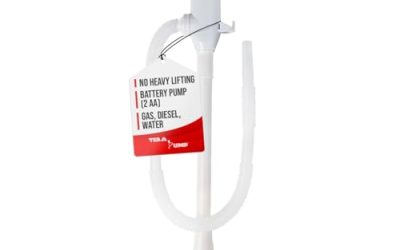
The TERA PUMP TRFA01 2nd Gen is the best overall pick in this guide because it combines the highest listed flow rate here with the feature that matters most during a fill: an auto-stop sensor. It runs on four AA batteries, moves fuel at a listed 3 gallons per minute, and stops itself when the receiving tank fills. That combination suits the core job of this guide, which is refueling a generator quickly and without spilling fuel on the ground.
The TRFA01 is a can-mounted pump. It screws or seats into the opening of a fuel can, and its intake tube draws from the bottom of the can while the discharge hose runs to the tank. The flexible intake hose is a practical detail, because rigid tubes struggle with irregular can shapes, and many utility jugs have an offset neck that a straight tube cannot follow. The pump is listed for gasoline, diesel, E15 to E85 ethanol blends, kerosene, and non-potable water, which covers the fuels a generator owner actually keeps on hand.
Four AA batteries keep the pump light and keep spares simple. A single set of fresh alkaline cells is enough for many refills, and AA cells are available at any store that sells batteries. The tradeoff is total capacity per set: a D-cell pump moves more liquid per battery change, so a household that refuels several large machines in one session may change AA cells more often. For the common case of one generator and one mower, that tradeoff is easy to accept.
2. Deway Automatic Fuel Transfer Pump with Hand Nozzle — Best Control
- View on Amazon: https://www.amazon.com/dp/B0DLDKHL7B
The Deway pump earns its place on control. It delivers a listed 2.6 gallons per minute through a hand-trigger nozzle, and it ships with a 59-inch rubber discharge hose, the longest hose in this guide. That length matters when the can sits on the ground and the tank sits high on a generator frame, or when a mower tank is tucked behind a body panel. The trigger lets the operator meter flow into a small tank, pause mid-fill to check the level, and stop instantly.
The pump runs on AA batteries and is listed for gasoline, diesel, and other liquids, with a maker figure of up to 100 gallons of transfer per battery set. Two adapters are included: a built-in adapter for standard cans and a dedicated adapter for VP Racing gas cans, which are common among owners of racing fuel jugs and utility cans. That adapter set makes the Deway the best fit for a household that owns both standard cans and racing-style jugs, because it covers both openings without a separate purchase.
3. SEDY Electric Hand Pump 83000 — Best Dual Battery Format
- View on Amazon: https://www.amazon.com/dp/B09Y2TR6GY
The SEDY Electric Hand Pump, model 83000, is the most flexible pump in this guide on power. It runs on either two D batteries or six AA batteries through a battery conversion device, so it works with whatever cells are on hand. That flexibility is worth more than it sounds during an outage, when the household battery drawer holds a mix of sizes and the generator needs fuel now.
The listed flow rate is 2.2 gallons per minute, which is the moderate end of this group, and it suits small and mid-size tanks well. The suction tube is 1 inch in diameter, which fits most fuel containers, and the discharge hose is 3 feet long, which is enough for a can set beside a generator or a mower. A built-in locking clip secures the nozzle on the receiving receptacle, which allows hands-free filling once the nozzle is seated and the pump is running.
4. BestCosy Portable Transfer Pump 66459 — Best Value Design
- View on Amazon: https://www.amazon.com/dp/B0CY44TVNJ
The BestCosy Portable Transfer Pump, model 66459, pairs a listed 2.4 gallons per minute flow rate with a 47-inch hose and the same dual battery format as the SEDY: two D batteries or six AA batteries. That combination covers the middle of this guide well, with enough flow for a generator tank, enough hose to reach it, and enough battery flexibility to keep the pump running on whatever cells are available.
The pump is listed for gas, fuel, diesel, and water transfer, and its maker describes overflow prevention among its features, with a hanging design and a built-in locking clip that secures the nozzle. The locking clip is the small feature that prevents the most common spill in this category: a nozzle that slips out of the filler neck while the pump runs. The 47-inch hose is long enough to bridge the gap between a can on the ground and a tank on a generator frame, and the thickened hose resists kinking, which matters when the hose is draped over a hot engine or a sharp frame edge.
5. HORUSDY Electric Fuel Transfer Pump — Best Simple Pump
- View on Amazon: https://www.amazon.com/dp/B0936H75HD
The HORUSDY Electric Fuel Transfer Pump is the simplest pump in this guide, and simplicity is a genuine advantage for a tool that may be used by several people in a household. It is a battery operated pump with a listed flow rate of 2.2 gallons per minute, and it moves gasoline, water, and other non-corrosive liquids. There is no trigger nozzle to learn and no adapter puzzle to solve before the first use: seat the pump, switch it on, and transfer fuel.
The pump uses AA battery cartridges, with two battery cartridges included, and the maker lists battery operation with six AA cells. That cartridge design keeps battery changes quick, because a spent cartridge comes out and a fresh one goes in without fumbling with individual cells in the dark. The pump is marketed for garages, vehicles, workshops, boats, and homes, which matches the ordinary uses of a transfer pump around a property.
The listed flow rate of 2.2 gallons per minute matches the SEDY, and it is the right pace for small tanks, mower tanks, and ATV tanks, where a fast pump would overshoot. For a large generator tank, it is slower than the TERA PUMP or the Deway, and a buyer who refuels large tanks often should weigh that difference. The pump includes the usual cautions for this category: use it only with the liquids its maker lists, keep it away from flame, and never leave it running unattended.
How to Use a Battery Powered Transfer Pump
Using a transfer pump is straightforward, and a short routine makes it safer. Start by checking the hose and seals for cracks, and confirm that the pump has fresh batteries. Seat the pump in the source can and confirm the adapter seals, then place the discharge nozzle in the receiving tank and secure it with the locking clip where one is fitted. Switch the pump on, watch the fill, and stop the pump before the tank reaches the brim, leaving room for fuel expansion. Remove the nozzle slowly, wipe any drips, and switch the pump off before moving it.
Frequently Asked Questions
Can a battery powered transfer pump move gasoline safely?
A pump listed for gasoline can move gasoline when it is used outdoors or in a well-ventilated area, away from flame and running engines, with the operator watching the fill. Battery powered pumps in this class are designed for that job, and the auto-stop and trigger features in this guide exist to reduce spills. Never use a pump with a liquid its maker does not list, and never leave a running pump unattended.
What is the difference between a transfer pump and a generator fuel pump?
A transfer pump is a portable tool that moves fuel from a can into a tank, and it runs on batteries. A generator fuel pump is an engine component that feeds fuel from a generator tank to its carburetor, and it is matched to a specific engine family. The two are different products with different jobs, and they are not interchangeable.
Can one pump move both fuel and water?
Many transfer pumps are listed for both fuel and non-potable water, and the pumps in this guide carry that listing. In practice, keeping one pump for fuel and another for water avoids carrying fuel residue into a water job and water into a fuel tank. If a single pump must serve both, flush and dry it between uses according to the maker instructions.
Conclusion
The best battery powered transfer pump for most generator owners is the TERA PUMP TRFA01 2nd Gen, because it pairs the highest listed flow rate in this guide with an auto-stop sensor that prevents the most common refueling spill. The Deway hand-nozzle pump is the better choice when control and hose reach matter most, thanks to its trigger nozzle, 59-inch hose, and VP Racing adapter. The SEDY and BestCosy pumps suit buyers who want the flexibility of two D or six AA batteries, with the BestCosy adding a longer hose and the SEDY offering the simplest dual-format design. The HORUSDY pump rounds out the group as a straightforward, easy-to-use option for small tanks and occasional refueling.




Write Your Review
No reviews yet. Be the first to share your experience!