
🛒 Best Price Today on Amazon
Prime members get fast, free shipping on everything above, plus member-only deals. New members get a 30-day free trial — cancel anytime.
Most portable power stations are 120V devices that happen to be large. The SOLIX F3800 Plus belongs to a smaller group that can deliver 120/240V split-phase power, which changes what you can back up: well pumps, some electric water heaters on a timer, 240V mini-split heat pumps, and a proper panel-level connection. That capability is expensive, so this review looks at the F3800 Plus through one question: do you actually have 240V loads that justify it?
The 240V question first
Check the circuits you would want running during an outage. If everything is a standard 120V outlet, you are paying for split-phase hardware you will never use, and a 120V station of similar capacity is cheaper. If your water comes from a well, or your heat comes from a 240V mini-split, the calculation flips completely.

Anker SOLIX F3800 Plus Portable Power Station, 3,840Wh, 3,200W Solar Input
Included for 'Anker SOLIX F3800 Plus Review: Is It Worth Buying in 2026?' because the listing specifies 840Wh and 200W Solar Input, details this guide uses to compare options.
View on Amazon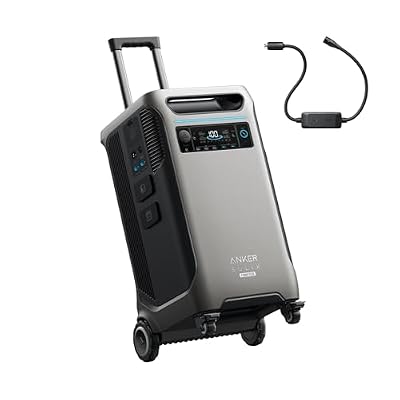
Anker SOLIX F3800 Plus Portable Power Station and 240V Generator Adapter
Included for 'Anker SOLIX F3800 Plus Review: Is It Worth Buying in 2026?' as a relevant option in this category; details come from the product listing.
View on Amazon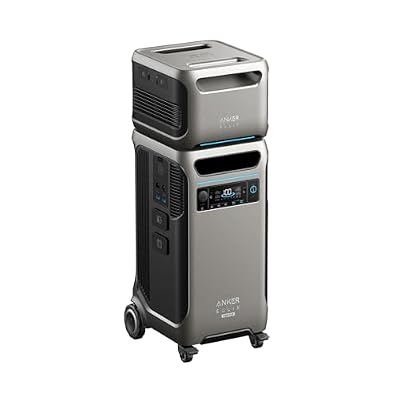
Anker SOLIX F3800 Plus Portable Power Station and BP3800 Expansion Battery
Included for 'Anker SOLIX F3800 Plus Review: Is It Worth Buying in 2026?' as a relevant option in this category; details come from the product listing.
View on Amazon
Anker SOLIX F3800 Plus Portable Power Station and 400W Solar Panel, 3,840Wh
Included for 'Anker SOLIX F3800 Plus Review: Is It Worth Buying in 2026?' because the listing specifies 840Wh, details this guide uses to compare options.
View on AmazonCommon 240V loads and what they need
Figures below are typical ranges; check the nameplate on your equipment.
| Load | Running watts | Starting surge | Daily energy (typical outage use) |
|---|---|---|---|
| 1/2 hp submersible well pump | 1,000-1,300W | 2,500-3,500W | 1-2kWh |
| 1 hp submersible well pump | 1,500-2,000W | 4,000-6,000W | 1.5-3kWh |
| 12k BTU inverter mini-split | 600-1,200W | Low (soft start) | 5-10kWh |
| 30-gallon electric water heater, limited use | 3,000-4,500W | None | 3-6kWh |
| Electric dryer, one load | 4,000-5,500W | Moderate | 2.5-4kWh |
The well pump is the clearest win: short bursts of high power, modest daily energy, and a load a 120V station simply cannot run.
Capacity and expansion reality
The F3800 Plus is positioned around 3.8kWh of LiFePO4 storage with a high-output inverter and support for expansion batteries; confirm current specs and bundles before buying. Plan on roughly 3.2 to 3.4kWh usable per base unit. A household running a well pump, fridge, lights, and internet can typically stretch that across a full day, while adding a mini-split for heat or cooling burns through it much faster.
How expansion changes the math
Each expansion pack adds a similar chunk of storage. With one or two packs, a well-and-essentials household reaches 2 to 3 days of coverage without recharging. Multi-day coverage with a mini-split running still demands solar.
Connecting it to the house
The F3800 Plus is designed to connect through a transfer switch, a dedicated home power panel, or a generator inlet with an interlock. This must be installed by a licensed electrician, with permits where required. Budget roughly $600 to $3,000 for the electrical work depending on the method and panel. Never use a double-male cord to backfeed an outlet; it can electrocute utility line workers and start fires.
Solar potential
High solar input is where this class earns its cost. With 2,000 to 2,400W of panels on a 5 peak-sun-hour day, you can harvest roughly 7 to 9kWh after real-world losses, enough to refill the base unit and run daytime loads. That turns multi-day outages from a countdown into a sustainable routine in sunny seasons.
Managing a well pump on battery
Well pumps are efficient on battery if you manage them. A pump only runs when the pressure tank drops to its cut-in pressure, often 30 or 40 psi, and each cycle lasts one to three minutes. A family of four using water sparingly might trigger 30 to 60 cycles a day, which works out to roughly 1 to 2kWh. The expensive moments are laundry and long showers, which can keep the pump running continuously. During an outage, run laundry only while solar is producing, keep showers short, and avoid irrigation entirely. Also confirm the inverter’s surge rating comfortably exceeds your pump’s starting current; a pump that stalls on startup can overheat, so test it once under supervision before you rely on it.
Versus a dual-fuel generator
A 7,000 to 9,500W dual-fuel generator with a 240V outlet costs a fraction of this system and runs a well pump indefinitely on propane. It is also loud, must operate outdoors at least 20 feet from openings, and needs maintenance and fuel storage. The F3800 Plus wins on silence, zero exhaust, indoor placement, and solar self-sufficiency.
FAQ
Can the F3800 Plus run a central air conditioner?
Some smaller 2 to 3-ton systems can start with a soft-start kit, but runtime on one base unit will be short. Most owners use it for essentials and treat central AC as a limited comfort load.
Do I need 240V if I only have a sump pump?
No. Most sump pumps are 120V. A 120V station with enough surge capacity is a better value for sump backup.
Bottom line
The F3800 Plus is worth buying if you have real 240V loads, especially a well pump or mini-split, and you want silent backup with strong solar recovery. Without 240V needs, a 120V station of similar capacity delivers the same outage protection for considerably less money.
Write Your Review
No reviews yet. Be the first to share your experience!