
Our Short List of 3
All 5 Picks at a Glance
| Product | Specs | Action |
|---|---|---|
 Nilight 90015A Battery Switch | Check price on Amazon | |
 Blue Sea Systems 6006 m-Series Battery Switch | Check price on Amazon | |
 Blue Sea Systems 9003E e-Series Battery Switch | Check price on Amazon | |
 Ampper Battery Disconnect Switch (On/Off) | Check price on Amazon | |
 Ampper 1-2-Both-Off Battery Disconnect Switch | Check price on Amazon |
🛒 Best Price Today on Amazon
Prime members get fast, free shipping on everything above, plus member-only deals. New members get a 30-day free trial — cancel anytime.
- How to Choose a Battery Switch for a Truck
- Nilight 90015A Battery Switch
- Blue Sea Systems 6006 m-Series Battery Switch
- Blue Sea Systems 9003E e-Series Battery Switch
- Ampper Battery Disconnect Switch (On/Off)
- Ampper 1-2-Both-Off Battery Disconnect Switch
- Frequently Asked Questions
- Final Verdict
- Product and ASIN Reference
A truck that sits between jobs, weekends, or seasons can lose its battery charge without ever turning a key. Clocks, alarm systems, telematics modules, keyless entry receivers, and aftermarket accessories all draw a small current while the truck is parked, and that quiet drain adds up. Add a winch, auxiliary lights, or a second battery for camping and work gear, and the electrical system becomes harder to shut down cleanly and harder to service safely. A battery switch solves that in the simplest possible way: it physically opens the battery circuit, so no load can draw power until the switch is turned back on.
The best battery switch for truck use is not the cheapest knob on a shelf or the one with the biggest number on the box. It is the switch whose continuous rating covers the truck’s real loads, whose studs accept the cable lugs already on the truck, and whose housing survives heat, vibration, road salt, and moisture. This guide compares five battery disconnect switches, explains how the ratings work, and matches each design to a single-battery daily driver, a diesel with heavy cranking demands, or a dual-battery work and overland setup.
As an Amazon Associate, we earn from qualifying purchases.
How to Choose a Battery Switch for a Truck
Start with current rating, because that decides whether a switch is safe for the job. Manufacturers list three numbers. The continuous rating is the current the switch can carry for an extended period without overheating, and it is the figure to compare against steady loads such as inverters, auxiliary lighting, and charging circuits. The intermittent rating covers a few minutes at a higher current. The cranking or momentary rating covers the brief surge of a starter motor. Never choose a switch on its cranking number alone, because a high momentary figure can hide a modest continuous rating that will run hot under a sustained load.
For most gasoline half-ton trucks, a continuous rating around 275 amps gives comfortable headroom for starting and normal accessories. Diesel trucks, trucks with winches, and trucks that charge an auxiliary battery at high current deserve the 300-amp to 350-amp class, along with the cable size needed to meet the rating. Several switches here only reach their published rating with large cable, up to 4/0 AWG on the heaviest model.
Next, decide between a simple on-off switch and a selector switch. An on-off switch has two positions and controls one battery or bank. It is the right choice for most trucks: turn it off when the truck is parked for a long stretch, during electrical work, or in an emergency. A selector switch, marked 1-2-Both-Off, manages two batteries, running loads from battery one, battery two, or both together. That suits dual-battery trucks where starting and auxiliary batteries are separated in normal use but combined in a pinch.
Mounting and terminal fit matter too. The rotary switches here connect through copper or tinned copper studs, commonly 3/8 inch, and existing cable lugs must match. A switch body also needs room for the knob to turn and for thick cables to bend without straining the studs. Ignition protection is worth looking for in an enclosed compartment, because an ignition-protected switch is designed so internal arcing cannot ignite surrounding vapors. A removable knob adds basic theft deterrence and prevents accidental reconnection during service, and a rear cover reduces the chance of a tool shorting the studs.
Nilight 90015A Battery Switch
The Nilight 90015A is a straightforward on-off disconnect built around a waterproof ABS housing and a rear cover that insulates the terminals against short circuits. For a truck that needs one battery shut off cleanly during storage, service, or long parking, that simplicity is the point: the switch is either connecting the battery or isolating it.
Its ratings suit a wide range of trucks: 275 amps continuous at 12 volts DC, 455 amps intermittent, and 1,250 amps momentary, across systems from 12 to 48 volts DC. That continuous figure covers the starting and accessory loads of most gasoline trucks and many diesel applications where the switch is used for isolation rather than a sustained high-current load. Copper terminal studs with nuts and washers are supplied, four mounting screw holes fix the housing to a panel or battery box, and the maker lists a two-year warranty. The rear cover also keeps the studs from contacting nearby metal if a cable shifts, though owners should still leave clearance for cable bends, because stiff battery cable puts side load on studs when forced into a tight turn.
Who It Suits
This switch suits truck owners who want a general-purpose, weather-resistant on-off disconnect for a single battery or bank, for storage, anti-drain use, and routine service. Owners who need to choose between two batteries should look at the selector model later in this guide, because the 90015A does not offer battery selection.
Blue Sea Systems 6006 m-Series Battery Switch
The Blue Sea Systems 6006, from the m-Series line, is a compact single-circuit on-off switch with a removable knob and ignition protection. Blue Sea rates it at 300 amps continuous, with 500 amps intermittent for five minutes and 900 amps cranking for thirty seconds. That step up in continuous capacity, in a compact footprint, makes the 6006 a strong fit for trucks where mounting space is tight but loads are not small.
One-piece tin-plated copper studs are a central part of the design. At 7/8 inch long, they leave room to stack more than one cable lug on a stud, a common need where a main cable and an accessory feed share a connection point, and tin plating helps resist corrosion on trucks driven through winter salt or stored outdoors. The switch can be surface mounted or installed through a panel from the front or rear, adapting to a battery box lid, an inner fender panel, or a bracket. Its removable knob prevents accidental reconnection during service and makes the truck harder to start for anyone without the knob, and the 6006 is ignition protected, suiting enclosed compartments where fuel vapor may be present.
Who It Suits
The 6006 suits truck owners who want a compact, corrosion-conscious switch with more continuous headroom than entry-level models, especially on overland and work trucks with winches or added accessories, and when the switch must share space with multiple cable lugs. Buyers who need to manage two batteries separately should choose a different model here.
Blue Sea Systems 9003E e-Series Battery Switch
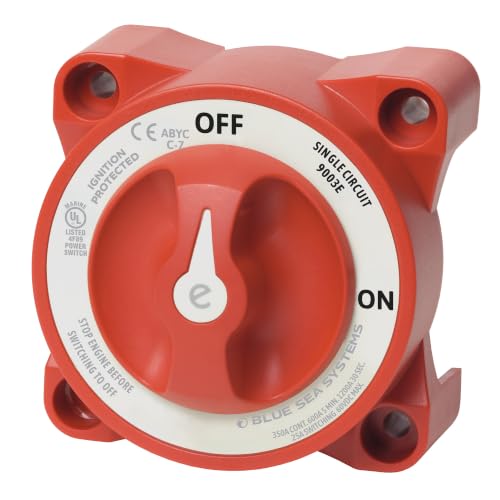
The Blue Sea Systems 9003E, from the e-Series line, is the heavy-duty on-off option in this guide. It is rated at 350 amps continuous, 600 amps intermittent for five minutes, and 1,200 amps starting for thirty seconds, with a maximum voltage of 48 volts DC. For a diesel truck or a truck whose switch must carry serious sustained current, those numbers put the 9003E at the top of this list.
That capacity comes with a cable requirement buyers should not skip. Blue Sea specifies 4/0 AWG cable to meet the ratings, with cable clearance of 1.10 inches. The terminal studs are tinned copper, sized 3/8-16 (M10), with a listed stud torque of 140 in-lb. This switch is built for thick cable and a firm, properly torqued connection, and it will not deliver its full rating through undersized wiring. The case allows surface or rear panel mounting, and the switch is ignition protected. It switches a single battery to a single load group, with no battery combining, keeping operation simple: on connects the bank, off isolates it.
Who It Suits
The 9003E suits diesel truck owners and anyone building a high-current single-bank system who is willing to run the large cable the rating requires, for heavy cranking and high charging currents. It is more switch than a light-duty truck in storage strictly needs, and it offers no battery selection between two banks.
Ampper Battery Disconnect Switch (On/Off)
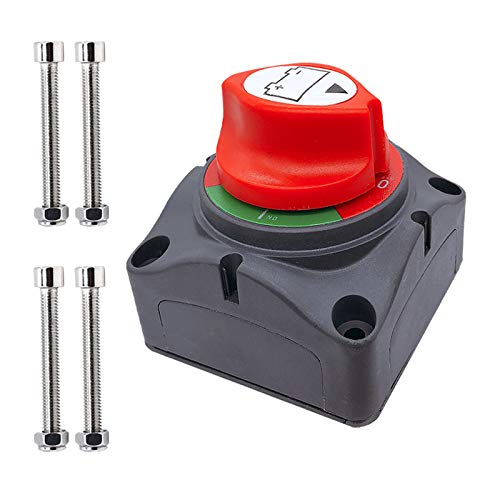
The Ampper on-off battery disconnect switch, model Am-CBS01, is the value-focused panel-mount option here. Its listing rates it at 275 amps continuous at 12 volts DC, 455 amps intermittent, and 1,250 amps momentary, for DC systems from 12 to 48 volts, in a heavy-duty ABS housing with copper terminal studs and an insulated rear cover.
Details for everyday truck use include side pads intended to keep dust away from the terminal area, a rear cover that insulates the terminals against short circuits, and four long bolts supplied for mounting. The knob uses a clear color convention, red for off and green for on, which helps in a dim battery compartment. The listing describes the fit as universal for 12 to 48 volt systems on vehicles including trucks, along with RV and marine use. As with every switch here, the continuous rating is the ceiling for sustained loads, so winch and inverter circuits should be checked against that 275-amp figure rather than the momentary number.
Who It Suits
This Ampper suits truck owners who want a simple on-off disconnect with solid ratings and clear position indication, without a selector function they will not use. It fits single-battery trucks used for commuting, seasonal work, and storage. Owners who need ignition protection or the highest continuous rating should compare the Blue Sea models above.
Ampper 1-2-Both-Off Battery Disconnect Switch
The Ampper 1-2-Both-Off switch is the one selector in this guide, built for trucks with two batteries. Its four positions let the driver run from battery one, battery two, or both together, or shut the system off entirely. That is the foundation of a practical dual-battery setup: keep the starting battery reserved for starting, run camp or work loads from the auxiliary battery, and combine both only when extra cranking help is needed.
The trade-off for that flexibility is a lower continuous rating: 200 amps continuous at 12 volts DC, 300 amps intermittent, and 1,000 amps momentary, for systems from 12 to 48 volts DC. The housing is ABS plastic, the terminal studs are copper with nuts and washers, and four sets of mounting bolts are included.
On a truck, this design earns its place when the second battery does a different job from the first. A contractor running inverters and lights at a site, or a camper running a fridge and lighting overnight, can drain the auxiliary battery without risking a no-start morning, then recharge it on the drive. The Both position should be a deliberate choice rather than a default, since combining a charged and a discharged battery lets them equalize, but as an emergency cranking aid it is genuinely useful.
Who It Suits
This selector suits dual-battery truck owners: overland and camping builds, work trucks with a dedicated auxiliary battery, and service trucks that need a reserve starting option. Single-battery owners gain nothing from the extra positions and should choose a simpler on-off switch with a higher continuous rating.
Frequently Asked Questions
Does a battery switch stop parasitic drain on a parked truck?
Yes. Installed in the main battery circuit and turned off, a battery switch physically breaks the connection between the battery and the truck’s electrical system. With the circuit open, clocks, alarms, and modules cannot draw current, so the slow drain that flattens a battery over days or weeks is stopped. The trade-off is that battery-powered memory functions, such as radio presets, may reset while the switch is off, and the truck cannot be started until it is turned back on.
Should a truck battery switch go on the positive or negative side?
Panel-mount rotary switches like these are normally wired into the positive cable run between the battery and the truck’s main distribution point, following the maker’s instructions. Small terminal-mounted knob switches, a different style not covered here, are usually fitted to the negative post. In either case, cable, stud size, and torque should match the listing, and anyone unsure about wiring should have the installation checked by a qualified auto electrician.
What continuous rating does a diesel truck need?
Diesel trucks crank harder than comparable gasoline trucks, especially in cold weather, and many run glow plug or intake heater loads around starting. The cranking surge is brief, so it falls under the cranking or momentary rating, but sustained loads such as auxiliary battery charging still need continuous headroom. A switch in the 300-amp to 350-amp continuous class, such as the Blue Sea models here, paired with the cable size the maker specifies, is the conservative choice for a diesel.
Can a battery switch replace a dual-battery isolator?
Not completely. A selector switch such as the Ampper 1-2-Both-Off lets the driver choose which battery feeds the loads and can combine both, but it does not automatically separate the batteries when the engine stops or manage charging between them. An automatic isolator or DC-to-DC charger handles those tasks without driver input. Many dual-battery trucks use both: automatic charging management for everyday driving, plus a manual switch for isolation during storage, service, or an emergency.
Final Verdict
For most truck owners, the decision comes down to how many batteries the truck runs and how much current the switch must carry. The Nilight 90015A and the Ampper on-off switch both deliver 275-amp continuous ratings in sealed, rear-covered housings, and either handles single-battery storage and service isolation well. The Ampper adds clear red and green position indication, while the Nilight lists a two-year warranty.
Owners who want more headroom should step up to Blue Sea Systems. The 6006 m-Series packs a 300-amp continuous rating, long tin-plated studs, and ignition protection into a compact body, and the 9003E e-Series raises the ceiling to 350 amps continuous for diesel and high-current builds that can run the large cable it requires. Dual-battery owners need the Ampper 1-2-Both-Off selector, which trades continuous capacity for control over two batteries.
Product and ASIN Reference
| Product | ASIN |
|---|---|
| Nilight 90015A Battery Switch | B07T288VN8 |
| Blue Sea Systems 6006 m-Series Battery Switch | B00445KFZ2 |
| Blue Sea Systems 9003E e-Series Battery Switch | B000MMC914 |
| Ampper Battery Disconnect Switch (On/Off) | B07413JWLD |
| Ampper 1-2-Both-Off Battery Disconnect Switch | B07PN9CT9H |



Write Your Review
No reviews yet. Be the first to share your experience!