
🛒 Best Price Today on Amazon
Prime members get fast, free shipping on everything above, plus member-only deals. New members get a 30-day free trial — cancel anytime.
- Quick Picks at a Glance
- How We Chose
- Diesel vs Gas for a Home Generator
- Air-Cooled vs Liquid-Cooled Diesel
- Electric Start and Controls
- Who Should Choose Diesel at Home
- Product Reviews
- Spec Comparison Table
- Worked Example: Sizing a Diesel for Essential Circuits
- Diesel Generator Care
- Safety and Installation
- Frequently Asked Questions
- Bottom Line
The best diesel generators for home backup power are the Generac XD5000E for a portable, long-runtime unit, the Yanmar YDG3700W-6EI for a quieter essentials-only setup, the Energypac Systems 6KW for a mid-size air-cooled diesel with electric start, and the Energypac 15kW enclosed unit or a Kohler KD-series standby diesel when you want true whole-house coverage. Diesel only makes sense at home if you need very long runtime per tank, fuel that stores better than gasoline, or an engine built for hundreds of hours of service. For a house that loses power a few days a year, a gasoline or dual-fuel portable is cheaper and easier. This guide explains who should choose diesel, how the main models compare, and how to size and install one safely.
Quick Picks at a Glance
- Best portable diesel for long outages: Generac XD5000E (12-gallon tank, Yanmar engine)
- Best compact diesel for critical circuits: Yanmar YDG3700W-6EI
- Best mid-size portable diesel: Energypac Systems 6KW (Yanmar L100 engine)
- Best step up toward whole-house: Yanmar YDG5500
- Best enclosed diesel for a large home: Energypac 15kW enclosed unit
- Best for farms and work sites, not typical homes: Kubota GL14000 LowboyPro
- Best permanent standby route: Kohler KD-series diesel standby
How We Chose
This list is based on research into manufacturer specifications, published product listings and comparison guides, not first-hand evaluation. We looked for diesel units that a homeowner can realistically buy and use for backup, then screened them on five criteria: rated output against a typical essentials load, tank size and published runtime, engine brand and cooling type, start method, and noise or enclosure. Where a spec could not be confirmed from more than one source, we describe the product by class instead of stating a number, and the spec table marks those cells as unconfirmed. Diesel models marketed only for commercial or marine use were left out. Natural gas and propane standby units, such as the Generac Guardian line, were also excluded because they are not diesel.

Westinghouse 14500 Peak Watt Tri-Fuel Home Backup Portable Generator, Remote Electric Start, Transfer Switch Ready, Gas, Propane, and Natural Gas Powered
Included for 'Best Diesel Generators for Home Backup Power' because the listing specifies Remote Electric Start and Transfer Switch Ready, details this guide uses to compare options.
View on Amazon
Westinghouse 28000 Peak Watt Tri-Fuel Home Backup Portable Generator, Remote Electric Start, Transfer Switch Ready, Gas, Propane, and Natural Gas Powered
Included for 'Best Diesel Generators for Home Backup Power' because the listing specifies Remote Electric Start and Transfer Switch Ready, details this guide uses to compare options.
View on Amazon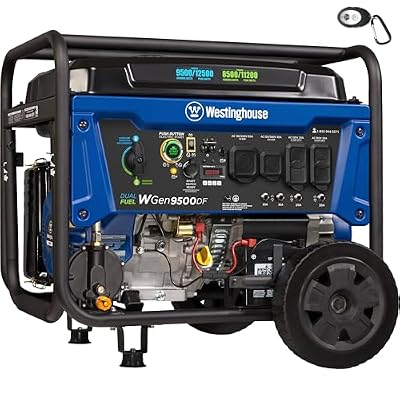
Westinghouse 12500 Watt Dual Fuel Home Backup Portable Generator, Remote Electric Start, Transfer Switch Ready, Gas and Propane Powered
Included for 'Best Diesel Generators for Home Backup Power' because the listing specifies Remote Electric Start and Transfer Switch Ready, details this guide uses to compare options.
View on Amazon
Generac 22kW Whole Home Generator, Transfer Switch & Cellular Capability | Whole House Backup Power, Automatic 200 Amp Transfer Switch, Outdoor Gas Propane, Protects Home Outages, Storm Protection
Included for 'Best Diesel Generators for Home Backup Power' because the listing specifies Transfer Switch & Cellular Capability and Whole House Backup Power, details this guide uses to compare options.
View on AmazonDiesel vs Gas for a Home Generator
The diesel decision comes down to four trade-offs: fuel storage life, runtime per gallon, noise, and upfront cost and weight.
Fuel storage life
Gasoline degrades quickly, especially ethanol blends, and is commonly cited as good for roughly three to six months without stabilizer. Diesel is generally cited as storing for about six to twelve months untreated, and longer with a biocide and stabilizer in a clean, sealed tank. Diesel also does not vaporize as readily, so it carries a lower fire risk during storage, although it is still a combustible liquid that needs an approved container and proper spacing from the house. For a generator that sits idle for most of the year, this is the strongest argument for diesel.
Runtime and fuel economy
Diesel engines convert more of each gallon into electricity at partial load. Using the published figures, the Generac XD5000E lists up to 32.4 hours at a 50 percent load from a 12-gallon tank. That works out to roughly 0.37 gallons per hour while delivering about 2,500 watts, or around 6.7 kilowatt-hours per gallon. A typical 5,500-watt-class gasoline inverter portable delivers closer to 4 kilowatt-hours per gallon at a light load. The practical result is fewer refueling trips during a multi-day outage.
Noise
Diesels are usually louder than inverter gasoline generators of similar output because they lack inverter-style throttle control and run at a fixed engine speed. Open-frame portables are noticeable from inside the house. Enclosed units, such as the Energypac 15kW enclosed model and the Kubota GL14000 LowboyPro, reduce noise considerably; the Kubota is published at roughly 65 to 67 dB.
Cost and weight
Diesel generators cost noticeably more than gasoline units of the same wattage and weigh far more. The XD5000E is listed at about 254 pounds, and the Energypac 6KW at about 320 pounds. Plan for wheels, a flat pad and a way to move the unit, because lifting it is not realistic.
Air-Cooled vs Liquid-Cooled Diesel
Most small diesel generators for homes, including the XD5000E, Yanmar YDG3700W-6EI and Energypac 6KW, are air-cooled single-cylinder designs. They are simple, have no coolant to service and work well for loads under about 6 kilowatts. Larger units in the 10 to 20 kilowatt range, and the Kohler KD-series, are typically liquid-cooled. Liquid cooling keeps the engine at a steadier temperature, lowers noise and supports long continuous running, but it adds a radiator, coolant changes and a larger footprint. If you only need a refrigerator, furnace blower, sump pump and lights, air-cooled is enough. If you want central air conditioning or an electric range on the generator, move to a liquid-cooled enclosed unit.
Electric Start and Controls
Diesel engines need strong cranking, and recoil-only starting can be hard on a single-cylinder engine with high compression. Electric start with a battery is the realistic choice for a home generator. The Energypac 6KW is published with key-switch electric start and a recoil backup. For the Generac XD5000E, listings disagree on the start method, so confirm that the exact variant you buy includes electric start and a battery. Keep the battery on a maintainer between outages, because a dead starting battery is the most common reason a backup generator will not start.
Who Should Choose Diesel at Home
Diesel is a good fit if at least two of these apply to you:
- Outages regularly last several days, as in rural areas, hurricane zones or ice-storm regions.
- You want to store fuel on site for months and rotate it only once a year.
- You already own diesel equipment, such as a tractor, and keep a diesel supply.
- The generator will also run on a farm, workshop or off-grid cabin, where high run hours are expected.
- You are installing a permanent system and prefer not to depend on a natural gas line.
Skip diesel if outages are rare and short, if you have a quiet neighborhood with strict noise ordinances and no room for an enclosure, or if your budget is tight. A dual-fuel or inverter portable will cover most households for far less money.
Product Reviews
1. Generac XD5000E
Spec line: 5,000 running watts · 5,500 starting watts · 12-gallon tank · up to 32.4 hours at 50% load · Yanmar 435cc diesel · air-cooled · about 254 lb
Best for: homeowners who want the longest unattended runtime in a portable diesel and have one fuel type to manage.
Skip if: you need a quiet unit, or you cannot confirm the electric-start variant.
- Pros: very large tank for the output; published half-load runtime covers more than a full day and a half; Yanmar engine has a strong reputation; enough power for a refrigerator, furnace blower, sump pump and lights.
- Cons: heavy; noisier than an inverter generator; service parts and dealers are less common than for gasoline models; start method differs between listings.
2. Yanmar YDG3700W-6EI
Spec line: 3,500 watts continuous · about 13-liter tank · roughly 9 hours per tank · about 81 kg (roughly 179 lb) · Yanmar diesel engine
Best for: critical circuits only: fridge, a few lights, a furnace blower and a sump pump, with a quieter and lighter package than larger diesels.
Skip if: you need multi-day runtime without refueling or want to run a well pump and a large blower together.
- Pros: lighter than most diesels; the engine brand is respected for durability; suited to essentials backup and small farm tasks.
- Cons: runtime per tank is much shorter than the XD5000E; limited output for a larger house.
3. Energypac Systems 6KW
Spec line: 6,000 watts rated · 3.5-gallon tank · up to about 8 hours · Yanmar L100 9.3 hp engine · air-cooled · electric start with recoil backup · about 320 lb · outlets: 120V duplex, 120V 30A twist-lock, 240V 20A twist-lock, 12V DC
Best for: households that need 240V capability and more headroom than a 3.5 kW unit.
Skip if: you want long runtime from a single fill, or need a quiet generator.
- Pros: 6 kW is enough to start a well pump and run a furnace; electric start; useful mix of outlets including a 240V twist-lock.
- Cons: small tank, so expect to refuel every shift on a heavy load; the heaviest of the portable options listed here.
4. Yanmar YDG5500
Spec line: higher-capacity member of the Yanmar portable diesel range · output, tank size and runtime not confirmed here
Best for: buyers who like the YDG3700 idea but need more output for a well pump or a larger blower.
Skip if: you need exact runtime numbers before buying; confirm the specs for the exact suffix you are considering.
- Pros: same engine family reputation; more headroom than the YDG3700.
- Cons: specs vary by model code; heavier and costlier than the smaller Yanmar.
5. Energypac 15kW Enclosed Diesel
Spec line: 15 kW class · enclosed housing · liquid-cooled class engine · exact tank and runtime not confirmed here
Best for: larger homes that want whole-house backup from a diesel unit with a sound-attenuating enclosure.
Skip if: you only need essentials; you will pay for capacity you will not use.
- Pros: enough output for central air on a mid-size house when sized correctly; enclosure reduces noise and protects from weather.
- Cons: needs professional installation, a transfer switch and a permanent pad; high upfront cost.
6. Kubota GL14000 LowboyPro
Spec line: 12,000 watts · enclosed · about 65 to 67 dB · about 904 lb · Kubota diesel
Best for: farms, job sites and large workshops that also happen to need house backup.
Skip if: you have a typical suburban home; it is more generator than most houses need and extremely heavy.
- Pros: quiet for its size; built for heavy duty; high output.
- Cons: aimed at commercial use; weight demands a trailer or a forklift; expensive.
7. Kohler KD-Series Diesel Standby
Spec line: permanent diesel standby · liquid-cooled · automatic transfer switch compatible · models vary by kilowatt rating
Best for: homes that need automatic whole-house backup without relying on natural gas.
Skip if: you want a portable generator, or you do not want a professional installation.
- Pros: automatic start when power fails; long-life engine class; fuel tank sized for extended outages.
- Cons: highest cost and installation complexity; local codes and permits apply to the tank and the pad.
Spec Comparison Table
| Model | Output | Tank | Published runtime | Cooling | Start | Weight |
|---|---|---|---|---|---|---|
| Generac XD5000E | 5,000 W running / 5,500 W starting | 12 gal | Up to 32.4 h at 50% load | Air | Confirm variant | About 254 lb |
| Yanmar YDG3700W-6EI | 3,500 W continuous | About 13 L | About 9 h | Air class | Not confirmed | About 81 kg |
| Energypac 6KW | 6,000 W | 3.5 gal | Up to about 8 h | Air | Electric with recoil | About 320 lb |
| Yanmar YDG5500 | Larger than YDG3700 | Not confirmed | Not confirmed | Not confirmed | Not confirmed | Not confirmed |
| Energypac 15kW enclosed | 15 kW class | Not confirmed | Not confirmed | Liquid class | Electric | Not confirmed |
| Kubota GL14000 LowboyPro | 12,000 W | Not confirmed | Not confirmed | Liquid class | Electric | About 904 lb |
| Kohler KD-series | Varies by model | Varies | Varies | Liquid | Automatic | Varies |
Worked Example: Sizing a Diesel for Essential Circuits
Use this method to decide between a 3.5 kW, 5 kW and 6 kW diesel. Add the running watts of everything you will power together, then add the extra surge of the single hungriest starter. The figures below use conservative published appliance ranges.
- Refrigerator: about 700 running, 2,200 starting in a conservative chart (efficient models are far lower).
- Sump pump, one-half horsepower: about 1,050 running, 2,150 starting.
- Furnace blower, one-half horsepower: about 875 running, 2,300 starting.
- Lights and chargers: about 300 running.
- Total running load: 700 + 1,050 + 875 + 300 = 2,925 W.
- Largest starting load is the furnace blower at 2,300 W. Its extra surge above running is 2,300 – 875 = 1,425 W.
- Peak demand if loads start one at a time: 2,925 + 1,425 = about 4,350 W.
That peak is above the continuous rating of a 3,500-watt unit but within the 5,500-watt starting rating of the XD5000E and well within the 6 kW Energypac. A 3,500-watt Yanmar can still work if you stagger starts and accept brief overload margins, but leave about 20 percent headroom. If you add a one-half horsepower well pump, add roughly 1,000 running watts and about 1,100 watts of extra surge, which pushes the peak to roughly 5,500 W and points you to a 6 kW unit.
Diesel Generator Care
- Avoid light loads: running a diesel below roughly 30 percent load for long periods can cause unburned fuel buildup, called wet stacking. Match the generator to your load or add a load that brings it into a healthy range.
- Keep fuel clean: use fresh diesel, drain water from the tank, and treat stored fuel for microbial growth.
- Change oil on schedule: follow the manual for the first oil change and later intervals. Diesel oil and filters are more expensive than small gasoline engines, but they are rarely needed in a home backup role.
- Exercise it: run under load for 30 minutes each month so fuel circulates and the battery stays charged.
Safety and Installation
- Run any generator outdoors only, in an open area at least 20 feet from the house with the exhaust pointed away from windows, doors and vents. Carbon monoxide can build up in a garage even with the door open.
- Install battery-powered or plug-in carbon monoxide alarms with battery backup on every level of the home.
- Never plug a generator into a wall outlet to power the house. This backfeed can electrocute line workers. Use a permanently installed transfer switch or a code-compliant interlock kit installed by a licensed electrician.
- Store diesel in approved containers, away from ignition sources and living areas. Check local rules before installing any permanent tank.
- Let the engine cool before refueling, and never refuel while it runs.
- Keep the unit dry. Use a canopy or open-sided cover with plenty of airflow, not a closed shed.
Frequently Asked Questions
Are diesel generators better than gas generators for home backup?
Diesel is better for long outages and fuel storage, but gas or dual-fuel is cheaper and quieter for short outages. Choose by outage length and budget.
Diesel units give more runtime per gallon and use fuel that keeps longer. They cost more, weigh more and are usually louder than inverter gasoline models.
How long can diesel fuel be stored for a generator?
Untreated diesel is commonly cited as lasting about six to twelve months, and longer with a stabilizer and biocide in a clean, sealed container.
Keep the container full to reduce condensation and rotate stored fuel yearly.
What size diesel generator do I need to power essentials?
Most homes can cover a refrigerator, furnace blower, sump pump and lights with a 4 to 6 kilowatt diesel. Add up running watts plus the largest start surge.
Add a well pump or central air only if the unit has enough margin. Whole-house loads usually need 15 kilowatts or more.
Do diesel generators need electric start?
Electric start is strongly preferred. Diesel engines have high compression and are hard to pull-start reliably.
Keep the battery on a maintainer so it works when the power fails.
Is a diesel generator safe to run in a garage?
No. Run every generator outdoors, at least 20 feet from the house, because exhaust contains deadly carbon monoxide.
Open garage doors do not make indoor use safe. Use CO alarms inside the home as a second layer of protection.
Are air-cooled diesel generators good enough for home use?
Yes, for loads up to roughly 6 kilowatts and for backup that runs a few days a year. They are simple and need little maintenance.
For long continuous running or higher loads, a liquid-cooled enclosed unit is the better choice.
Can I connect a diesel generator directly to my home panel?
Only through a properly installed transfer switch or interlock kit. Never backfeed through a wall outlet.
A licensed electrician should do the installation and confirm it meets local code. This protects utility workers and your equipment.
How loud are diesel generators?
Open-frame portables are loud enough to be heard throughout a yard. Enclosed models are much quieter, such as the Kubota GL14000 at about 65 to 67 dB.
Position the unit away from bedrooms and neighbors, and check local noise limits.
Bottom Line
If you want a portable diesel for multi-day outages, the Generac XD5000E offers the longest published runtime in this group, while the Yanmar YDG3700W-6EI suits lighter essentials loads. The Energypac 6KW gives more output with electric start, and the Energypac 15kW enclosed unit or a Kohler KD-series standby is the right path for whole-house diesel backup. Size by adding running watts and the largest surge, install it with a transfer switch, and keep it outdoors away from the house.


Write Your Review
No reviews yet. Be the first to share your experience!