
Our Short List of 3

- Power source: 115-volt AC plug-in
- Fence range: up to 25 miles
- Output energy: 1 joule
- Design: low impedance for weedy fence lines
- Power source: 12-volt battery (not included)
- Fence range: up to 30 miles
- Output energy: up to 3 joules
- Design: low impedance, solid-state circuitry

- Power source: solar panel with internal 6-volt rechargeable battery
- Fence range: up to 10 miles
- Output energy: 0.15 joule
- Runtime: up to 2 weeks without sun on a full charge
All 4 Picks at a Glance
| Product | Specs | Action |
|---|---|---|
| Zareba EAC25M-Z 25-Mile AC Fence Charger |
| Check price on Amazon |
| Parmak Magnum 12 MAG12-UO Battery Fence Charger |
| Check price on Amazon |
| Zareba ESP10M-Z 10-Mile Solar Fence Charger |
| Check price on Amazon |
 Parmak Magnum Solar-Pak 12 Fence Charger |
| Check price on Amazon |
🛒 Best Price Today on Amazon
Prime members get fast, free shipping on everything above, plus member-only deals. New members get a 30-day free trial — cancel anytime.
A fence charger is the heart of every electric fence. Pick one with too little punch and cattle lean through the wire, goats slip out, and predators learn the line is harmless. Pick the right one and the fence trains animals once, then mostly polices itself.
The five chargers below cover the three power styles used on farms and ranches: plug-in AC units for fences near the barn, battery units for remote pasture, and solar units that run far from any outlet. Each is a low-impedance design, which matters once summer weeds lean on the bottom wire.
As an Amazon Associate, we earn from qualifying purchases.
Quick answer
For a fence near power, the Zareba EAC10M-Z handles small pastures while the Zareba EAC25M-Z covers longer runs with double the output. Off grid, the Parmak Magnum 12 MAG12-UO runs from a 12-volt battery, the Zareba ESP10M-Z is a compact solar pick for short lines, and the Parmak Magnum Solar-Pak 12 pairs solar charging with serious output for big, weedy pastures.
Zareba EAC10M-Z 10-Mile AC Fence Charger
The EAC10M-Z is the simple plug-in option for a home pasture, a horse paddock, or a garden fence that sits within reach of a barn outlet. It plugs into a standard 115-volt outlet and puts 0.5 joule of output energy onto the line, enough to teach cattle, horses, pigs, and goats to respect a short fence.
Because it is a low-impedance charger, it keeps pushing voltage through light weed contact instead of shorting out the way older solid-state units do. Zareba sizes it for up to 10 miles of fence in clean conditions, with shorter real-world runs once vegetation presses on the wire. A fuseless design and a fence indicator light keep day-to-day checks simple.
Specs
- Power source: 115-volt AC plug-in
- Fence range: up to 10 miles
- Output energy: 0.5 joule
- Design: low impedance, works in heavy weed conditions
- Animals: cattle, horses, pigs, goats, and small livestock
- Extras: fuseless design, fence indicator light
Zareba EAC25M-Z 25-Mile AC Fence Charger
- Power source: 115-volt AC plug-in
- Fence range: up to 25 miles
- Output energy: 1 joule
- Design: low impedance for weedy fence lines
The EAC25M-Z steps up to bigger country. With up to 25 miles of fence range and roughly double the output of its smaller sibling, it suits multi-paddock cattle setups, long perimeter runs, and cross fencing that stays hot through the growing season.
The low-impedance circuit is the main reason to choose it. Grass and brush touching the lower strands drain energy from any charger, and this one is built to hold a deterrent pulse under that load. It still needs a nearby outlet and a proper ground system, but for a fixed headquarters fence it delivers steady, maintenance-light service year after year.
Parmak Magnum 12 MAG12-UO Battery Fence Charger
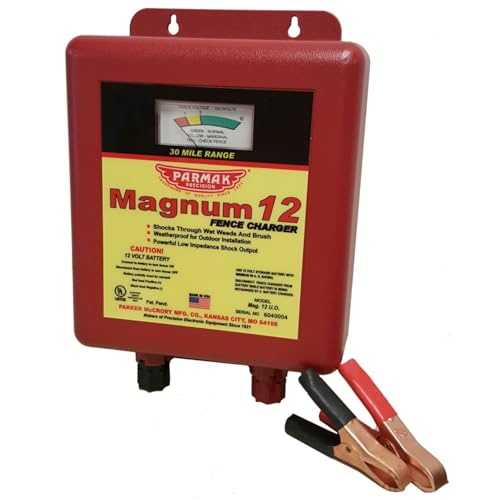
- Power source: 12-volt battery (not included)
- Fence range: up to 30 miles
- Output energy: up to 3 joules
- Design: low impedance, solid-state circuitry
The Magnum 12 is the classic battery-powered workhorse. It runs from a 12-volt deep-cycle battery you supply, so it can sit on a back fence line with no outlet and no panel to keep clean. Parmak sizes it for up to 30 miles of fence, and its output climbs as high as 3 joules under load, which is genuine predator-level deterrence.
A built-in performance meter on the sealed, weatherproof case shows fence condition and battery state at a glance, so a quick ride along the line tells you whether the fence is hot. Parmak builds these units in Kansas, and the housing is meant to live outdoors full time.
Zareba ESP10M-Z 10-Mile Solar Fence Charger
- Power source: solar panel with internal 6-volt rechargeable battery
- Fence range: up to 10 miles
- Output energy: 0.15 joule
- Runtime: up to 2 weeks without sun on a full charge
The ESP10M-Z is a self-contained solar unit for short fence lines: a rotational grazing cell, a chicken run, a goat pen, or a garden that needs to keep deer and raccoons honest. Its built-in panel charges an internal 6-volt battery, and a full charge can carry the fence for up to two weeks without sun.
Output is a modest 0.15 joule, so this is a trainer for small animals and short, clean runs rather than a charger for stubborn cattle on a long line. The case mounts directly on a T-post with the included bracket, and a Fence OK indicator light confirms the pulse at a glance. Keep the panel wiped clean and facing south, and the unit largely looks after itself.
Parmak Magnum Solar-Pak 12 Fence Charger
- Power source: solar panel with sealed 12-volt gel battery included
- Fence range: up to 30 miles
- Output energy: over 3 joules
- Design: low impedance, charges through wet weeds and brush
The Solar-Pak 12 takes the Magnum 12 formula and makes it fully self-sufficient. A solar panel tops up the sealed 12-volt gel battery inside the weatherproof case, so the charger runs day and night on fence lines that may be miles from the nearest outlet. Output reaches beyond 3 joules, and Parmak sizes it for up to 30 miles of fence.
That output, paired with low-impedance circuitry, suits weedy summer pasture, cattle country, and predator pressure from coyotes. The built-in performance meter carries over from the battery model, and the sealed battery means no watering and no separate battery box to build.
How to choose
Match the power source to the fence first. A plug-in AC charger is the most dependable and needs no battery care, but only works where an outlet is close. Battery units free you from outlets at the expense of hauling and recharging a deep-cycle battery. Solar units remove that chore, yet their real output depends on sun exposure and battery health, so mount the panel where nothing shades it.
Next, think in joules rather than miles. Mile figures assume a single strand of clean wire, and no working farm fence looks like that. Allow about 1 joule of output for every 10 miles of multi-strand fence, plus headroom for weed growth. Low-impedance chargers are the right default for any line touching vegetation.
Animal type matters too. Cattle and horses learn quickly and respect moderate output on a visible wire or tape. Goats, sheep, and pigs need more strands and a stronger pulse through hair or wool, and predator control calls for the hottest fence you can maintain, with tight strand spacing low to the ground.
Finally, budget effort for grounding, because a weak ground is the most common reason a good charger feels feeble. Drive at least three galvanized ground rods, each 6 to 8 feet long, spaced about 10 feet apart and joined with insulated wire and clamps. Test the fence at its far end with a proper tester.
FAQ
How many joules do I need for cattle?
For trained cattle on a few strands of wire, 0.5 to 1 joule usually holds them once they learn the fence. Larger herds, bulls, and long weedy lines call for 2 joules or more, which is where the Parmak units above come in.
How many ground rods does a fence charger need?
Plan on three ground rods, 6 to 8 feet deep, spaced roughly 10 feet apart, and add more in dry or rocky soil. Most weak fences trace back to grounding, not to the charger itself.
Will a solar charger work through winter?
Yes, if the panel gets direct sun and stays clear of snow. The Zareba solar unit above can run about two weeks without sun on a full charge, and the Parmak Solar-Pak carries a larger battery still. Short days plus a tired battery is the usual failure, so check the battery before winter.
Can one charger run several paddocks?
Yes. One charger can feed a whole system of paddocks through underground lead-out wire and cut-out switches, as long as its joule output covers the total fence length. Size for the full system with everything connected, not for one paddock at a time.
Verdict
Choose the Zareba EAC10M-Z for a small fence near the barn, the EAC25M-Z when that fence grows, the Parmak Magnum 12 for battery power on remote lines, the Zareba ESP10M-Z for a light solar setup, and the Parmak Solar-Pak 12 for solar freedom with full-strength output.



Write Your Review
No reviews yet. Be the first to share your experience!