
Our Short List of 3

- Best for: High-horsepower EFI builds that need strong, steady fuel flow.
- 100 GPH flow
- 8 AN female inlet
- 6 AN female outlet
- Supports up to 900 EFI horsepower
- Best for: EFI conversions needing flexible flow, common AN fittings and E85 compatibility.
- 12V
- 75 PSI
- 200 LPH at 75 PSI
- 255 LPH at 43 PSI

- Best for: Direct replacement of a GSL392-style inline EFI pump.
- 255 LPH flow
- 15-120 PSI operating range
- Installation kit included
- 6AN fittings
All 3 Picks at a Glance
| Product | Specs | Action |
|---|---|---|
| Holley 12-170 Universal In-Line Fuel Pump |
| Check price on Amazon |
| EVIL ENERGY 300 LPH External Inline Fuel Pump |
| Check price on Amazon |
| JDMSPEED 255LPH GSL392 Inline Fuel Pump |
| Check price on Amazon |
🛒 Best Price Today on Amazon
Prime members get fast, free shipping on everything above, plus member-only deals. New members get a 30-day free trial — cancel anytime.
Converting a carburetted engine to electronic fuel injection, or replacing a tired external pump on an existing EFI setup, turns on one component that has to deliver the right fuel volume at the right pressure every time the engine runs. Pick a pump with too little flow and the engine starves at high load; pick one with the wrong fittings or pressure range and the install becomes a string of adapters, leaks and return trips to the parts store, so the choice affects everyday driving as well as full-throttle performance.
This guide covers universal inline EFI pumps for builders, restorers and owners upgrading older vehicles, and it focuses on external pumps that mount outside the tank rather than in-tank units. Each pump below was selected from the name and specifications shown on its Amazon page, with flow, pressure, fittings and fuel compatibility compared so you can match a pump to your engine instead of guessing, and to avoid paying twice for the wrong pump.
Quick Picks
As an Amazon Associate we earn from qualifying purchases
| Product | Best for | Key spec from title |
|---|---|---|
| Holley 12-170 Universal In-Line Fuel Pump | High-horsepower EFI builds needing strong flow | 100 GPH flow, supports up to 900 EFI horsepower |
| EVIL ENERGY 300 LPH External Inline Fuel Pump | Flexible installs with common AN fittings and E85 use | 300 LPH at 43 PSI and 13.5V |
| JDMSPEED 255LPH GSL392 Inline Fuel Pump | Straightforward replacement of a GSL392-style pump | 255 LPH flow with installation kit included |
How to Choose
Match Flow to the Engine You Are Feeding
Flow is the first number to get right, because an EFI system needs enough fuel at full load with some margin left over, not just enough at idle. A mild street engine can run happily on a modest pump, while a high-horsepower build, a boosted engine or one running E85 will demand far more volume for the same power. Check the flow figure at the pressure your system runs, since a pump that looks generous at low pressure may deliver much less once pressure rises. If your plans include more power later, choosing a pump with headroom now is cheaper than replacing an undersized pump after the next upgrade.
Check Pressure Range and Regulator Compatibility
EFI systems run at far higher pressure than a carburettor setup, so the pump must hold steady pressure across the whole operating range of your engine. Look at the minimum and maximum pressure the pump is rated for, and make sure it lines up with your regulator and injectors rather than fighting them. A pump that cannot reach your target pressure will leave the engine lean, while one that far exceeds it puts extra strain on the regulator and return line. Confirm the pressure figures on the listing, and plan the regulator and return plumbing as part of the same job, not as an afterthought.
Get the Fittings and Mounting Right
Inline pumps live outside the tank, so the inlet and outlet fittings decide how cleanly the pump joins your fuel lines. Compare the thread size and type on the pump with the lines, hose ends and adapters you already own, and count the adapters you would need before ordering. A pump with common AN fittings often makes the install simpler, while an unusual thread can add cost and delay. Mount the pump low and close to the tank where the listing allows, keep it away from exhaust heat, and secure it firmly so vibration and road movement cannot loosen a connection over time on rough roads.
Handle Fuel Safely During Install and Use
Fuel work demands care from the first connection to the first start, because petrol, race fuel, diesel and E85 are all flammable and a leak under pressure can turn serious quickly. Work in a ventilated area away from sparks and open flames, relieve system pressure before opening a line, and keep a suitable extinguisher within reach. Use fittings and hose rated for the fuel and pressure involved, tighten connections to the correct feel without forcing a thread, and check every joint for leaks with the engine off before you start it. Never run a pump dry, and never ignore the smell of fuel after an install.
The 3 Best Options
Holley 12-170 Universal In-Line Fuel Pump
- Best for: High-horsepower EFI builds that need strong, steady fuel flow.
- 100 GPH flow
- 8 AN female inlet
- 6 AN female outlet
- Supports up to 900 EFI horsepower
High-horsepower EFI builds that need strong, steady fuel flow.
Confirm the AN fitting sizes match your fuel lines and plan for a regulator and return line suited to the flow.
A builder chasing serious power will appreciate how much capability this Holley pump packs into a universal inline format. With flow rated at 100 GPH and support for up to 900 EFI horsepower, it suits high-output street cars, track-day builds and engines where fuel demand climbs sharply at full throttle. Its AN inlet and outlet fittings fit neatly and securely into a proper EFI plumbing layout, simplifying the plumbing work, and compatibility with pump gas, race gas, diesel and E85 gives you room to change fuels without changing pumps. Treat it as the strong-flow option when the engine plan calls for real headroom rather than a minimum-spec replacement.
Watch out for: Confirm the AN fitting sizes match your fuel lines and plan for a regulator and return line suited to the flow.
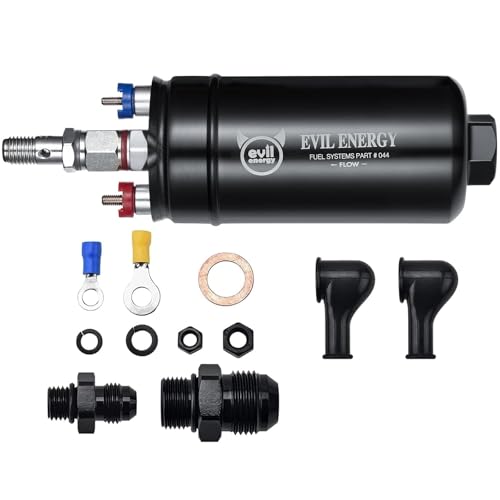
EVIL ENERGY 300 LPH External Inline Fuel Pump
- Best for: EFI conversions needing flexible flow, common AN fittings and E85 compatibility.
- 12V
- 75 PSI
- 200 LPH at 75 PSI
- 255 LPH at 43 PSI
EFI conversions needing flexible flow, common AN fittings and E85 compatibility.
Check the flow at your system pressure, since output falls as pressure rises.
This EVIL ENERGY pump earns its place through flexible flow figures and fittings that suit a wide range of EFI conversions. Its output changes with pressure and voltage, reaching 300 LPH at 43 PSI and 13.5V, with lower figures at higher pressure, so you can judge it against the pressure your system actually runs on the road or at the track. The 10AN inlet and 6AN outlet cover common plumbing setups, alloy steel construction suits the under-vehicle environment, and compatibility with E85, gasoline and diesel keeps your fuel options open. It is a solid middle choice when you want strong flow without the largest pump in this guide.
Watch out for: Check the flow at your system pressure, since output falls as pressure rises.
JDMSPEED 255LPH GSL392 Inline Fuel Pump
- Best for: Direct replacement of a GSL392-style inline EFI pump.
- 255 LPH flow
- 15-120 PSI operating range
- Installation kit included
- 6AN fittings
Direct replacement of a GSL392-style inline EFI pump.
Verify the 6AN fittings and the kit contents match your existing lines before you start the install.
Anyone replacing a GSL392-style pump will find this JDMSPEED unit the most direct swap of the three, thanks to a familiar, well-matched form, a 255 LPH flow figure and an installation kit included in the box. Its operating range of 15 to 120 PSI covers the pressures most EFI systems use, and the 6AN fittings match a common plumbing standard for external pumps. It also replaces the 400-939, which helps when you are matching a pump to an older listing or a cross-reference from a previous install. Choose it when you want a straightforward replacement with all the parts to fit it included, rather than a high-horsepower upgrade.
Watch out for: Verify the 6AN fittings and the kit contents match your existing lines before you start the install.
Which One Fits Your Situation
You Are Building a High-Horsepower EFI Engine
Pick the Holley 12-170 Universal In-Line Fuel Pump. Its 100 GPH flow and support for up to 900 EFI horsepower give a powerful engine the steady fuel volume it needs at full load, and its compatibility with pump gas, race gas, diesel and E85 leaves room to change fuels later. Pair it with a regulator and return line that can handle the flow, and check the AN fittings against your lines.
You Are Converting an Older Car to EFI
Pick the EVIL ENERGY 300 LPH External Inline Fuel Pump. Its flow figures across different pressures let you match it to the system you are building, its 10AN inlet and 6AN outlet suit common conversion plumbing and keep the parts list short, and E85 compatibility means the pump will not limit a future fuel change. Alloy steel construction also suits a pump mounted outside the tank on an older vehicle.
You Need a Direct Replacement for a Failed Pump
Pick the JDMSPEED 255LPH GSL392 Inline Fuel Pump. It replaces the GSL392 and 400-939, delivers 255 LPH across a 15 to 120 PSI range, and arrives with an installation kit included, which shortens a repair that is already unwelcome enough and gets the vehicle back on the road sooner. Check the 6AN fittings first against your lines, fit the kit carefully, and test for leaks before driving anywhere.
You Want Room to Grow Without Overspending Now
Pick the EVIL ENERGY 300 LPH External Inline Fuel Pump when your current engine is modest but a bigger build is already on the horizon. Its 300 LPH figure at 43 PSI and 13.5V gives useful headroom for more power later, while its wide pressure range and fuel compatibility keep the door open for future tuning changes without forcing another pump swap and another round of plumbing soon after.
Common Mistakes
- Buying a pump by its headline flow number alone, without checking what it delivers at the pressure your EFI system actually runs at full load.
- Choosing an in-tank pump by mistake, or ordering an inline pump for a setup that has no safe external mounting point, return line or space low near the tank.
- Mixing fitting sizes and thread types, then discovering mid-install that the adapters you need are not in the box, or in stock at the local store.
- Mounting an external pump high up, far from the tank or close to exhaust heat, where it struggles to draw fuel and runs hotter than it should.
- Skipping a leak check after the install, and only noticing a weeping fitting once fuel has pooled or the engine has already run under pressure.
Frequently Asked Questions
Can an inline pump replace an in-tank pump?
Yes, in many conversions it can, provided the system has a suitable external mounting point, a return line and a regulator matched to the pump. An inline pump still needs a clean, steady fuel supply from the tank, so check pickup, filtration and line routing before swapping pump types, and confirm the pump sits low enough to stay primed.
What flow do I need for my EFI engine?
It depends on horsepower, fuel type, pressure and use, since E85 and boosted engines need much more volume than a mild petrol setup. Compare the pump flow at your system pressure with your engine demand at full load, keep some margin for hot weather and future tuning, and size the regulator, lines and return plumbing to match.
Are these pumps compatible with E85?
The Holley and EVIL ENERGY pumps listed here state compatibility with E85, while the JDMSPEED listing does not state E85 compatibility. Check the specifications and fuel ratings for the pump you choose, and confirm the hoses, seals and fittings in your system suit the fuel you plan to run. Fuel compatibility is worth checking before you order, not after the install.
Do I need a return line with an inline EFI pump?
Most EFI setups use a return line and a regulator to hold steady pressure, so plan for both from the start when you fit an inline pump. Confirm the arrangement your regulator and injectors require, route the return cleanly away from heat and moving parts, and check every joint carefully for leaks before starting the engine.




Write Your Review
No reviews yet. Be the first to share your experience!