
🛒 Best Price Today on Amazon
Prime members get fast, free shipping on everything above, plus member-only deals. New members get a 30-day free trial — cancel anytime.
- Top Pick: Peladow Snow and Ice Melter Calcium Chloride Pellets, 25 lb
- Runner-up: Snow Joe Ice Beater Melter, 50 Lb Bag
- Also consider: Morton Safe-T-Salt Rock Salt, 25 lb
A winter storm that knocks out power also locks up the ground outside. The walkway to the door, the driveway, and the path to an outdoor generator still have to stay passable, often in the coldest hours of the year. Ice melt is the tool most households reach for, and the choice usually comes down to two chemistries: rock salt, the familiar default, and calcium chloride, the cold-weather specialist. This guide compares the two camps through five current products.
Every melting temperature quoted below is a maker claim, not a guarantee. Real performance depends on pavement temperature, how much product is spread, and whether it goes down before or after ice bonds to the surface. No ice melt makes a surface slip-free, and every product here is a chemical that has to be applied exactly as its label directs. With those limits in view, the differences between the camps are real and worth matching to your climate and your concrete.
As an Amazon Associate, we earn from qualifying purchases.
Quick Answer
Rock salt (sodium chloride) is the familiar, widely stocked melter, but makers rate it only to about 5 °F and it slows well before that. Calcium chloride pellets work at far colder temperatures and generate heat on contact, so they suit deep-winter storms. Magnesium chloride and CMA blends trade some cold-end power for gentler handling of concrete and vegetation. Match the chemistry to your coldest nights and your surfaces.
Peladow Snow and Ice Melter Calcium Chloride Pellets, 25 lb

Peladow is the reference product for the calcium chloride camp: a 25 lb bag of calcium chloride pellets, and the name commercial crews have used for this chemistry for decades. Calcium chloride works differently from rock salt. The pellets draw moisture from the air and ice, and they release heat as they dissolve, so they start melting on contact and keep working as temperatures fall far below the range where rock salt fades.
The trade-offs are handling and restraint. Calcium chloride is the strongest melter in this guide, and the label rate matters: spreading extra does not melt faster, and over-application is what damages concrete and nearby plants. For households whose storms arrive with single-digit or sub-zero nights, this is the camp to start from.
| Brand | Product | ASIN | Key specs |
|---|---|---|---|
| Peladow | Snow and Ice Melter Calcium Chloride Pellets, 25 lb | B00QJ8WX2U | Calcium chloride pellets; 25 lb bag; heat-generating on contact with ice |
Snow Joe Ice Beater Melter, 50 Lb Bag

The Ice Beater is Snow Joe’s entry in the calcium camp, in a 50 lb bag sized for long driveways and repeated storms. The formula is a calcium blend in heat-generating pellet form, and the maker claims melting action down to -15 °F. That figure is a maker claim, and it assumes the product is spread at the label rate on ice it can actually reach. Snow Joe positions this melter for concrete, driveways, and sidewalks.
One maker rule matters for this brand: Snow Joe’s own guidance is to apply its melts only on concrete or asphalt that is at least a year old, because fresh surfaces are still curing and are easier to damage. The big bag is the practical draw here. A 50 lb supply removes the mid-storm store run, and pellets store well between storms as long as the bag is resealed and kept dry.
| Brand | Product | ASIN | Key specs |
|---|---|---|---|
| Snow Joe | Ice Beater Melter, 50 Lb Bag | B0GKC5BC21 | Calcium blend heat-generating pellets; 50 lb bag; maker-claimed melting action down to -15 °F |
Morton Safe-T-Salt Rock Salt, 25 lb

Safe-T-Salt is the reference product for the rock salt camp: plain sodium chloride, the mineral halite, in a 25 lb bag. Rock salt melts by lowering the freezing point of water, and it works well in the moderate cold most regions see most of the winter. Morton’s stated melting floor for this product is 5 °F, and that number deserves a practical reading. As pavement temperatures fall toward the single digits, rock salt’s melting slows sharply, so a storm that starts at 25 °F and ends at 8 °F can leave salt sitting on ice it is barely touching.
Within its range, rock salt is simple and predictable. It is the hardest of these five on vegetation and the least forgiving of sloppy application, so measure by the label rather than by the handful, and sweep up excess once the ice has released rather than leaving it to wash into planting beds.
| Brand | Product | ASIN | Key specs |
|---|---|---|---|
| Morton | Safe-T-Salt Rock Salt, 25 lb | B000VYH6HU | Sodium chloride (halite) rock salt; 25 lb bag; maker-stated melting floor of 5 °F |
Harris Kind Melt Pet Friendly Ice and Snow Melter, 15 lb

Kind Melt is the middle path in this comparison. Its formula is magnesium chloride, which the maker states is the product’s full active chemistry, and Harris positions it for households with pets. Treat that positioning as a maker claim, not a safety guarantee: no ice melt is harmless, and the label’s pet guidance still applies, including keeping pets off treated surfaces until the melt has dissolved and done its work. The 15 lb bag includes a scoop for measured, repeatable spreading.
Magnesium chloride sits between the two camps on performance. It keeps working at temperatures below rock salt’s useful range, though it does not match calcium chloride at the coldest end, and it trades some of that cold-end power for gentler handling of concrete and vegetation. For a household with a moderate climate, a dog, and newer walkways, that balance is the argument.
| Brand | Product | ASIN | Key specs |
|---|---|---|---|
| Harris | Kind Melt Pet Friendly Ice and Snow Melter, 15 lb | B07XZMYCK9 | Magnesium chloride formula (maker claim); 15 lb bag; scoop included; model SAFEMELT-15 |
Snow Joe Premium Enviro Blend Ice Melt, 25 lb
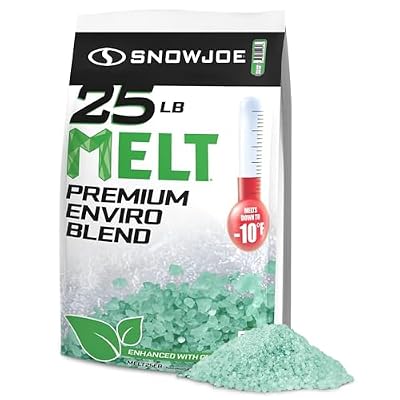
The Enviro Blend is built around calcium magnesium acetate, usually shortened to CMA, blended into green-coated crystals. The green coating is a practical touch: it shows where the product has already been spread, which makes even, label-rate coverage easier and over-application less likely. Snow Joe claims effectiveness at sub-zero temperatures down to -10 °F, and positions the blend as safer for vegetation, concrete, and metals; both points are maker claims, and the corrosion point is the CMA argument, since acetate melters are chosen where metal and finished concrete matter.
CMA blends are the gentlest chemistry in this guide and the slowest to bite in deep cold, so this is a pick for maintained surfaces rather than rescue work on thick ice. Clear the snow first, spread on the thin bond layer, and let it work.
| Brand | Product | ASIN | Key specs |
|---|---|---|---|
| Snow Joe | Premium Enviro Blend Ice Melt, 25 lb | B01N3BB9PA | CMA blend; green-coated crystals; 25 lb bag; maker-claimed effectiveness down to -10 °F |
How to Choose
Start with your coldest realistic night, not your average one. If storms in your area regularly push pavement temperatures into the single digits or below zero, rock salt will leave you disappointed at exactly the wrong moment, and a calcium chloride product belongs on the shelf. If your winters hover in the twenties, rock salt at the label rate handles most events.
Next, look at what the melt will touch. Concrete or asphalt less than a year old should not get chloride melts at all; wait a season. Older concrete, planting beds, and metal thresholds all argue for the gentler magnesium chloride or CMA options, applied sparingly. Then settle the habits that matter more than chemistry: clear the snow first, because melt works on the thin bond layer under ice and not through deep snow; spread before a storm when ice is expected to bond; store the bag sealed and dry, away from children and pets; and wash your hands after handling any of these products.
Who Should Skip
Skip every product in this guide if your concrete or asphalt is less than a year old; chloride and acetate melts alike belong on cured surfaces. Skip ice melt entirely if what you need is traction on uncleared snow: melt is not sand, it does not work through deep snow, and it is not a substitute for shoveling. Also skip the strongest calcium chloride products if you will not measure the label rate, because over-application is where the concrete and plant damage in this category actually comes from. And if children and pets cannot be kept off a treated surface until the product has dissolved, per the label, clear and sand that surface instead.
FAQ
Does calcium chloride damage concrete?
Any ice melt can contribute to concrete damage when it is over-applied or used on concrete that has not cured, and calcium chloride is strong enough that the label rate deserves respect. Spread at the directed rate on concrete at least a year old, and sweep up residue after the ice releases. The bigger risks are excess product and new surfaces, not the chemistry used as directed.
When is the best time to apply ice melt?
After clearing the snow, or before ice has bonded when a storm is coming. Melt works on the thin bond layer between ice and pavement; it cannot burn down through deep snow. A light application at the label rate before freezing rain bonds can prevent the hardest ice layer from forming.
Is a pet-positioned ice melt completely safe for pets?
No. Pet positioning is a maker claim about a gentler formula, not a promise that the product is harmless. Follow the label’s pet guidance: keep pets off treated surfaces until the melt has dissolved and worked, store the bag sealed and out of reach, and wash your hands after handling. Treat every ice melt as a household chemical, because that is what it is.
Can ice melt replace shoveling?
No. Ice melt is not traction sand and not a snow-removal tool. It loosens the bond between a thin ice layer and the pavement so the ice can be scraped away. On deep or uncleared snow it is wasted product. Clear first, melt the bond layer, then scrape.
Final Verdict
The two camps win in different weather. Rock salt, represented here by Morton’s Safe-T-Salt, is the sensible default where winter cold stays moderate and surfaces are old and plain. Calcium chloride, in the Peladow pellets and Snow Joe’s Ice Beater, is the storm shelf’s insurance for the coldest nights, when rock salt simply stops working. Between them, Harris Kind Melt and Snow Joe’s Enviro Blend trade raw cold-end power for gentler handling of concrete, vegetation, and the animals that walk across both. Pick by your coldest night and your newest surface, apply at the label rate, and no chemistry in this guide will disappoint you.








Write Your Review
No reviews yet. Be the first to share your experience!