
🛒 Best Price Today on Amazon
Prime members get fast, free shipping on everything above, plus member-only deals. New members get a 30-day free trial — cancel anytime.
The HomePower 3600 Plus is essentially a bet on the future: a home-sized battery around 3.6kWh that can grow with add-on packs. Buying it is worth it only if you expect to expand, or if the base capacity alone already fits your outage profile better than a fixed 3kWh unit. This review focuses on the economics of that expansion path, because that is where buyers either save money or lock themselves into an expensive ecosystem.
Buying now versus growing later
An expandable station lets you split the cost of a large system across months or years. The trade-off is that expansion packs are proprietary. Once you commit, every added kilowatt-hour must come from the same brand at whatever price it sets.
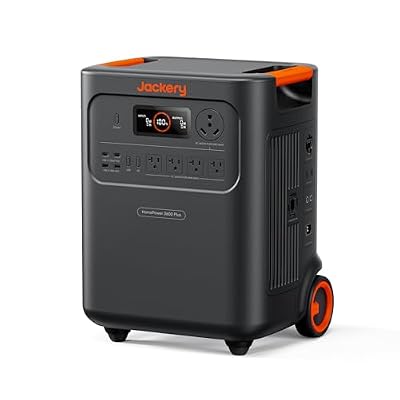
Jackery HomePower 3600 Plus Power Station, 3584Wh, 3600W AC Output
Included for 'Jackery HomePower 3600 Plus Review: Is It Worth Buying in 2026?' because the listing specifies 3584Wh and 3600W AC Output, details this guide uses to compare options.
View on Amazon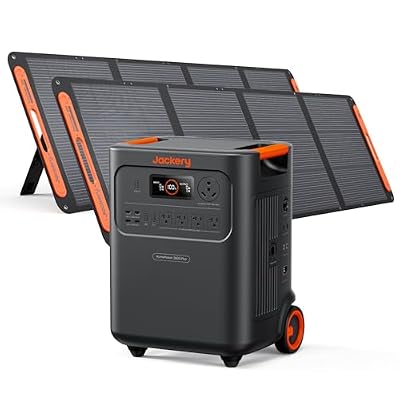
Jackery HomePower 3600 Plus & 2x200W Solar Panels, 3584Wh, 3600W AC Output
Included for 'Jackery HomePower 3600 Plus Review: Is It Worth Buying in 2026?' because the listing specifies 3584Wh and 3600W AC Output, details this guide uses to compare options.
View on Amazon
Jackery HomePower 3600 Plus and Extra Battery & 2x200W, 7168Wh, 3600W
Included for 'Jackery HomePower 3600 Plus Review: Is It Worth Buying in 2026?' because the listing specifies 7168Wh and 3600W, details this guide uses to compare options.
View on Amazon
Jackery HomePower 3600 Plus and Extra Battery, 7168Wh, 3600W AC Output
Included for 'Jackery HomePower 3600 Plus Review: Is It Worth Buying in 2026?' because the listing specifies 7168Wh and 3600W AC Output, details this guide uses to compare options.
View on AmazonRough cost-per-kWh at each step
Prices shift constantly; the table uses typical sale-price ranges to show the pattern, not exact quotes.
| Configuration | Nominal capacity | Usable estimate | Typical cost range | Rough cost per usable kWh |
|---|---|---|---|---|
| Base unit only | ~3.6kWh | ~3.1kWh | $1,800-$2,800 | $580-$900 |
| Base + 1 expansion pack | ~7kWh | ~6kWh | $3,300-$5,000 | $550-$830 |
| Base + 2 packs | ~10.5kWh | ~9kWh | $4,800-$7,200 | $530-$800 |
| Base + 3 packs | ~14kWh | ~12kWh | $6,300-$9,400 | $525-$780 |
The takeaway is that cost per kWh falls only slowly as you expand, because the packs themselves are not cheap. Expansion is about convenience and single-inverter simplicity, not savings.
When expansion actually pays off
Expansion is worth it when your outages last longer than one day and solar cannot fully refill the system each day. A household using 6 to 8kWh daily for essentials, including a furnace blower and fridge, needs roughly two days of storage to ride through an average multi-day storm, which points to the base plus one or two packs.
When it does not
If your outages are short, or you have enough solar to refill 3.1kWh daily, the base unit is enough. Buying an expandable model and never expanding means you paid a premium for a door you never opened.
The 600Wh difference versus a 3kWh sibling
The step from 3kWh to 3.6kWh adds about 500Wh usable. That covers roughly one extra overnight run of a fridge, around 8 to 10 hours, or an extra 12 hours of internet and lights. It is meaningful for people sitting right at the edge of overnight coverage, and irrelevant for people who will expand anyway.
Integration and 240V considerations
Check whether your configuration supports 240V output or pairing two units for split-phase. Loads like a 240V well pump need that capability, plus a transfer switch or interlock installed by a licensed electrician. Without it, the system is limited to 120V circuits through extension cords or a 120V transfer switch.
Placement for a multi-pack system
A base with two or three packs is heavy and bulky. Plan a permanent spot in a garage, utility room, or basement with ventilation, a hard floor, and no flood risk. Keep charging temperatures above freezing for LiFePO4 cells.
Solar matching
To refill 6kWh a day you need roughly 1,800 to 2,400W of panels in a 4 to 5 peak-sun-hour climate after losses. Confirm the unit’s solar input limit and voltage window, because solar input is often the real bottleneck on multi-day recovery, not battery size.
Questions to answer before you commit
Three questions decide whether this model is a smart buy. First, how long was your longest outage in the past five years? If it ran past 36 hours, you are an expansion buyer. Second, can you mount or place at least 1,200W of panels in sun? If not, extra packs become your only way to extend runtime, which raises the total cost. Third, is the brand’s expansion pack readily available now? Ecosystems occasionally change, and a pack that is hard to find in three years leaves you stuck at base capacity. Buyers who answer yes, yes, and yes get the full value of this design; buyers who answer no to the first question should consider a fixed-capacity unit and keep the difference.
FAQ
Do I need to buy expansion packs right away?
No. The advantage of this design is starting with the base unit and adding packs after you see how your household actually uses it in a real outage.
Will expansion packs from other brands work?
No. Expansion batteries are proprietary and communicate with the base unit; third-party packs will not connect safely.
Bottom line
The HomePower 3600 Plus is worth buying if you are fairly sure you will expand to 7kWh or more, or if its extra 600Wh gets you past overnight fridge coverage. If you will never add packs, a fixed 3kWh-class unit or a lower-cost 2kWh station delivers similar value for less money.
Write Your Review
No reviews yet. Be the first to share your experience!