
🛒 Best Price Today on Amazon
Prime members get fast, free shipping on everything above, plus member-only deals. New members get a 30-day free trial — cancel anytime.
Both 5,500W and 7,500W generators typically come with a 240V L14-30R outlet, and both can feed your home through a 30-amp transfer switch. So why pay more for the bigger one? The answer usually lies in the starting surge of your largest motor, and in how many heavy loads you want to run at once. A deep well pump, a central air conditioner, and a furnace all starting within the same few seconds need a very different generator from a sump pump and a fridge. Here’s the practical breakdown.
Class-level specifications
| Spec (class range) | 5,500W class | 7,500W class |
|---|---|---|
| Running / starting watts | 4,500-5,500 / 6,500-7,000W | 7,000-7,500 / 9,000-9,500W |
| Max through a 30A 240V inlet | Full output | ~7,200W (inlet limit) |
| Weight | 130-180 lb | 190-230 lb |
| Fuel tank | 4-6 gal | 6-8 gal |
| Fuel use at half load (gasoline) | ~0.4-0.5 gal/hr | ~0.55-0.7 gal/hr |
| Runtime per tank at half load | ~9-12 hrs | ~10-12 hrs |
| Noise at 23 ft | 60-74 dBA | 65-76 dBA |
| Typical price (open-frame) | $700-$1,300 | $900-$1,600 |
Ratings vary by model and fuel. Propane typically reduces output by about 8-12%. Check the current spec sheet for the exact figures.
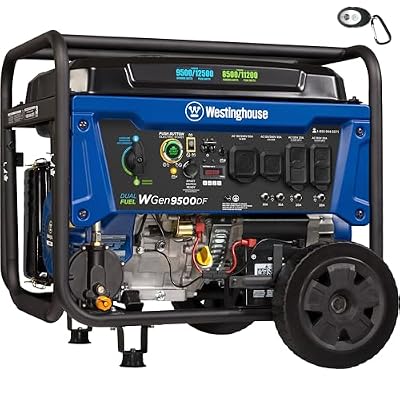
Westinghouse 12500 Watt Dual Fuel Home Backup Portable Generator, Remote Electric Start, Transfer Switch Ready, Gas and Propane Powered
Included for '5500W vs 7500W Generator: Which Do You Need?' because the listing specifies Remote Electric Start and Transfer Switch Ready, details this guide uses to compare options.
View on Amazon
Westinghouse 9500 Peak Watt Dual Fuel Home Backup Portable Generator, Electric Start, Transfer Switch Ready, Gas & Propane Powered, CO Sensor
Included for '5500W vs 7500W Generator: Which Do You Need?' because the listing specifies Electric Start and Transfer Switch Ready, details this guide uses to compare options.
View on Amazon
DuroStar DS13000MX 13,000-Watt 500cc Dual Fuel Portable Generator - Gas and Propane, Remote Electric Start, Whole Home Power Backup, Transfer Switch Ready, RV & Emergency Ready
Included for '5500W vs 7500W Generator: Which Do You Need?' because the listing specifies 000-Watt 500cc Dual Fuel Portable Generator and Gas and Propane, details this guide uses to compare options.
View on Amazon
Generac 12,500 Starting Watt Tri-Fuel Portable Generator, Electric Start
Included for '5500W vs 7500W Generator: Which Do You Need?' because the listing specifies 500 Starting Watt Tri-Fuel Portable Generator and Electric Start, details this guide uses to compare options.
View on AmazonThe 30-amp inlet ceiling
This detail is often missed. A 30A 240V inlet and transfer switch can deliver at most 7,200W (30A x 240V). A 7,500W generator already fills that connection, so buying a 9,000W or larger generator only makes sense with a 50A inlet and switch. Between 5,500W and 7,500W, though, the 30A setup works for both, and the larger generator lets you use nearly all of the inlet’s capacity.
Scenarios where 5,500W is enough
- City water home: fridge, freezer, sump pump, gas furnace blower, lights, internet, and a microwave used carefully
- Rural home with a 1/2 HP well pump, managed so the pump and other motors start separately
- One or two window AC units plus essentials in summer
Scenarios that call for 7,500W
Larger well pumps
A 1 HP submersible can surge to about 5,000-6,000W on a hard start. On a 5,500W generator, that leaves nothing for anything else. The 7,500W class starts it while the fridge and furnace keep running.
Small central AC
A 2-ton central AC typically runs at 1,800-2,500W and can surge to 5,000-7,000W without a soft-start kit. With a soft-start kit, installed by an HVAC technician, many 7,500W generators can run a 2-2.5 ton system along with essentials. A 5,500W unit usually can’t.
More simultaneous loads
Running the dishwasher, washing machine, and microwave while the fridge and well pump cycle is realistic on 7,500W. On 5,500W it requires constant load juggling.
What you give up going bigger
More fuel: roughly 0.15-0.2 gallons per hour extra at similar loads, or about 2-3 extra gallons per 12-hour day. More weight: moving 200+ lb across wet lawn is a two-person job. More noise: expect neighbors to notice. If your load list truly fits 5,500W with some margin, the smaller unit is cheaper to run over a week-long outage.
Propane and dual fuel at this size
At 0.5+ gallons of gasoline per hour, fuel logistics dominate long outages. Dual-fuel models let you run on a pair of 20 lb propane cylinders, each lasting roughly 5-8 hours at moderate load in this class, or connect to a larger tank. Propane doesn’t go stale, which matters for a generator that may sit unused for a year. For a 7,500W unit, a 100 lb cylinder or a tank connection installed by a licensed propane technician makes multi-day operation practical.
Safety and installation
Generators this size produce a lot of carbon monoxide. Keep them at least 20 feet from the house, with the exhaust pointed away from doors, windows, and vents, and never in a garage, even with the door open. Install CO alarms on every level. The connection to your panel must be a transfer switch or interlock with a generator inlet, installed and permitted by a licensed electrician. A double-male backfeed cord can electrocute lineworkers and start fires.
FAQ
Can a 7,500W generator run central air?
Often a 2-2.5 ton unit, especially with a soft-start kit, while other loads are managed. Larger 3-4 ton systems typically need the 9,500-12,000W class or a standby generator.
Is a 30A or 50A transfer switch better for a 7,500W generator?
A 30A setup (7,200W) matches a 7,500W generator well. Choose 50A only if you might upgrade to a 9,000W+ generator later.
Bottom line
A 5,500W generator handles 240V essentials and a smaller well pump at lower fuel cost. A 7,500W unit uses the full capacity of a 30A inlet, starts larger pumps, and makes small central AC realistic. Base the choice on your biggest motor’s surge and how many loads must run together.
Write Your Review
No reviews yet. Be the first to share your experience!