
🛒 Best Price Today on Amazon
Prime members get fast, free shipping on everything above, plus member-only deals. New members get a 30-day free trial — cancel anytime.
Between 7,500 and 12,000 watts, a portable generator starts to look like a small whole-home solution. That brings a decision many buyers don’t expect: at the top of this range, you’re competing with permanently installed standby generators on capability, and some of the same trade-offs apply. The biggest differences are the 50-amp outlet, the ability to run central air or electric cooking alongside everything else, and a much heavier, thirstier machine. Here’s how the two classes compare, and when to consider a standby unit instead.
Class comparison
| Spec (class range) | 7,500W class | 12,000W class |
|---|---|---|
| Running / starting watts | 7,000-7,500 / 9,000-9,500W | 9,500-12,000 / 12,000-15,000W |
| Main 240V outlet | L14-30R (30A) | 14-50R (50A) plus L14-30R |
| Transfer switch / inlet | 30A (7,200W max) | 50A (12,000W max) |
| Weight | 190-230 lb | 250-330 lb |
| Fuel tank | 6-8 gal | 8-10 gal |
| Gasoline use at half load | ~0.55-0.7 gal/hr | ~0.9-1.2 gal/hr |
| Fuel per 24 hrs (half load) | ~13-17 gal | ~22-29 gal |
| Typical price (open-frame, dual-fuel) | $900-$1,600 | $1,500-$2,800 |
These are typical ranges. Verify the specific model’s ratings on each fuel, and its outlet configuration, on the current spec sheet.

DuroMax XP12000EH 12,000-Watt Dual Fuel Portable Generator – Gas & Propane, Electric Start, Whole Home Backup Power, Transfer Switch Ready, RV & Emergency Ready
Included for '7500W vs 12000W Generator: Which Do You Need?' because the listing specifies 000-Watt Dual Fuel Portable Generator and Gas & Propane, details this guide uses to compare options.
View on Amazon
DuroMax Gas Powered Portable 12000 Watt-Electric Start-Home Back Up & RV Ready, 50 State Approved Generator, Blue, Black
Included for '7500W vs 12000W Generator: Which Do You Need?' because the listing specifies 50 State Approved Generator and Blue, details this guide uses to compare options.
View on Amazon
DuroMax XP13000HX 13,000-Watt Dual Fuel Portable Generator - Gas & Propane, Electric Start, Whole Home Power Backup, Transfer Switch Ready, RV & Emergency Ready
Included for '7500W vs 12000W Generator: Which Do You Need?' because the listing specifies 000-Watt Dual Fuel Portable Generator and Gas & Propane, details this guide uses to compare options.
View on Amazon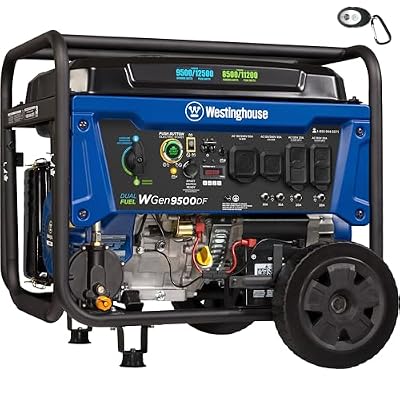
Westinghouse 12500 Watt Dual Fuel Home Backup Portable Generator, Remote Electric Start, Transfer Switch Ready, Gas and Propane Powered
Included for '7500W vs 12000W Generator: Which Do You Need?' because the listing specifies Remote Electric Start and Transfer Switch Ready, details this guide uses to compare options.
View on AmazonWhat 12,000W makes possible
Central air conditioning without compromise
A 3-4 ton central AC runs at roughly 3,000-4,500W and surges much higher. A 12,000W generator can start and run it, often with a soft-start kit fitted by an HVAC technician, while the fridge, freezer, lights, and well pump continue. On 7,500W, a 3-ton system is usually out of reach.
Electric cooking and water heating
A 4,500W water heater element or a couple of range burners can run alongside essentials on 12,000W. On 7,500W, each of those loads essentially needs the generator to itself.
Fewer load-management chores
The biggest quality-of-life gain is simple: at 12,000W, most households can live nearly normally, minus dryer-plus-oven-plus-AC all at once. At 7,500W, someone is always deciding what to turn off.
The costs of going big
Fuel logistics
At about 1 gallon per hour, a 12,000W generator needs roughly 25 gallons of gasoline per day. That’s five 5-gallon cans, refilled at stations that may also be without power. Dual-fuel units connected to a large propane tank (100-500 gallons) by a licensed propane installer largely solve this. It’s the main reason many 12,000W owners run on propane.
Weight and noise
At 250-330 lb, the generator is effectively stationary. Plan a permanent, level outdoor pad at least 20 feet from the house, with a covered but open-sided shelter rated for running operation. Expect 70-78 dBA at 23 feet, and check local noise ordinances.
Right-sizing with a load calculation
Before buying either class, list every circuit you’ll want during an outage, with running and starting watts. Then add the largest single starting surge to the sum of everything else’s running watts. A typical rural list might be a refrigerator (200W), chest freezer (150W), 1 HP well pump (1,500W running, 5,000W start), furnace blower (600W), lights and internet (300W), and a microwave (1,200W). That comes to about 3,950W running, and roughly 7,450W at the moment the pump starts while everything else runs. That home fits a 7,500W generator with careful habits. Add a 3-ton AC at 3,500W running and it clearly belongs in the 12,000W class. An electrician can take clamp-meter readings on the panel for a more precise picture.
When a standby generator makes more sense
If you’re considering 12,000W portable plus a 50A transfer switch, a propane tank, and a permanent pad, compare an air-cooled home standby generator in the 14-26 kW range. Installed costs often run $7,000-$15,000+, versus perhaps $3,500-$6,000 for the portable route with professional electrical and propane work. Standby units start automatically, run on natural gas or propane without refueling, and exercise themselves weekly. For frequent, long outages, the extra cost often pays off in convenience.
Installation and safety essentials
A 50A generator connection requires a 50A inlet, a matching cord, and a transfer switch or interlock sized for it, all installed by a licensed electrician, usually with a permit. Never backfeed a panel through a range or dryer outlet. The generator’s CO output is substantial. Position it 20+ feet from the home, with the exhaust away from openings and HVAC intakes, never in a garage or enclosed shelter. Use battery-backed CO alarms on every level, and prefer models with automatic CO shutoff.
FAQ
Can a 12,000W generator run a whole house?
For many homes up to about 2,500 square feet, including central AC, it can run nearly everything with modest load management. Large homes with electric heat, multiple AC units, or electric cooking plus a dryer may still exceed it.
Do I need a 50A transfer switch for a 12,000W generator?
To use its full capacity, yes. A 30A connection caps usable output at about 7,200W, which wastes the larger generator.
Bottom line
Choose 7,500W for essential circuits, a well pump, and small central AC with a 30A transfer switch. Choose 12,000W with a 50A connection for near-normal living, including larger central AC, on a propane supply. If you’re heading toward 12,000W anyway, price a standby generator before you decide.


Write Your Review
No reviews yet. Be the first to share your experience!