
🛒 Best Price Today on Amazon
Prime members get fast, free shipping on everything above, plus member-only deals. New members get a 30-day free trial — cancel anytime.
A dull blade skates off cable insulation and tears hose instead of slicing it. The sharpener families fix that differently. Electric units grind a fresh bevel through staged slots. Guided rod systems clamp the blade and hold the angle while stones do the cutting. Ceramic rod setups draw the blade down upright rods at a preset angle.
Angle matters as much as abrasive. Most Western kitchen knives and shop utility blades carry a 20-degree bevel per side; many Japanese kitchen knives use a keener 15 degrees. Feed a 15-degree blade into a 20-degree sharpener and it regrinds the edge wider; feed a thick 20-degree blade into a 15-degree slot and the abrasive polishes the shoulders without touching the apex.
As an Amazon Associate, we earn from qualifying purchases.
Quick Answer
The Chef’sChoice 15XV is the fastest route to a keen 15-degree edge on straight and serrated kitchen knives. The Presto 08800 EverSharp is the simpler two-stage electric for everyday 20-degree household blades. The Work Sharp Precision Adjust clamps the blade and dials in any angle from 15 to 30 degrees, and the Lansky Deluxe 5-Stone System covers similar ground with five stones. The Spyderco Tri-Angle Sharpmaker needs no power and handles serrated edges and scissors best.
1. Chef’sChoice 15XV EdgeSelect Professional Electric Knife Sharpener

The 15XV suits anyone who wants a keen edge without learning a technique. All three stages run under precision angle guides, so the blade sits correctly as you draw it through. Stages one and two use diamond abrasives to shape and sharpen; the third uses a flexible stropping disc that polishes the edge and also handles serrated blades.
Know the commitment: this machine puts a 15-degree edge on everything. A first pass converts a 20-degree factory edge to that slimmer profile, taking longer and removing more metal; later touch-ups are quick. Thick outdoor blades ground at wider angles do not suit it.
Specs
– Three stages: two diamond stages plus a flexible stropping stage
– Fixed 15-degree edge angle per side, precision angle guides
– Handles straight-edge, serrated, and Santoku style blades
– Model 0101500, countertop electric unit
2. Presto 08800 EverSharp Electric Knife Sharpener

The EverSharp is the straightforward two-stage electric for the drawer of everyday knives most homes own. Sapphirite grinding wheels do the cutting: stage one grinds the bevel, stage two hones it finer, and blade guides hold a preset angle suited to household and sport knives ground near 20 degrees per side.
Its limits are plain. It sharpens non-serrated blades only, so bread knives need a different tool, and it offers no angle choice: fine when your blades match its preset, a poor fit when they do not.
Specs
– Two stages: Sapphirite wheel grinding, then fine honing
– Preset blade guides for standard household knife angles
– Sharpens plain-edge kitchen, household, and sport knives
– Not intended for serrated blades or scissors
– Model 08800, 120-volt countertop unit
3. Work Sharp Precision Adjust Knife Sharpener

The Precision Adjust is a guided rod system built on one idea: the clamp holds the knife, the angle stays put, and you move the abrasive instead of the blade. Set the angle anywhere from 15 to 30 degrees, lock the blade in the clamp, and sweep the Tri-Brasive rod along the edge. Its faces carry 320-grit diamond for reshaping, 600-grit diamond for refining, and fine ceramic for finishing.
Because the angle dials in, this is the most flexible sharpener in the group. It matches a 15-degree kitchen edge, a 20-degree utility blade, or a stout 25-degree outdoor knife without regrinding any of them, and the ceramic rod works into serrations too. The trade-off is pace: each blade takes a few minutes of deliberate strokes.
Specs
– Adjustable angle from 15 to 30 degrees in 1-degree increments
– Tri-Brasive rod: 320-grit diamond, 600-grit diamond, fine ceramic
– Clamp-and-chassis design holds the blade at the set angle
– Ceramic rod also touches up serrated edges
– Model WSBCHPAJ, manual bench system
4. Lansky Deluxe 5-Stone Sharpening System
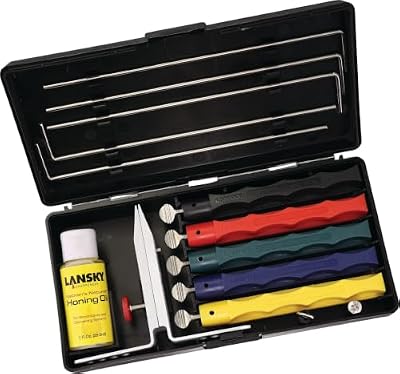
The Lansky is the classic clamp-and-guide-rod kit, stretched here across five stones. The blade locks into a two-piece clamp, a guide rod attaches to the stone holder, and the rod rides through one of four angle holes in the clamp: 17, 20, 25, or 30 degrees. Because the rod enforces the angle on every pass, a beginner gets the same even bevel an experienced hand would.
The stones run from rescue work to polish: 70-grit extra coarse rebuilds a chipped edge, 120 and 280 shape and sharpen, 600 refines, and the 1000-grit ultra fine ceramic stone leaves a smooth finish. It is the slowest method here, but the control is excellent.
Specs
– Five stones: 70, 120, 280, 600, and 1000 grit
– Four guide angles: 17, 20, 25, and 30 degrees per side
– Two-piece knife clamp with guide-rod angle holes
– Alumina ceramic stones, honing oil included
– Model LKCLX, in a storage case
5. Spyderco Tri-Angle Sharpmaker

The Sharpmaker takes the opposite approach to a clamp system: the stones stand still at a fixed angle and you move the knife, drawing it straight down the upright ceramic rods as if slicing. The base offers two settings, 30 degrees inclusive for keen edges and 40 degrees inclusive for durable ones, meaning 15 or 20 degrees per side. Medium brown rods grind, fine white rods finish, and the rod corners slip into serrations.
This is the most versatile tool here for odd jobs: serrated blades, scissors, shop shears, and fish hooks all fit its rods. It needs no power and packs into its own base. The catch is technique: keep the blade vertical on every stroke, and expect damaged edges to take patience, since the kit has no truly coarse stone.
Specs
– Two settings: 30 and 40 degrees inclusive (15 or 20 per side)
– Alumina ceramic rods in medium and fine grits
– Rod corners sharpen serrated blades; scissors position in base
– Base stores the rods and includes brass safety rods
– Model 204MF, fully manual, no power or oil
How to Choose
Begin with the angle already on your blades. A sharpener must meet that angle or let you set it. Fixed-angle electrics like the Presto suit a uniform drawer of standard blades. The Chef’sChoice deliberately converts everything to 15 degrees, a feature if you want keener edges, and a real commitment. Guided systems from Work Sharp and Lansky match each blade instead.
Think in stages next. A coarse stage reshapes, removing metal quickly to repair chips and rebuild a flattened bevel. A medium stage does routine sharpening on a blade that has merely gone dull. A fine stage hones and polishes, and a stropping stage refines further without grinding. Neglected blades need the coarse end of that ladder; maintained blades need only a two-stage electric.
Abrasives decide feel and lifespan. Diamond cuts fastest and works dry, so the Chef’sChoice and Work Sharp use it for shaping. Tungsten carbide inserts, common in cheap pull-through tools, tear metal off and leave a rough edge; no pick here relies on them. Ceramic cuts slowly and finely, ideal for finishing, and Sapphirite wheels sit between.
Be honest about scope. Serrated blades cannot pass through straight slots; they need a stropping stage, a tapered rod, or rod corners, pointing you to the Chef’sChoice, Work Sharp, or Sharpmaker. Scissors need their own geometry, and only the Sharpmaker addresses them here. Finally, a honing steel is not a sharpener: it removes almost no metal, only straightening a folded edge.
FAQ
Can I sharpen a serrated knife at home?
Yes, but not in a straight slot. The abrasive must reach into each scallop: the stropping stage on the Chef’sChoice 15XV, the ceramic rod on the Work Sharp Precision Adjust, or the rod corners on the Spyderco Sharpmaker all do this.
What is the difference between 15-degree and 20-degree edges?
A 15-degree bevel per side is thinner, slices with less resistance, and suits fine kitchen work, but the edge is more delicate. A 20-degree bevel is tougher and shrugs off harder use, so utility and outdoor blades wear it.
Will an electric sharpener damage my knives?
Used as directed, no, but electrics remove metal faster than manual tools, so a heavy hand shortens a blade’s life and can reprofile its angle. Use light pressure.
Verdict
For convenience and the keenest kitchen edge, the Chef’sChoice 15XV earns the top spot, provided you are happy living at 15 degrees. The Presto EverSharp covers standard household blades with the least fuss. Buyers wanting one tool for every angle they own should pick the Work Sharp Precision Adjust for flexibility or the Lansky Deluxe for its five-stone range. The Spyderco Sharpmaker is the quiet overachiever: the only pick that also takes on serrated blades and scissors.
Write Your Review
No reviews yet. Be the first to share your experience!