
🛒 Best Price Today on Amazon
Prime members get fast, free shipping on everything above, plus member-only deals. New members get a 30-day free trial — cancel anytime.
Generator work is full of fasteners in awkward places: alternator bracket bolts behind a belt guard, valve cover bolts under a fuel line, frame bolts you can touch but barely swing a wrench on. A cordless ratchet earns its keep in exactly those spots: the slim head slides into gaps a socket wrench cannot use, and the motor spins the fastener out once you break it loose.
As an Amazon Associate, we earn from qualifying purchases.
Quick answer
For most generator engine and frame work, a 3/8 inch cordless ratchet in the 50 to 60 ft-lb range is the sweet spot. The DEWALT DCF510B is the most versatile pick because its interchangeable anvils cover both 3/8 and 1/2 inch sockets on a 20V platform. The DEWALT DCF503B gives 12V owners similar torque in a lighter tool. The Makita XRW01Z swaps between 3/8 and 1/4 inch anvils and spins far faster than the rest. The Ingersoll Rand R3130 brings an air tool feel on a 20V battery, and the Ryobi PBLRC25B adds an extended neck for bolts buried deep in a frame rail.
One honest note applies to every tool below: the torque figure on the box is fastening torque, for running a bolt down and snugging it up. None of these replaces a breaker bar for freeing a seized bolt, or a torque wrench for final tightening.
DEWALT 20V MAX XR Sealed Head Ratchet (DCF510B)
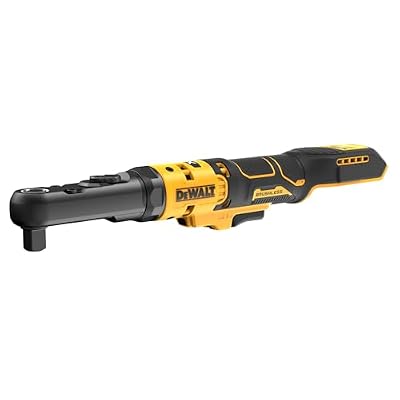
The DCF510B is the heavy lifter of this group. Its brushless motor delivers up to 75 ft-lbs of torque, the highest figure here, and the sealed head keeps dust, grit and oil mist out of the mechanism. The standout feature is the interchangeable anvil set: one tool accepts both 3/8 inch and 1/2 inch anvils, so it runs both small engine bolts and heavier frame hardware. A variable speed trigger covers 0 to 300 RPM, an LED light sits at the head, and a trigger lock prevents accidental runs in a tool bag. It is a bare tool for the DEWALT 20V MAX platform.
Specs
– Drive: interchangeable 3/8 in and 1/2 in anvils
– Max torque: 75 ft-lbs
– Speed: 0 to 300 RPM, variable trigger
– Motor: brushless, sealed head
– Platform: DEWALT 20V MAX, bare tool
– Extras: LED light, trigger lock
DEWALT XTREME 12V MAX Ratchet (DCF503B)

The DCF503B proves a 12V tool need not be a light-duty toy. Its brushless motor produces up to 60 ft-lbs of torque, more than several 18V and 20V rivals, while the compact XTREME body weighs about 2 lb and slips into tighter bays than a full-size 20V tool. For generator covers and panel hardware, that smaller footprint often decides whether the tool gets used at all. Speed runs from 0 to 250 RPM, and the glass-filled nylon housing resists fuels and solvents that splash around small engines. It takes DEWALT 12V MAX batteries and is sold as a bare tool.
Specs
– Drive: 3/8 in
– Max torque: 60 ft-lbs
– Speed: 0 to 250 RPM, variable trigger
– Motor: brushless
– Platform: DEWALT 12V MAX, bare tool
– Housing: glass-filled nylon, LED light
Makita 18V LXT Ratchet (XRW01Z)

The Makita XRW01Z plays a different game: speed and flexibility over raw torque. It ships with interchangeable 3/8 inch and 1/4 inch anvils, covering everything from tiny carburetor screws up to mid-size engine bolts. The motor spins up to 800 RPM, more than double most rivals, making long threaded runs feel effortless. Torque is a modest 35 ft-lbs, so this is a run-down tool rather than a bolt breaker, and Makita leans into that honestly: a lock button lets you use it as a manual ratchet when a fastener needs hand force. It runs on Makita 18V LXT batteries and is sold as a bare tool.
Specs
– Drive: interchangeable 3/8 in and 1/4 in anvils
– Max torque: 35 ft-lbs
– Speed: 0 to 800 RPM, variable trigger
– Platform: Makita 18V LXT, bare tool
– Extras: manual lock mode, LED light
– Weight: about 2.6 to 3.5 lb with battery
Ingersoll Rand 20V Ratchet (R3130)

Ingersoll Rand built its name on air tools, and the R3130 feels like a pneumatic ratchet that cut its hose. The 3/8 inch tool delivers 54 ft-lbs of max torque at up to 225 RPM, squarely in the working range for engine brackets, exhaust hardware and frame bolts on mid-size generators. A feather-touch variable speed lever gives the fine low-speed control air tool users expect. The housing mixes metal and composite sections, and the head stays slim for work between frame rails. It runs on the IQV20 platform as a bare tool.
Specs
– Drive: 3/8 in
– Max torque: 54 ft-lbs
– Speed: 0 to 225 RPM, feather-touch lever
– Platform: Ingersoll Rand IQV20 20V, bare tool
– Housing: metal and composite
– Extras: slim head for confined bays
Ryobi 18V ONE+ HP Brushless Extended Reach Ratchet (PBLRC25B)

Reach is the Ryobi’s whole argument. The extended neck puts the 3/8 inch head well ahead of your hand, helping with bolts set deep between a fuel tank and a frame rail, and the head rotates to four positions so the paddle trigger stays comfortable while the socket angle changes. A brushless motor gives up to 55 ft-lbs of torque and 0 to 230 RPM, driven by a metal paddle trigger that is easy to feather with a gloved hand. It runs on Ryobi 18V ONE+ batteries as a bare tool.
Specs
– Drive: 3/8 in, pin detent anvil
– Max torque: 55 ft-lbs
– Speed: 0 to 230 RPM, paddle trigger
– Motor: brushless, extended neck
– Platform: Ryobi 18V ONE+, bare tool
– Extras: 4-position rotating head, dual LED lights
How to choose
Match the drive to the hardware first. A 3/8 inch drive covers the great majority of generator engine and frame bolts. Choose 1/2 inch, or a tool with a swappable 1/2 inch anvil like the DEWALT DCF510B, for larger frame or lug hardware. A 1/4 inch anvil earns its place for shrouds, carburetors and control panels, where a big head will not fit and too much torque snaps small bolts.
Read torque figures with care. The headline number is the most the tool can apply while fastening under ideal conditions, not a promise about breaking loose corroded hardware. Crack tight bolts free by hand, spin them out with the ratchet, then set final torque by hand or with a torque wrench.
Head profile and reach decide whether the tool gets used at all. A low, slim head fits between a pulley and a frame rail; an extended neck reaches bolts your hand cannot follow. Trigger style matters too: a paddle trigger works well with gloves, while a slim finger trigger gives finer control on small hardware. Finally, buy into the battery platform you already own; a bare tool that shares packs with your drill is almost always the sensible purchase.
FAQ
Can a cordless ratchet break loose a seized frame bolt?
Usually not, and it should not be asked to. These tools are built to run fasteners quickly, not to deliver breaker bar force. Crack the bolt loose by hand first, then let the ratchet spin it out. Forcing a stalled ratchet shortens head life.
Which drive size is best for generator work?
A 3/8 inch drive is the best single choice for most owners, covering common engine and frame sizes. Add 1/2 inch capability for larger chassis or wheel hardware, and 1/4 inch if you often remove covers and carburetor parts.
Should I buy a bare tool or a kit?
If you already own batteries from the same platform, a bare tool is the efficient buy. If this is your first tool on a platform, pick a kit with battery and charger; a compact 2.0 Ah pack keeps the tool light in tight bays.
Can I finish tightening by hand with the tool?
Yes, within reason. Most cordless ratchets tolerate use as a manual ratchet once the motor stops, and the Makita even provides a lock mode for it. Keep hand force moderate, and use a torque wrench where the maker publishes a figure.
Verdict
Buy the DEWALT DCF510B if you want one ratchet for both engine bolts and heavier frame hardware; its swappable anvils and 75 ft-lb output make it the most capable tool here. Choose the DEWALT DCF503B for a lighter 12V tool that still pulls hard, or the Makita XRW01Z when your work is mostly small fasteners that reward speed. The Ingersoll Rand R3130 suits pros who like air tool manners without the hose, and the Ryobi PBLRC25B is the reach pick for ONE+ owners. Keep the honest division of labor: hand tools break bolts loose and set final torque; the ratchet makes everything in between fast.
Write Your Review
No reviews yet. Be the first to share your experience!