
🛒 Best Price Today on Amazon
Prime members get fast, free shipping on everything above, plus member-only deals. New members get a 30-day free trial — cancel anytime.
A household vacuum gives up the first time it meets a puddle, a pile of sawdust, or the grit under a workbench. A wet and dry shop vacuum is built for exactly that work. It swallows liquids and dry debris in the same tank, shrugs off screws and wood chips that would choke a home machine, and doubles as a blower for clearing a dusty bench.
This guide compares five proven models spanning the sizes most buyers need, from a 2.5-gallon unit that lives in a car trunk to a 16-gallon drum built for flood water and renovation debris. Around a generator bay, the same machine handles spilled water, tracked-in gravel, and fine dust, with one firm exception covered below: fuel.
One caution before the picks. The peak horsepower figure on the box is a laboratory number, not a promise of suction at the nozzle. Airflow in cubic feet per minute and sealed suction tell you far more.
As an Amazon Associate, we earn from qualifying purchases.
Quick answer
- Best for cars and small spills: Armor All AA255, 2.5 gallons
- Best compact all-rounder: Stanley SL18116P, 6 gallons
- Best mid-size for most garages: CRAFTSMAN CMXEVBE17590, 9 gallons
- Best for workshops and fine dust: DEWALT DXV10P, 10 gallons, 90 CFM
- Best for big water and heavy debris: CRAFTSMAN CMXEVBE17595, 16 gallons
Every model below handles wet and dry messes, converts to blowing duty, and uses filters you can swap in minutes.
1. Armor All AA255 Wet/Dry Utility Vac

The AA255 is the vac you grab for a car interior, a spilled drink, or the gritty corner of a trunk. Its 2 peak HP motor sounds modest, and it is, but through the short hose the suction is plenty for crumbs, sand, pet hair, and small hardware under seats.
It converts to a blower, handy for pushing water off a washed car. For wet pickup you slide on the foam sleeve; for dry work the reusable cloth filter goes back in. Detailing nozzles, including a crevice tool and brush nozzle, come in the box.
Know the limits. A 2.5-gallon tank fills fast with leaves or shop debris, the reach is short, and fine drywall dust clogs the cloth filter quickly.
Specs
– Tank capacity: 2.5 gallons
– Motor: 2 peak HP, corded
– Pickup: wet and dry, converts to blower
– Filtration: foam sleeve (wet), cloth filter (dry)
– Hose and cord: 6 ft hose, 10 ft power cord
2. Stanley SL18116P Wet/Dry Vacuum

The Stanley SL18116P steps up to a 6-gallon tank and a 4 peak HP motor, where a shop vac becomes a genuine garage tool rather than a car accessory. It handles a full floor sweep, a washing-machine leak, or a bench covered in offcuts without constant emptying.
Suction is honest mid-range pull: strong on sawdust, gravel, and spilled water, less heroic at the end of a fully extended hose run. The exhaust port accepts the hose for blowing duty, and a cartridge filter handles dry debris while the foam sleeve goes on for liquids.
Pick this size when one vac must cover the car, garage floor, and light workshop cleanup. It is not built for drywall dust or flood water.
Specs
– Tank capacity: 6 gallons
– Motor: 4 peak HP, corded
– Pickup: wet and dry, blower via exhaust port
– Filtration: cartridge filter, foam sleeve for wet pickup
– Mobility: four swivel casters, top carry handle
3. CRAFTSMAN CMXEVBE17590 9 Gallon Wet Dry Vac
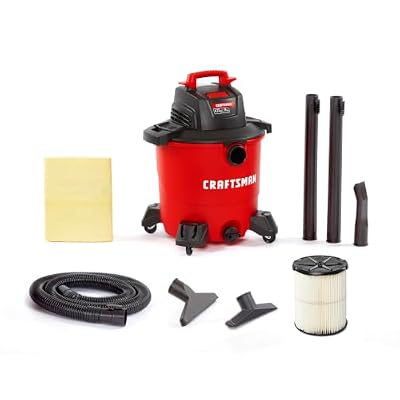
Nine gallons is the sweet spot for a two-car garage, and this CRAFTSMAN is the balanced pick of the group. The 4.25 peak HP motor feeds a wide 2-1/2 inch hose, so chunky debris, wood chips, and gravel move through without the clogging that plagues narrow-hose machines.
Filtration is a strength here. The Qwik-Lock pleated cartridge changes in seconds with no tools, and a dust collection bag comes in the box. Run the bag for sawdust or drywall dust: it keeps the cartridge clean and holds suction longer. For liquids, pull the bag out, fit a foam sleeve, and use the built-in drain.
A rear blower port and onboard accessory storage round out the package.
Specs
– Tank capacity: 9 gallons
– Motor: 4.25 peak HP, corded
– Hose: 2-1/2 in x 7 ft locking Dual-Flex hose
– Filtration: Qwik-Lock pleated cartridge, dust bag included
– Pickup: wet and dry, rear blower port, built-in drain
4. DEWALT DXV10P 10 Gallon Wet/Dry Vacuum

The DXV10P is the pick for readers who work with wood or do regular renovation cleanup. DEWALT publishes a real airflow figure, 90 CFM, and that number shows at the nozzle: the vac pulls fine dust and heavier chips with equal willingness, and suction holds up as the tank fills. The poly tank shrugs off knocks that would dent thin steel.
Its two-stage motor also runs noticeably quieter than the single-stage motors in most rivals, a difference you feel during a long cleanup in an attached garage. A fine dust cartridge filter handles drywall and sanding dust, especially paired with filter bags, and the built-in drain and blower port cover wet work.
Specs
– Tank capacity: 10 gallons, poly construction
– Motor: 5.5 peak HP, two-stage design
– Airflow: 90 CFM published figure
– Filtration: fine dust cartridge filter, bag compatible
– Pickup: wet and dry, built-in drain and blower port
5. CRAFTSMAN CMXEVBE17595 16 Gallon Wet Dry Vac

When the job is a flooded basement, a burst pipe, or a full renovation tear-out, tank size wins arguments. This 16-gallon CRAFTSMAN pairs the biggest drum in the group with a 6.5 peak HP motor and a 2-1/2 inch Dual-Flex hose that passes rubble, nails, and sodden insulation without choking.
Wet work is where the design earns its keep. An oversized drain empties a full tank through a cap at the base: 16 gallons of water weighs well over 100 pounds, far too much to tip safely. A rear blower port handles leaves outdoors, and the Qwik-Lock cartridge plus a dust bag cover dry cleanup.
The trade-offs are size and noise. This vac claims real floor space, and like most big single-stage machines it is loud on long runs.
Specs
– Tank capacity: 16 gallons
– Motor: 6.5 peak HP, 1440 watts, corded
– Hose: 2-1/2 in x 7 ft POS-I-LOCK Dual-Flex hose
– Filtration: Qwik-Lock pleated cartridge, dust bag included
– Pickup: wet and dry, oversized drain, rear blower port
How to choose
Match the tank to the mess. Two to four gallons suits cars and small spills. Five to nine gallons covers most garages. Twelve and up earns its space for flood water and renovation debris.
Read airflow, not the horsepower badge. Peak HP is measured in a lab at the instant a motor strains against a blocked intake; it says little about working suction. Compare CFM for moving debris and water lift for pulling through long hoses.
Pick the hose for your debris. Narrow 1-1/4 inch hoses are light and precise for cars. A 2-1/2 inch hose swallows chips and rubble but feels clumsy in tight interiors. Mid-size 1-7/8 inch hoses split the difference.
Plan filtration around fine dust. For drywall dust and sawdust, run a filter bag ahead of a fine dust cartridge; the bag keeps suction steady. For liquids, remove the bag and paper filter, fit the foam sleeve, then dry the tank.
Mind noise and reach. Big single-stage motors are loud; a two-stage design or hearing protection helps on long jobs. Add hose and cord lengths to judge your working radius.
FAQ
What size shop vac suits a two-car garage?
Nine to twelve gallons is the practical middle: the tank swallows a full cleanup between emptyings, and the unit still stores in a corner.
Does a higher peak HP number mean stronger suction?
No. Peak HP is a brief laboratory maximum, not working suction. Airflow in CFM and sealed suction in inches of water lift predict real pickup far better.
Can I vacuum water with the dry filter and bag fitted?
Do not. Paper filters and dust bags clog and tear when soaked. Pull them out, fit the foam sleeve for wet work, and let everything dry fully first.
Can a shop vac clean up a fuel spill in the generator bay?
Never vacuum gasoline, diesel, or solvent spills. Fuel vapors passing through a sparking motor can ignite. Spread absorbent granules or pads, ventilate the space, and dispose of the soaked material as hazardous waste. The same rule covers hot ash and embers.
Verdict
Most garages are best served by the 9-gallon CRAFTSMAN for its balance of size, hose width, and filtration. Choose the DEWALT for fine dust, the 16-gallon CRAFTSMAN for water and heavy debris, and the Armor All or Stanley when space is tight and jobs stay small.

Write Your Review
No reviews yet. Be the first to share your experience!