
🛒 Best Price Today on Amazon
Prime members get fast, free shipping on everything above, plus member-only deals. New members get a 30-day free trial — cancel anytime.
A spreader turns a bag of granules into an even feed instead of green stripes and pale patches. The right pick depends on lawn size, on how much product you push in a season, and on how close your beds and paths sit to the turf. A small handheld unit suits a pocket lawn, while a tow-behind hopper earns its keep on an acre. The five below cover that whole range, and each matches the setting numbers printed on common lawn food bags.
As an Amazon Associate, we earn from qualifying purchases.
Quick answer
For most small and medium lawns, the Scotts Turf Builder EdgeGuard Mini is the easy pick: it arrives assembled, holds enough product for 5,000 square feet, and its edge guard keeps granules off paths and beds. For tiny yards and spot feeding, the Scotts Whirl is lighter and quicker. Bigger suburban lawns suit the Scotts Turf Builder EdgeGuard DLX, which holds enough for 15,000 square feet. The EarthWay 2150 is the heavy-duty push pick, and the Agri-Fab 45-0463 covers large grounds behind a tractor.
Scotts Turf Builder EdgeGuard Mini Broadcast Spreader

The Mini comes out of the box ready to work, with the dial pre-set at the factory for Scotts products. The hopper holds enough lawn food, seed or ice melt to cover up to 5,000 square feet, which matches a typical front and back lawn without a refill halfway round.
Its EdgeGuard feature is the part you will use most. Flip it on along a driveway, path or flower bed and it blocks the throw on that side, so granules land on grass only and stay out of beds where they can scorch plants.
The plastic hopper shrugs off damp, salty mixes that eat metal parts, and the unit hangs on a garage hook between jobs.
Specs
- Type: push broadcast spreader
- Coverage per fill: up to 5,000 sq. ft.
- EdgeGuard blocks throw along beds and paths
- Pre-set dial for Scotts products
- Rustproof poly hopper and agitator
- No assembly needed
Scotts Whirl Hand-Powered Spreader
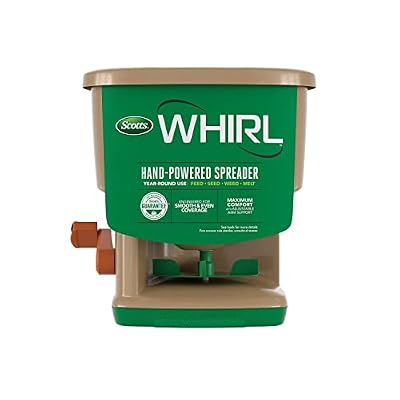
The Whirl is built for small lawns, narrow side yards and quick spot work. You carry it by hand, turn the crank, and the spinning plate throws seed, feed or ice melt in a gentle arc. The hopper holds up to 1,500 square feet of product, plenty for a townhouse lawn or for patching thin areas after a repair.
An adjustable arm support braces against your forearm, taking the strain out of the wrist. Five dial settings match the flow to fine seed or chunky pellets, and the unit needs no assembly and no power source.
Because you hold it, the Whirl reaches places a wheeled spreader cannot: steps, slopes, tight corners and the strip between fence and bed.
Specs
- Type: handheld crank spreader
- Coverage per fill: up to 1,500 sq. ft.
- Five flow settings on the dial
- Adjustable arm support
- Handles seed, feed, salt and ice melt
- Fully assembled, no power needed
Scotts Turf Builder EdgeGuard DLX Broadcast Spreader

The DLX is the Mini’s bigger brother, sized for lawns that outgrow a 5,000 square foot hopper. It holds enough to cover up to 15,000 square feet, so a large suburban lawn gets fed in one fill instead of three.
It keeps the same EdgeGuard system, blocking the throw on one side beside beds, paths and pool edges. Larger wheels roll more calmly over bumps and thick turf, and the dial and flow lever sit high on the handle. If your lawn runs from a third of an acre to a full acre and you feed it several times a year, this is the push spreader that fits the workload.
Specs
- Type: push broadcast spreader
- Coverage per fill: up to 15,000 sq. ft.
- EdgeGuard blocks throw along beds and paths
- Large wheels for rough turf
- Handle-mounted dial and flow lever
- Pre-set for Scotts products
EarthWay 2150 Commercial Broadcast Spreader

The EarthWay 2150 suits owners who feed big lawns often and want a machine that shrugs off seasons of use. Its rustproof poly hopper holds 50 pounds of product, and the epoxy coated steel frame stands up to damp granules and winter storage.
The patented three-hole drop shut-off system is the heart of it. The plate closes evenly across all three holes, giving a balanced throw to both sides and a clean shut-off at the end of each pass, with no dribble line when you stop. Side spread control blocks the left-hand throw beside beds and borders.
Thirteen-inch pneumatic stud tires roll over ruts and roots that stop small plastic wheels, and the rate dial sits high on the handle.
Specs
- Type: high-capacity push broadcast spreader
- Hopper capacity: 50 lb, rustproof poly
- Three-hole drop shut-off for an even pattern
- Side spread control near beds
- 13-inch pneumatic stud tires
- Epoxy coated steel frame
Agri-Fab 45-0463 Tow-Behind Broadcast Spreader

Once a lawn passes an acre, pushing a spreader becomes an afternoon gone. The Agri-Fab 45-0463 hitches to a garden tractor or ATV and does the walking for you. Its poly hopper holds 130 pounds of seed, feed or ice melt, and it throws a pattern up to 12 feet wide, so wide grounds take a handful of passes.
The flow control lever mounts within reach of the seat, so you can open and close the gate at headlands and stop lines without climbing down. A universal hitch pin fits most riding mowers and lawn tractors, and the enclosed gearbox keeps grit and damp away from the gears.
Large pneumatic tires keep it tracking calmly over uneven ground. It needs a shed corner rather than a wall hook, but for estates and smallholdings nothing else here comes close on ground covered per hour.
Specs
- Type: tow-behind broadcast spreader
- Hopper capacity: 130 lb, rustproof poly
- Spread width: up to 12 ft
- Flow lever reachable from the seat
- Universal hitch for tractors and ATVs
- Enclosed gearbox, pneumatic tires
How to choose
Match the type to the lawn first. Broadcast spreaders throw granules in a wide fan and cover open lawns fast, which suits most gardens. A drop spreader releases product straight down between its wheels, giving a hard edge along beds and paths but demanding exact overlap on every pass, so it rewards slow work on small plots.
Set the dial to the number printed on the bag before you pour anything in, with the hopper over a path so stray granules sweep up easily. If the bag lists no setting for your model, apply at half rate and make two passes at right angles. That crossing pattern hides thin spots far better than one heavy pass.
Walk at a steady pace for the whole lawn, since throw width grows and shrinks with your speed. Overlap each pass by roughly the wheel track width so no strip gets a double dose or none at all, and close the gate before you stop or turn, or a pile will drop and scorch a ring in the turf.
Hopper size is the last call. Small lawns are fine with a handheld or a 5,000 square foot fill. Lawns near an acre want the DLX class or the EarthWay, and anything beyond that points to the tow-behind. After every job, rinse the hopper and plate and dry the unit before storage, because damp fertilizer corrodes metal and cakes onto plastic.
FAQ
Can one spreader handle seed, feed and ice melt?
Yes. All five picks here spread grass seed, granular feed and ice melt. Rinse the hopper between products so salt residue never sits in the mechanism, and use a finer dial setting for small seed than for chunky pellets.
Why does my lawn show stripes after feeding?
Stripes usually come from uneven overlap or a changing pace. Keep a steady pace, overlap each pass by the wheel track width, and try the half-rate method with two crossing passes.
How do I store a spreader over winter?
Empty it fully, wash out the hopper and plate, let everything dry, and oil any exposed metal linkage lightly. Store it under cover with the gate closed.
Is a drop spreader better than a broadcast spreader?
Neither wins everywhere. A drop spreader gives the sharpest edge beside beds and paths, but it is slower and shows missed strips clearly. A broadcast spreader covers ground faster and forgives small overlaps.
Verdict
For the average lawn, buy the Scotts EdgeGuard Mini. Small yards and patch work belong to the Whirl, bigger suburban lawns to the EdgeGuard DLX, and demanding schedules to the EarthWay 2150. If your ground runs past an acre, hitch up the Agri-Fab 45-0463 and let the tractor do the walking. Either way, a steady pace, a correct dial setting and a rinsed hopper matter most.
Write Your Review
No reviews yet. Be the first to share your experience!