
Our Short List of 3

- Best for: Liveaboard and cruising boats that need a complete inverter charger kit with remote monitoring.
- 2000W pure sine wave output
- 3400W surge
- 100A charger
- Dual 50A transfer switch

- Best for: Boats with lithium battery banks that need a matching charge profile and a clear display.
- 2000W continuous output
- 6000W surge
- 12V DC to 120V AC
- LCD display
- Best for: Boats with motor-driven appliances and several battery types to support.
- 2000W continuous output
- 6000W peak
- 12V DC to 120V AC
- Pure sine wave output
All 3 Picks at a Glance
| Product | Specs | Action |
|---|---|---|
| Go Power GP-IC2000-12-PKG |
| Check price on Amazon |
| Renogy 2000W Pure Sine Wave Inverter Charger PCL1-20111S |
| Check price on Amazon |
| Ampinvt FT-20212 2000W Low Frequency Inverter Charger |
| Check price on Amazon |
🛒 Best Price Today on Amazon
Prime members get fast, free shipping on everything above, plus member-only deals. New members get a 30-day free trial — cancel anytime.
A boat’s electrical system has two jobs that pull in opposite directions. The inverter must turn battery power into clean alternating current for the appliances on board, and the charger must refill those batteries properly whenever shore power is available. An inverter charger does both jobs in one box, switching between them automatically, and that combination matters most on a boat where space is tight and every connection is exposed to damp and vibration.
This guide compares three marine inverter chargers sold on Amazon, chosen from their listing titles and specifications. All three are the same type: a pure sine wave inverter charger for a 12-volt battery bank, with an automatic transfer switch and a multi-stage charger. Space is tight below deck, so one box doing two jobs also saves the room a separate charger would take. They differ in surge capacity, charge current, and the battery types they support. Boat size, battery bank, and the appliances on board will decide which one fits.
Quick Picks
As an Amazon Associate we earn from qualifying purchases.
| Product | Best for | Key spec from title |
|---|---|---|
| Go Power GP-IC2000-12-PKG | A complete kit with remote and sensor included | 2000W pure sine wave, 100A charger, dual 50A transfer switch |
| Renogy 2000W Pure Sine Wave Inverter Charger PCL1-20111S | Lithium-ready charging with an LCD display | 2000W continuous, 6000W surge, 4-stage charger |
| Ampinvt FT-20212 2000W Low Frequency Inverter Charger | Low-frequency design with fast transfer | 2000W continuous, 6000W peak, 35A adjustable charge current |
How to Choose
Continuous Power and Surge Capacity
Continuous power is the wattage the unit can deliver hour after hour, and surge capacity is the short burst it can supply when a motor starts. A refrigerator compressor, an air conditioner, or a water pump can draw several times its running wattage for a second at startup, so the surge figure matters as much as the continuous one. Add up the running watts of everything that may run at once, then check the largest motor’s startup draw against the surge rating. Leave margin above the largest single load, not just the average draw. A unit that covers the running load but not the startup surge will trip exactly when the compressor kicks in, usually at the worst moment.
Pure Sine Wave Output
Pure sine wave output matters on a boat because the appliances on board assume clean mains power. Sensitive electronics, induction cooktops, and variable-speed motors run poorly or overheat on modified sine wave power, and some simply refuse to start. All three picks here are pure sine wave units, so the choice is not whether to buy pure sine wave but how clean the output stays under load. Check the listing for a stated waveform and a total harmonic distortion figure where one is given, and treat any unit that does not state pure sine wave as unsuitable for a boat full of modern electronics. Modified sine wave can also make audio equipment hum, which is a common complaint on boats.
Charging Stages and Battery Compatibility
The charger half of the unit decides how long the batteries last, and multi-stage charging is what protects them. A four-stage charger moves through bulk, absorption, float, and equalisation, which keeps flooded batteries healthy without overcharging them. Lithium batteries need a different charge profile, so confirm the unit supports the battery type actually installed before buying. Adjustable charge current is useful too, since a small bank charges best at a lower current and a large bank needs the full rate. Equalisation matters most for flooded banks that sit unused for weeks between trips. A charger that cannot match the bank’s chemistry will shorten battery life no matter how good the inverter half is.
Transfer Switch Speed and Shore Power
The transfer switch is what moves the boat between shore power and battery power, and its speed decides whether the appliances notice the change. A transfer time of a few milliseconds keeps computers, navigation screens, and televisions running through the switch, while a slow transfer drops them and forces a restart. Check the stated transfer time in the listing, and confirm the switch rating covers the shore-power circuit it will connect to. Dual transfer switches add flexibility for boats with two shore-power inlets, and a remote panel lets the owner monitor and control the unit from the helm instead of the engine room. A helm panel saves a trip below deck at every plug-in.
The 3 Best Options
Go Power GP-IC2000-12-PKG
- Best for: Liveaboard and cruising boats that need a complete inverter charger kit with remote monitoring.
- 2000W pure sine wave output
- 3400W surge
- 100A charger
- Dual 50A transfer switch
Liveaboard and cruising boats that need a complete inverter charger kit with remote monitoring.
Confirm the installation space fits a 38.7 lb unit with ventilation clearance around it.
The Go Power unit is the most complete kit in this guide, and it suits boat owners who want everything in one box. It delivers 2000 watts of pure sine wave power with a 3400-watt surge, and its 100-amp charger refills a 12-volt bank quickly when shore power is connected. A dual 50-amp transfer switch handles two shore-power circuits, and the included ICR-50 remote plus temperature sensor let the owner monitor charging from elsewhere on the boat. The listing cites UL458 and UL1741 compliance, 90 percent efficiency, power sharing, and a 3-year warranty. It is the pick for a liveaboard or cruising boat where the inverter charger runs daily.
Watch out for: Confirm the installation space fits a 38.7 lb unit with ventilation clearance around it.
Renogy 2000W Pure Sine Wave Inverter Charger PCL1-20111S
- Best for: Boats with lithium battery banks that need a matching charge profile and a clear display.
- 2000W continuous output
- 6000W surge
- 12V DC to 120V AC
- LCD display
Boats with lithium battery banks that need a matching charge profile and a clear display.
At 51.1 lb it is the heaviest pick here, so plan the mounting and the lift into place.
The Renogy unit suits boats with lithium battery banks, since its four-stage charger is listed as lithium-battery compatible. It delivers 2000 watts continuous with a 6000-watt surge, converting 12-volt DC to 120-volt AC, and an LCD display shows the unit’s status at a glance. An automatic transfer switch moves the load between shore power and battery power, and the unit weighs 51.1 lb. The manufacturer part number is PCL1-20111S. It is the pick for owners who have already moved to lithium and want a charger that matches that chemistry, with a display that makes the system’s state obvious without a separate monitor.
Watch out for: At 51.1 lb it is the heaviest pick here, so plan the mounting and the lift into place.
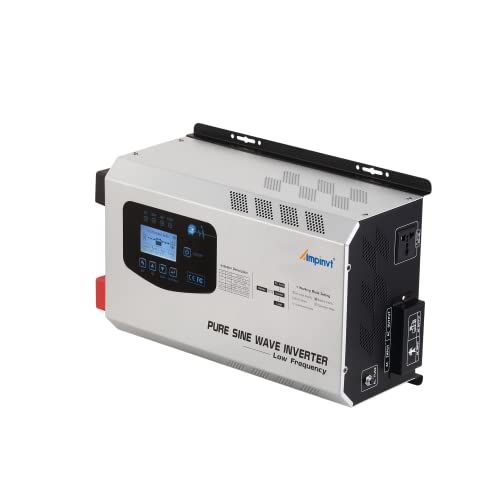
Ampinvt FT-20212 2000W Low Frequency Inverter Charger
- Best for: Boats with motor-driven appliances and several battery types to support.
- 2000W continuous output
- 6000W peak
- 12V DC to 120V AC
- Pure sine wave output
Boats with motor-driven appliances and several battery types to support.
The 35A charge current is lower than the other picks, so large banks refill more slowly.
The Ampinvt unit is the low-frequency pick, built around a transformer design that handles motor startup loads well. It delivers 2000 watts continuous with a 6000-watt peak, converting 12-volt DC to 120-volt AC as a pure sine wave, and its transfer time is 4 milliseconds or less, so connected electronics stay running through a shore-power switch. The 35-amp charge current is adjustable, and the unit supports gel, sealed lead-acid, flooded, and LiFePO4 batteries. An RS485 port allows external monitoring, and the model number is FT-20212. The listing brand is OAE, sold as Ampinvt. It is the pick for boats with motor-driven appliances and a mixed battery bank.
Watch out for: The 35A charge current is lower than the other picks, so large banks refill more slowly.
Which One Fits Your Situation
A Liveaboard Boat with a Full Electrical System
A liveaboard runs its inverter charger every day, and the Go Power unit fits that job best. Its 100-amp charger refills the bank quickly between shore-power stops, the dual transfer switch handles two inlets, and the remote panel keeps the system visible from the helm. The temperature sensor protects the bank during hot-weather charging. The 3-year warranty and the listed safety standards suit a unit that works this hard. Confirm the mounting space and ventilation before ordering.
A Boat That Has Moved to Lithium Batteries
Lithium banks need a charger with the right profile, and the Renogy unit fits that situation. Its four-stage charger is listed as lithium-battery compatible, and the LCD display shows charging state without extra instruments. The display also shows faults early, before a dead bank strands the boat. The 6000-watt surge covers motor startups, and the automatic transfer switch keeps electronics running. Weigh the 51.1 lb unit carefully during installation, and confirm the battery bank voltage is 12 volts.
A Boat with Motor-Driven Appliances
Refrigerators, air conditioners, and water pumps all draw heavy startup current, and the Ampinvt unit suits that situation best. Its low-frequency design and 6000-watt peak handle motor startups, while the 4-millisecond transfer keeps navigation screens alive through a shore-power change. The RS485 port allows monitoring from a separate display. The adjustable charge current suits a mixed bank of gel, flooded, and LiFePO4 batteries. Accept the slower 35-amp charging as the trade for the fast transfer and motor handling.
A Small Boat with Occasional Shore Power
Small boats that plug in only occasionally need a unit that charges efficiently in short windows. The Go Power unit fits best here, since its 100-amp charger makes the most of a brief shore-power stop. A short stop still refills a small bank at full rate. The Renogy unit is the alternative when the bank is lithium and the owner wants the display. Whichever unit is chosen, confirm the charger profile matches the battery type before the first plug-in.
Common Mistakes
- Sizing by continuous watts alone and forgetting the startup surge of the largest motor on board.
- Buying a charger that does not match the battery chemistry actually installed in the boat.
- Ignoring the transfer time, then wondering why the navigation screen restarts every time shore power connects.
- Mounting the unit in a sealed locker with no ventilation, which shortens its life in a damp engine room.
- Assuming any 2000-watt unit fits any boat, when battery voltage and shore-power rating vary.
Frequently Asked Questions
What size inverter charger does a boat need?
Add up the running watts of everything that may run at once, then check the largest motor’s startup draw against the surge rating. A 2000-watt continuous unit with a 6000-watt surge covers most boats up to a moderate size. Check the shore-power circuit rating too, since the transfer switch must cover it. Confirm the battery bank is 12 volts and the charger current suits the bank’s size before ordering.
Can an inverter charger run an air conditioner?
A 2000-watt unit can run a small marine air conditioner if the startup surge fits within its peak rating, which is why the surge figure matters. Soft-start kits reduce the startup draw and make the match easier. The bank must also sustain the load between charges. Check the air conditioner’s locked-rotor amps against the unit’s surge rating, and confirm the battery bank can sustain the load.
How fast does the transfer switch need to be?
A transfer time of a few milliseconds keeps computers, navigation screens, and televisions running through the change between shore power and battery power. Slower transfers drop those devices and force restarts, which is a real problem for navigation equipment. Slow transfers also reset clocks and timers. The Ampinvt unit in this guide states 4 milliseconds or less, which is fast enough for sensitive electronics.
Does an inverter charger need ventilation?
Yes, and this matters more on a boat than on land. Inverter chargers generate heat under load, and a sealed locker traps that heat along with damp air. Salt air makes corrosion worse, so keep terminals clean and connections tight. Mount the unit where air can circulate, keep the vents clear, and check the manufacturer’s clearance figures in the installation manual before fitting it into a tight space.





Write Your Review
No reviews yet. Be the first to share your experience!