
🛒 Best Price Today on Amazon
Prime members get fast, free shipping on everything above, plus member-only deals. New members get a 30-day free trial — cancel anytime.
- Understanding Starting Watts vs. Running Watts
- Fuel Type Selection: Gasoline, Diesel, or Dual-Fuel?
- Job Site Durability: Roll Cages, GFCI Outlets, and Weather Resistance
- Inverter Technology vs. Conventional Generators for Sensitive Tools
- Common Sizing Mistakes Contractors Make
- When It Pays to Upgrade to Premium Commercial Features
- Related Guides
- FAQ
- Related Guides
Setting up power on a professional job site requires far more than just grabbing a standard recreational inverter and crossing your fingers. Contractors, builders, and trade professionals face demanding heavy-duty tool loads, abrasive dust, unpredictable weather, and continuous run cycles that routinely destroy residential-grade equipment.
Navigating the equipment market in 2026 means looking past flashy marketing claims to focus on the engineering standards that keep crews working and prevent costly downtime. Let’s break down the actual specifications, sizing principles, and durability factors that truly matter when investing in commercial job site power.
As an Amazon Associate we earn from qualifying purchases at no extra cost to you.

Understanding Starting Watts vs. Running Watts
One of the most frequent errors contractors make involves confusing running watts with starting watts. Running watts represent the continuous power a generator can supply while tools like table saws, air compressors, and heavy lighting rigs are operating simultaneously. Starting watts, or surge watts, refer to the temporary burst of electrical power required to force motor-driven tools into motion.
Electric motors often demand up to three times their normal running wattage for a split second upon startup. If your commercial generator cannot handle these cumulative surge loads, the unit will bog down, trip internal breakers, or drop voltage. Always audit the specific amperage and wattage requirements of your heaviest simultaneous tool draws before matching them to a generator’s output specifications.
Fuel Type Selection: Gasoline, Diesel, or Dual-Fuel?
Choosing the right fuel source impacts both day-to-day operational convenience and long-term site logistics. Gasoline remains the most widely available option and features a lower initial purchase price, but it degrades quickly and presents storage hazards on active commercial properties. Diesel units offer exceptional durability, superior fuel efficiency under heavy loads, and a higher flash point that aligns well with standard heavy machinery fuel caches.
Dual-fuel models add flexibility by allowing crews to switch between gasoline and propane. Propane burns cleaner, extends engine life by reducing carbon buildup, and does not degrade in storage, making it an excellent choice for intermittent site use or backup compliance. Assess your fuel logistics, on-site safety regulations, and local availability before committing to a single fuel ecosystem.
Job Site Durability: Roll Cages, GFCI Outlets, and Weather Resistance
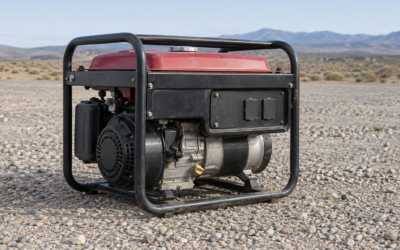
A true commercial portable generator is built to withstand brutal physical environments. Look for heavy-duty steel roll cages that protect the engine block and alternator housing from falling debris, shifting lumber, or accidental impact from skid steers and trucks. Integrated lifting eyes and flat-free wheel kits are also essential for safely maneuvering heavy units across muddy, uneven terrain.
Electrical safety is non-negotiable on professional builds. OSHA regulations and general workplace safety require job site generators to feature fully bonded neutral configurations and weather-resistant, OSHA-compliant GFCI protected outlets. Rubber outlet covers prevent moisture, concrete dust, and metal shavings from shorting out your power panel during active wet-weather operations.
Inverter Technology vs. Conventional Generators for Sensitive Tools
Modern commercial job sites rely heavily on computerized diagnostics, battery chargers for cordless tool ecosystems, laser levels, and sensitive laptops. Conventional open-frame generators produce variable electrical current that can introduce harmonic distortion and fry expensive electronic tool components. Clean power with minimal Total Harmonic Distortion is critical for safeguarding modern contractor equipment.
Commercial-grade inverter generators condition the raw power through a multi-step digital processor, delivering clean sine wave electricity that mirrors household wall power. While inverters typically cost more upfront and feature slightly lower maximum output capacities compared to heavy conventional units, the protection they afford your expensive electronic gear quickly justifies the investment.
Common Sizing Mistakes Contractors Make
Under-sizing is a guaranteed way to burn out an alternator and ruin a productive workday. Many project managers calculate only the exact wattage of their tools without factoring in power loss due to high ambient temperatures, high altitudes, or long extension cord runs. Engines lose roughly three percent of their rated power for every thousand feet of elevation and one percent for every ten degrees above standard operating temperatures.
Conversely, massively over-sizing a generator wastes fuel and forces diesel or gas engines to run under light loads for extended periods. Light-load running causes wet stacking in diesel engines and cylinder glazing, leading to excessive oil consumption and premature mechanical failure. Aim for a safety margin where your average continuous load sits comfortably between fifty and eighty percent of the generator’s maximum rated capacity.
When It Pays to Upgrade to Premium Commercial Features
Entry-level portable generators often use consumer-grade splash-lubricated engines designed for occasional weekend use. Upgrading to a premium commercial model typically gets you a heavy-duty cast-iron cylinder sleeve, full-pressure lubrication with an automotive-style spin-on oil filter, and an industrial-grade brushless alternator designed for thousands of hours of continuous operation.
Additional features like low-oil automatic shutdown, hour meters for precise maintenance scheduling, and electric push-button start with cold-weather aids save valuable labor hours. When downtime directly translates to missed deadlines and lost revenue, paying a premium for industrial-grade components is always the more cost-effective long-term choice.
Related Guides
To explore specific model recommendations and side-by-side performance metrics, check out our comprehensive Best Commercial Portable Generator for Job Site in 2026: Compared and Ranked guide.
FAQ
Do job sites require GFCI protected outlets on generators?
Yes, OSHA safety regulations require all 125-volt, single-phase, 15-, 20-, and 30-ampere receptacle outlets on construction sites to have approved ground-fault circuit interrupter protection. Using a generator equipped with factory-installed GFCI breakers ensures compliance and protects workers from electrical shock hazards.
How many running watts do I need for a standard crew?
A small two-to-three person framing or finishing crew typically requires between 4,000 and 7,000 running watts to simultaneously power saws, chargers, and lights. Larger crews operating heavy demolition hammers, air compressors, and multiple high-draw saws will easily require units rated from 10,000 to 15,000 watts or more.
Is diesel better than gasoline for commercial portable generators?
Diesel generators generally offer superior longevity, better fuel economy under heavy continuous loads, and greater overall site safety due to less volatile fuel storage requirements. However, gasoline models are significantly lighter, less expensive to purchase initially, and easier to start in freezing winter conditions.
How often should I perform maintenance on a heavily used job site generator?
Commercial generators operating in dusty, high-vibration construction environments require much more frequent attention than residential backup units. You should inspect and clean the air filter daily, change the engine oil and filter every 100 hours of operation, and test the safety shutoff systems monthly.



Write Your Review
No reviews yet. Be the first to share your experience!