
🛒 Best Price Today on Amazon
Prime members get fast, free shipping on everything above, plus member-only deals. New members get a 30-day free trial — cancel anytime.
The Honda EU2200i and the Yamaha EF2200iS are close rivals: both are 2,200-watt-class inverter generators aimed at campers, tailgaters and homeowners who want quiet backup power for a few essentials. Neither is a clear winner on paper. Honda is commonly seen as the lighter and quieter-sounding option, while Yamaha tends to be noted for its larger fuel tank and simple controls. Because manufacturers revise models and bundle features differently by region, this guide covers general design differences, then shows how to decide using your own loads. Always check current specifications before you buy.
Short verdict
If you carry the generator often, store it in a tight space or camp near other people, Honda’s reputation for low weight and a soft engine note makes it the natural first look. If you care more about longer running between refuels, or you simply find a particular layout easier to use, Yamaha deserves equal attention. The honest summary is that they overlap on about 90 percent of what matters, so the last 10 percent, which is weight, tank size, price and local dealer support, usually settles it.
Neither choice is wrong. Buyers who regret a purchase in this size class are mostly people who underestimated their loads, not people who picked the wrong badge.
Side-by-side comparison
The table below uses general, widely published characteristics. Treat the descriptions as direction, not exact data, and confirm against the current spec sheet for the model year you are considering.
| Factor | Honda EU2200i | Yamaha EF2200iS |
|---|---|---|
| Class | 2,200-watt-class inverter | 2,200-watt-class inverter |
| Continuous output | Roughly 1,800 W | Roughly 1,800 W |
| Weight | Commonly listed as lighter | Commonly listed as a few pounds heavier |
| Fuel tank | Around one gallon | Commonly a little larger |
| Throttle mode | Eco-throttle that adjusts engine speed to load | SmartThrottle that adjusts engine speed to load |
| Parallel option | Yes, with the maker’s cable | Yes, with the maker’s cable |
| Outlets | Two 120 V plus a 12 V DC port | Two 120 V plus a 12 V DC port |
Noise and runtime
Inverter generators are quieter than open-frame models because the engine speed drops when the load is light. Both of these machines use that approach, so the noise you hear depends heavily on what you plug in. Charging a phone and running two lights keeps either engine near idle, while a microwave or a space heater forces it to speed up.
Published decibel figures are usually given at a quarter load and a fixed distance, and real-world levels shift with surroundings, because hard surfaces reflect sound. Runtime follows the same logic: a small load stretches a tank into many hours, and a full load shortens it a great deal. A larger tank helps most when you want to refuel less often overnight, but you should still shut the engine off and let it cool before you add fuel.
Weight and portability
At roughly 45 to 55 pounds each, these units are portable but not light. The difference between them is small on paper and noticeable only if you lift them regularly, for example from a truck bed to a campsite. Check the handle position, the width of the frame and whether you have a place to set it down at both ends of the trip.
Lift with your legs, keep the fuel valve closed and the engine cool when you transport it, and strap it so it cannot tip. A generator that leaks fuel in a vehicle is a hazard, so many owners carry it upright in an open truck bed or on a hitch carrier instead of inside a car.
Which one fits which use
- Weekend camping and tailgating: weight and noise matter most, which often points to the lighter, quieter-sounding option.
- Home backup for essentials: a bigger tank and simple controls matter, as does having the right extension cord and a plan for a safe connection.
- Small RV or trailer: a single unit suits lights, fans, a fridge and electronics. Air conditioning usually calls for two units in parallel or a larger generator.
- Job sites and light tools: check the startup surge of any motor tool, since surges can exceed the continuous rating.
Worked example: sizing your loads
Suppose a family wants to ride out a short outage with a refrigerator, a few LED lights, a laptop, a router and phone chargers. These numbers are assumptions for illustration only. Check the label on each of your own appliances.
| Load | Assumed running watts | Assumed startup watts |
|---|---|---|
| Refrigerator | 150 | 600 |
| Four LED lights | 40 | 40 |
| Laptop | 65 | 65 |
| Router and modem | 25 | 25 |
| Phone chargers | 30 | 30 |
Running watts add up to 310. The fridge’s startup surge adds about 450 on top for a moment, so the peak is near 760 watts. That sits well below roughly 1,800 continuous, so either generator handles it comfortably. Add a 1,000-watt space heater and the total jumps to about 1,310 running, still inside the limit but with little headroom, which is why many people avoid mixing heaters with everything else.
Maintenance and long-term ownership
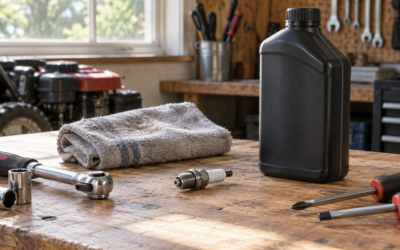
Small inverter generators reward routine care. The manual for each model lists an oil change interval, commonly after an initial break-in period and then at regular running-hour or calendar intervals, along with spark plug inspection, air filter cleaning and valve clearance checks. Following that schedule matters more than the badge on the side, because most no-start problems trace back to old fuel or a clogged carburetor rather than to a design flaw.
Plan storage before you need the machine. Many owners either run the carburetor dry or add a fuel stabilizer, and they start the engine briefly every month or two so seals stay lubricated. Keep the unit covered and dry, off bare concrete if moisture is a problem, and store spare oil, a spark plug and a funnel in the same bin. Parts availability and a nearby service dealer are real advantages for both brands, so look up the closest authorized shop before you commit.
Finally, think about the total cost of ownership rather than the sticker alone. Fuel use at light load is modest for either machine, but a unit you cannot service locally can become an expensive paperweight. Ask about warranty length, what voids it and whether registration is required.
What to check before buying
- Current continuous and maximum ratings on the manufacturer’s sheet, not an old listing.
- Whether the model includes a built-in carbon monoxide shutoff feature, which varies by version and region.
- The parallel cable, if you plan to expand later, and whether it is included or sold separately.
- Warranty terms and the location of the nearest authorized service dealer.
- Fuel type and any ethanol guidance in the manual, since stale or ethanol-heavy fuel can gum up small carburetors during storage.
Safe operation basics
Place the generator outdoors on level ground, far from windows, doors and vents, and point the exhaust away from the building. Never run it in a garage, shed, tent or crawlspace. Let it cool before refueling, store fuel in an approved container away from ignition sources, and do not connect it to household wiring without a properly installed transfer switch put in by a licensed electrician. Keep a working carbon monoxide alarm indoors.
Common myths
One myth says that a higher maximum rating means you can run more. In practice the continuous rating is the number that counts for normal use. Another says that an inverter generator never needs maintenance, which is wrong: oil changes, spark plug checks and air filter care still apply, as the manual describes. A third myth is that quiet means safe indoors. A quiet engine still produces carbon monoxide.
Related guides
Frequently asked questions
Are the Honda EU2200i and Yamaha EF2200iS the same size in watts?
Both are sold in the 2,200-watt class, with a higher starting or maximum rating and a lower continuous rating, commonly around 1,800 watts. Exact figures can differ between production runs and regions, so read the data plate or the current manufacturer sheet before you plan around a number. Size your loads against the continuous rating, not the maximum.
Will a single unit run an RV air conditioner?
Possibly, but not reliably on one unit. Small RV air conditioners often draw a high startup surge that can exceed a single 2,200-watt-class machine, especially in hot weather. Many owners pair two compatible units with a parallel cable. Check the air conditioner’s starting amps in its manual, and ask the manufacturer whether a soft-start accessory is recommended.
Which one is easier to carry?
Honda is commonly listed as the lighter of the two, and weight matters if you lift the unit into a trunk or carry it over uneven ground. The gap is only a few pounds, though, and both have a carry handle. Compare the dry weights on the current spec sheets, and remember that fuel adds weight.
Is it safe to run either generator inside a garage or tent?
No. Engines produce carbon monoxide, which can build up quickly in enclosed or partly enclosed spaces, even with doors open. Run the unit outdoors, well away from windows, doors and vents, on a level surface, and use a battery-powered or plug-in carbon monoxide alarm indoors. Follow the manual’s placement guidance.
Is parallel operation necessary for most owners?
Not for most small jobs. A single unit can handle lights, a phone charger, a laptop, a fridge and a small fan. Parallel operation is for people who need roughly double the capacity, such as a larger RV. It needs the correct manufacturer cable, and the two units should be matched as the manual describes.

Write Your Review
No reviews yet. Be the first to share your experience!