
🛒 Best Price Today on Amazon
Prime members get fast, free shipping on everything above, plus member-only deals. New members get a 30-day free trial — cancel anytime.
Winterizing a portable generator is mostly about removing old fuel, protecting the engine and battery, and storing the machine in a dry, ventilated location. Done incorrectly, stale gasoline can gum up the carburetor, moisture can corrode electrical parts, and a covered generator can become a fire or carbon-monoxide hazard. Oil left in the crankcase can also collect contaminants during long storage, while an unmaintained starter battery may be dead when the power goes out.
The process below works for most gasoline and dual-fuel portable generators. Always use your owner’s manual for the exact oil grade, fuel-draining procedure, spark-plug specifications, and storage limits. If you are preparing a generator for the 2026 winter season, set aside roughly 30 to 60 minutes for the job, plus drying time.
As an Amazon Associate we earn from qualifying purchases at no extra cost to you.

What You Need
| Item | Why | Optional? |
|---|---|---|
| Fresh engine oil and the correct drain container | Allows an oil change before storage and prevents spills. | No |
| Fuel stabilizer | Slows fuel deterioration if gasoline will remain in the tank. | No for fuel left in the tank; yes if the tank and carburetor will be completely drained |
| Approved gasoline container | Holds drained fuel safely. Use a container rated for gasoline, not a household bottle. | No for draining; yes otherwise |
| Basic hand tools and a funnel | Useful for removing drain plugs, accessing the battery, and adding oil without spills. | Some tools may be required |
| Gloves, shop towels, and a flashlight | Protect your hands and help you spot leaks, dirt, or rodent damage. | Yes |
| Battery maintainer or charger | Keeps an electric-start battery ready during storage. | Yes, if your generator has a battery |
| Breathable generator cover | Protects against dust while allowing moisture to escape. | Yes |
| Portable Generator Rain Cover Waterproof for 5000–10000W, 32 x 24 x 24 inches, about $15–$20 | Can shield a compatible generator from dust and incidental moisture when it is shut down and stored correctly. | Yes |
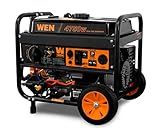
For example, a dual-fuel model such as the WEN 4,750-Watt 120V/240V DF475T, which commonly sells for about $450–$500, has gasoline and propane-specific storage considerations. Confirm that any cover fits your generator’s actual length, width, and height, including the wheel kit and handles.
Step-by-Step
-
Cool, clean, and inspect the generator (10 minutes)
Move the generator outdoors, away from doors, windows, vehicles, and ignition sources. If it has been running, shut it down normally and let it cool completely. Never service a hot engine or drain fuel near a flame, pilot light, heater, or smoking area.
Brush away leaves and dirt. Look for loose fasteners, cracked fuel lines, damaged wiring, oil stains, and signs of rodents. Check that the air filter, muffler, fuel cap, recoil starter, wheels, and frame are intact. Do not operate the generator if the fuel tank or fuel line is leaking.
-
Choose a fuel-storage method (5 minutes)
For a gasoline generator, you generally have two choices: stabilize the fuel and leave it in the tank, or drain the tank and carburetor completely. Follow the manual, because some manufacturers specify one method. Draining is often the better choice for seasonal storage, but even a small amount left in the carburetor can form deposits.
For a dual-fuel generator, store gasoline according to the gasoline instructions. Disconnect the propane hose and remove the propane cylinder. Store propane cylinders upright outdoors in a cool, well-ventilated place, away from heat and ignition sources. Never store a propane cylinder in a basement, living area, or enclosed garage.
-
Stabilize or drain the gasoline (10–20 minutes)
If the manual allows stabilized storage, add the correct amount of fuel stabilizer to fresh gasoline before adding it to the generator. Run the engine outdoors for the period specified on the stabilizer label, usually long enough for treated fuel to reach the carburetor. Do not guess at the dosage; too much is not better.
If draining, turn the fuel valve off if equipped and place an approved gasoline container beneath the drain. Open the tank drain or use the manufacturer’s procedure. Then drain the carburetor bowl, if the generator has one. Dispose of old gasoline through a local household hazardous-waste or fuel-recycling program. Do not pour it onto soil or down a drain.
-
Change the engine oil (10–15 minutes)
Changing oil before storage removes combustion byproducts and moisture that can promote corrosion. Run the generator for a few minutes first only if the manual permits it and the machine is fully outdoors; otherwise, work with the engine cool.
Place a drain pan beneath the plug, remove the filler cap and drain plug, and let the oil flow completely. Reinstall the plug securely, then add the specified amount and grade of fresh oil. Many portable generators use small-engine oil such as 10W-30, but the correct viscosity depends on the model and expected temperature. Do not overfill. Check the level on a level surface, and recycle used oil at an automotive or municipal collection point.
-
Protect the cylinder and air intake (5–10 minutes)
Some manuals recommend removing the spark plug, adding a small amount of engine oil to the cylinder, and pulling the recoil starter slowly several times before reinstalling the plug. This coats internal surfaces during storage. Use only the amount specified by the manufacturer; excess oil can cause starting problems.
Inspect or replace the air filter if it is dirty, wet, or damaged. Do not saturate a paper filter with oil. Cover the exhaust outlet and air intake only as directed by the manual, and remove any temporary plugs or coverings before starting the generator again.
-
Maintain the battery (5 minutes, plus charging time)
If your generator has electric start, inspect the battery terminals for corrosion and clean them with the proper battery-cleaning method. Disconnect the negative cable first if the manual permits battery removal, then the positive cable. Keep the battery connected to an appropriate maintainer, or charge it periodically according to the manufacturer’s instructions.
Do not use a charger that is not designed for the battery type. Store a removable battery in a dry location where it cannot contact metal objects. A battery that will not hold a charge should be replaced before the next emergency, not merely recharged.
-
Store it dry, covered, and accessible (10 minutes)
Wipe the frame and controls dry, then place the generator on a level surface in a dry, well-ventilated storage area. Keep it away from rain, snow, sprinklers, corrosive chemicals, and combustible materials. Do not store it where fuel vapors could collect, and never run it indoors, in a basement, or in an attached garage.
Use a cover only after the generator is cool and shut down. A waterproof 32 x 24 x 24-inch cover may fit some 5,000- to 10,000-watt units, but measure first. The cover should not trap condensation, block required ventilation during operation, or create a trip hazard around the wheels and cords.
Mistakes to Avoid
- Running it indoors to “burn off” fuel: Carbon monoxide can become fatal quickly, even with a door or window open.
- Draining fuel into an unsafe container: Use an approved gasoline container and follow local disposal rules.
- Leaving untreated gasoline for months: Fuel can oxidize and clog the carburetor, especially in warm storage areas.
- Covering a hot generator: Heat can damage the cover or ignite nearby material.
- Using the rain cover while operating: A cover is for storage unless it is specifically designed and approved for operation by the generator manufacturer.
- Forgetting propane: Disconnect the hose and store the cylinder safely outdoors. Do not assume a disconnected cylinder is suitable for indoor storage.
- Overfilling oil: Too much oil can cause leaks, smoke, or engine damage.
- Ignoring pests: Rodents can chew wiring and air-filter material. Inspect again before startup.
How Often
Winterize the generator whenever it will sit unused for more than about 30 days, or at the end of the season if it is an emergency-only machine. Run and inspect it about once a month during storage if the owner’s manual recommends periodic operation, but run it only outdoors with appliances connected as directed. Monthly operation is not a substitute for proper fuel storage and maintenance.
Before every use, check the oil level, fuel system, cords, outlets, air filter, battery, tires, and exhaust area. After severe weather, inspect for water intrusion and corrosion.
When to Call a Pro or Replace
Call a qualified small-engine technician for a persistent no-start condition, carburetor flooding, fuel leaks, damaged wiring, repeated circuit-breaker trips, unusual knocking, or an exhaust problem. Get professional help if you smell gasoline after the fuel valve is closed or see damage around the propane connection.
Replacement may make more sense when the frame is badly rusted, the fuel tank leaks, the alternator or control board has failed, or repair costs approach the price of a comparable new generator. Also replace cracked cords, melted outlets, and batteries that will not hold a charge. Never bypass a breaker, grounding feature, low-oil shutdown, or carbon-monoxide safety device.
FAQ
Should I store a portable generator with gas in it?
Only if the owner’s manual permits it and the fuel has been treated with the correct stabilizer. For longer seasonal storage, draining the tank and carburetor is often preferable, provided the manual gives a safe draining procedure.
Can I leave propane connected to a dual-fuel generator?
No. Shut off the cylinder, disconnect the hose as directed, and store the cylinder upright outdoors in a cool, ventilated location. Keep the generator itself in a dry area away from fuel vapors.
Does a generator need to be covered in winter?
A cover can protect against dust and incidental moisture during storage, but it is not a substitute for a dry storage area. Use the correct size, let the machine cool first, and remove the cover completely before starting.
How do I prepare the generator after winter storage?
Remove any intake or exhaust protection, inspect for pests and leaks, reconnect the battery, add fresh fuel if needed, check the oil level, and test the generator outdoors without a load first. Let it run normally before connecting appliances.





Write Your Review
No reviews yet. Be the first to share your experience!